
Kings Weston Roman Villa
The bulldozer drivers found the first stones. It was November 1947, and they were grading ground in Lawrence Weston, north-west Bristol, for a new post-war council estate desperately needed to rehouse families bombed out of the city centre. Under the topsoil they hit walls, then tesserae, then a stretch of patterned mosaic that nobody had walked on in 1,500 years. The City Engineer wanted to keep building houses. The University of Bristol wanted archaeologists. A compromise was struck: three months. Twenty volunteers, including local schoolchildren and members of the Clevedon Archaeological Society, would work dawn to dusk to excavate what they could before the diggers returned. The press called it a race against time. They were not exaggerating.
A Villa Above the Severn
Sometime after AD 268-270, a Romano-British landowner built a substantial villa on a slope overlooking the salt marshes of the lower Avon. He chose his ground carefully. The marsh flats fattened cattle. The higher ground grew cereals. A short distance south stood the small Roman port of Abonae, modern Sea Mills, which traded up to Gloucester and Bath along well-made roads. The villa was no isolated farmstead but the heart of a working agricultural estate, one of several within a few hundred metres. Excavations in 1982 at nearby St Bede's Catholic College revealed another Romano-British farmstead established a century earlier. The Lawrence Weston ridge in the late Roman period was a busy, productive landscape of stone-built villas, mosaic floors, and underfloor heating, looking down on grazing herds and the muddy estuary beyond.
Mosaics, Hypocaust, and a Buried Pig
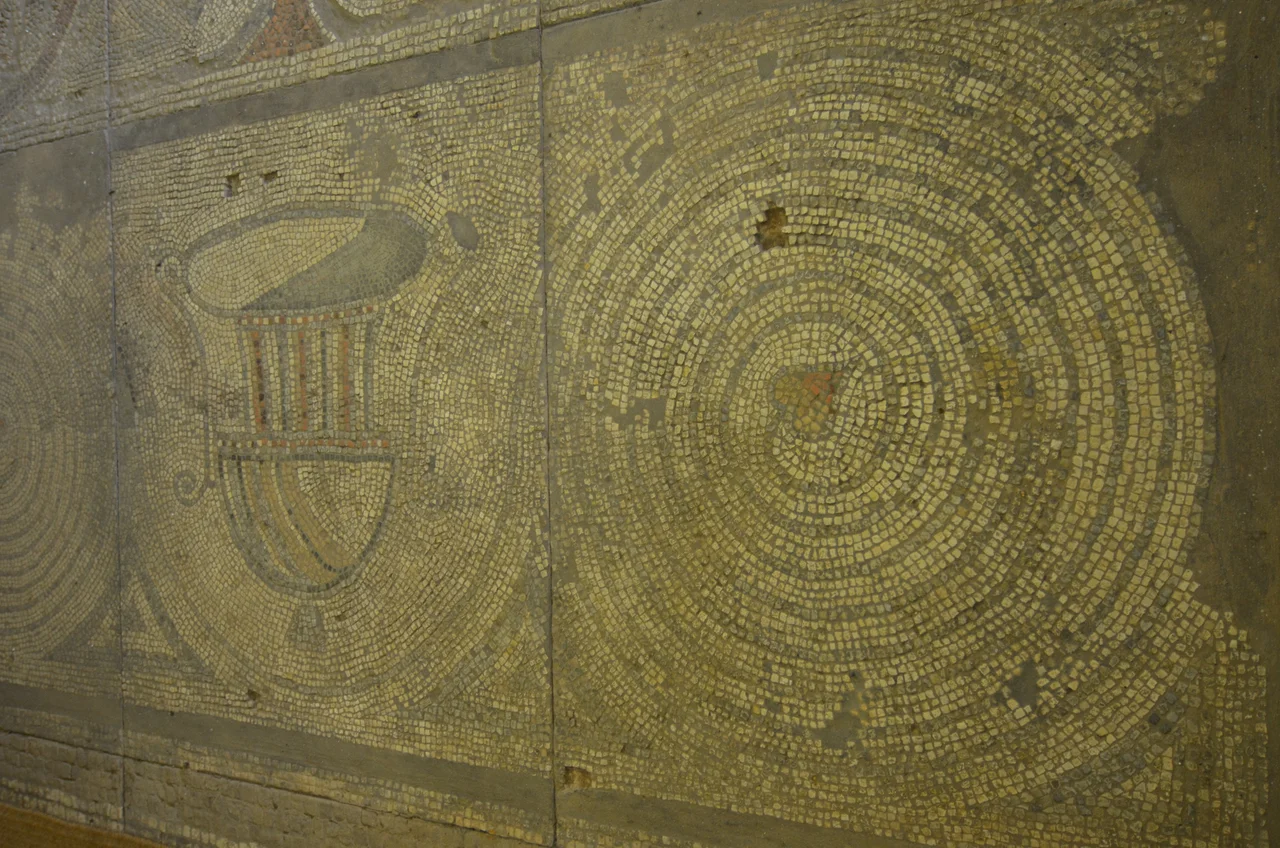
The eastern building, the part now visible to visitors, is a winged corridor villa: a long central porticus connecting two projecting wings, with a courtyard between. The walls were carboniferous limestone faced with calcareous sandstone and rendered in white stucco. Two fourth-century mosaics survive in situ. The one in Room VII contains over 115,000 tesserae, arranged in a geometric design with a central krater, a two-handled wine cup. The mosaicist made mistakes that remain visible: the shading on the krater falls from the wrong side, and the alternating red-and-yellow circles break their pattern at one point. The villa also retains its hypocaust system, where hot air from a furnace circulated under raised floors, and the only Roman bath suite visible anywhere in Bristol. Near the main entrance, the excavators found something stranger: the foundation burial of a young pig, an offering perhaps for the household's good fortune.
George Boon's Race
Excavation began on 23 March 1948 under twenty-year-old George C. Boon, then a Latin student at the University of Bristol, and a local archaeologist named John Clevedon Brown. Boon went on to become one of the leading Romano-British numismatists of his generation, but in 1948 he was a student running a volunteer dig in his spare hours. The team worked from 6 p.m. until dark on weekdays and from 10 a.m. until dark at weekends, the only daylight they had. Bryan O'Neil, the Chief Inspector of Ancient Monuments, came down from London to inspect. He compared the site's significance to Chedworth, the famous Cotswold villa. That comparison saved it. In May 1948 the Housing Committee formally halted construction of ten proposed houses around the villa. In January 1949 the City Council approved a permanent preservation plan, redesigning the estate layout to set the new homes back from the ancient walls. The bulldozers stopped where the archaeologists had drawn their lines.
Roof, Mural, and a Mural-Sized Question
Numismatic finds show occupation continued into the late fourth century. Coins of the Valentinian and Gratian periods, struck up to AD 381, mark the last identifiable phase. The porticus appears to have collapsed before final abandonment, after which squatters camped in the ruined shell, perhaps for decades, before the building disappeared under collapsing rubble and plough soil. In 1984 a protective building was erected over the bath suite and mosaics, with a Canadian red cedar roof chosen for durability. In 2024, a 20-metre mural appeared on a wall along Long Cross, near the villa, depicting an encounter between a Roman soldier and a member of the indigenous Dobunni tribe, the people who lived here before Rome arrived. Repairs to the protective building completed in 2025, and the villa reopened to the public in June of that year. The buried pig is still there, beneath the threshold. Whoever laid it down would not have imagined what came next.
Flight Context
Kings Weston Roman Villa sits at 51.4973°N, 2.6672°W in Lawrence Weston, north-west Bristol, enclosed by the post-war council estate that almost destroyed it. The protective cover building is visible as a low rectangular structure among streets of brick semis, just south of Long Cross road. The wider landscape is suburban, with Lawrence Weston bounded by Kings Weston House and woodland to the south. Recommended viewing altitude 2,000-3,500 feet. Bristol Airport (EGGD/BRS) lies 11 nautical miles south. The River Avon's lower estuary and the Severn Bridge are visible to the west and northwest, with Avonmouth Docks 2 nautical miles to the west.
From the Air
Located at 51.4973°N, 2.6672°W in Lawrence Weston, north-west Bristol. Recommended viewing altitude 2,000-3,500 feet. Low rectangular protective cover building surrounded by post-war brick semis, just south of Long Cross road; Kings Weston House and woodland sit to the south. Nearest airport: Bristol Airport (EGGD/BRS) 11 nm S. Avonmouth Docks 2 nm W; lower Avon estuary and Severn Bridge visible to the W and NW.
Nearby Stories
- Cosmeston Medieval Village 1.4 km away
- Glastonbury Festival 3.5 km away
- Tintern Abbey 3.6 km away
- Quantock Hills 4.8 km away
- Ebbw Vale Steelworks 10 km away
- New Wardour Castle 12 km away
- Windmill Hill, Avebury 16 km away
- Cotswolds 18 km away