
Glastonbury Festival
Michael Eavis was a Somerset dairy farmer who went to a Led Zeppelin concert. The year was 1970, the venue was an open-air festival at the Bath and West Showground, and Eavis came home determined to put on something similar at Worthy Farm. He scheduled the first Pilton Pop, Blues and Folk Festival for Saturday 19 September 1970. The Kinks pulled out at the last minute. Tyrannosaurus Rex stepped in. Fifteen hundred people paid one pound each, drank the free milk Eavis provided from his cows, and slept in a field. Fifty-five years later, his daughter Emily runs the same festival on the same farm. It now holds two hundred thousand people, has its own postcode for the duration, and is broadcast live across the world.
From Pyramid to Tor
The festival's symbol arrived in 1971, when Andrew Kerr persuaded Eavis to host a second event under the new name 'Glastonbury Fair'. Bill Harkin designed a stage that was a one-tenth replica of the Great Pyramid of Giza, built from scaffolding and metal sheeting, and positioned it over what he called a 'blind spring' from the practice of dowsing. David Bowie played. Traffic played. Fairport Convention, Hawkwind and Gong played. The festival was filmed by Nicolas Roeg and David Puttnam and a triple album was released. The Pyramid Stage became permanent in 1981, rebuilt from telegraph poles and metal sheeting repurposed from the Ministry of Defence, doubling as a hay barn and cowshed in winter. The current Pyramid Stage stands 25 metres tall, with 292 audio speakers, 8.5 kilometres of cables, 354 microphones and 3,743 light bulbs, and the main system runs at 250,000 watts. The farm is in the Vale of Avalon, overlooked by Glastonbury Tor six miles to the west.
Mud, Rain and Sound Systems
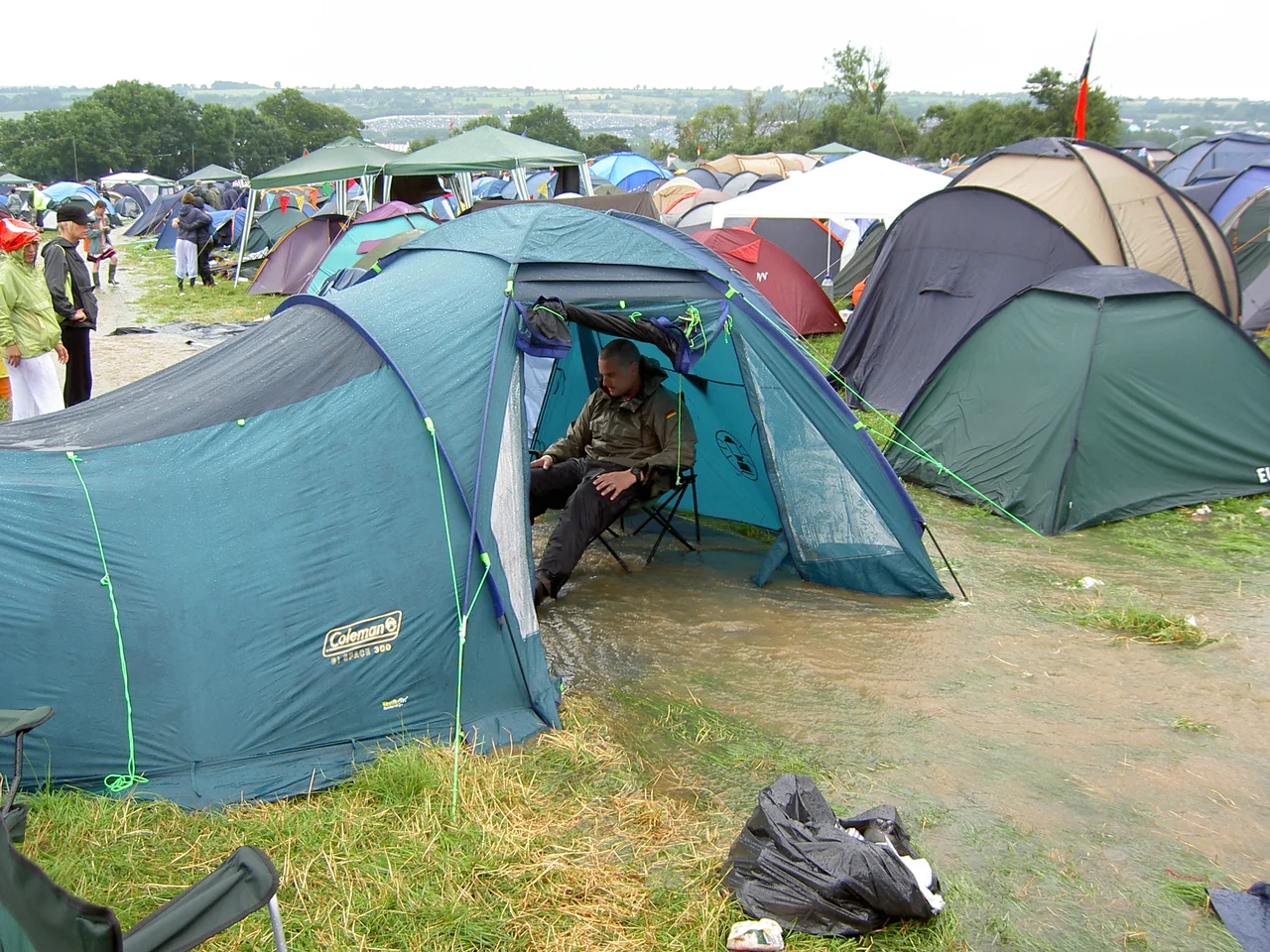
Glastonbury's myths grew with its scale. The mud of 1985 was a mixture of clay and liquefied cow dung, since Worthy Farm is a dairy operation and the festival site sits in a valley at the head of the Whitelake River. The 1989 festival saw the first unofficial sound systems, raves running through the night around the edges of the official site. In 1994 the Pyramid Stage burned down ten days before the festival; a replacement went up in time, and a 150 kilowatt wind turbine powered part of the site for the first year. That year Orbital's televised set on Channel 4 became one of the most-cited turning points in British music, making dance music suddenly respectable to mainstream audiences and persuading the festival to install a dedicated dance tent in 1995. The Levellers played to a crowd estimated at 300,000 the same year, still the largest single audience the festival has recorded.
Gatecrashers and the Superfence
By 1999 the festival's popularity had outrun its security. An estimated 250,000 people attended that year, even though only 100,000 tickets had been sold. After the deaths at Roskilde Festival in 2000, the local council refused any further licence until the gatecrashing problem was solved. The 2001 fallow year was used to plan a complete rebuild of the perimeter, and when the festival returned in 2002 it had a substantial 'superfence' that effectively eliminated unauthorised entry. The Mean Fiddler Organisation handled the new security operation. Tickets in 2003 sold out in one day. Tickets in 2004 sold out in twenty-four hours through an overloaded telephone and website system that recorded two million attempted connections in the first five minutes. From 2007 ticket buyers had to pre-register with passport photographs printed into their tickets, a system that has effectively shut down touting.
Headliners and History
Glastonbury's headline slots have become a snapshot of the era. Coldplay first headlined in 2002 and have now done so a record five times, overtaking The Cure's four. Beyoncé in 2011 became the first solo female artist to headline since Sinéad O'Connor in 1990. Billie Eilish in 2022, at twenty, became the youngest headline act in the festival's history. Paul McCartney and Kendrick Lamar shared the same weekend. Jay-Z headlined in 2008 to controversy that, viewed across the gap, looks almost quaint. Elton John performed his self-billed last UK show on the Sunday of 2023, with Guns N' Roses and the Arctic Monkeys topping the other two nights. The 2024 festival saw Dua Lipa and SZA take the Friday and Saturday Pyramid Stage slots, with Coldplay closing out the festival's fifth headline appearance on Sunday. Behind the Pyramid Stage sit dozens of smaller venues: the Other Stage, the John Peel Tent (renamed Woodsies in 2023 in tribute to the late BBC DJ), the West Holts, the Park, the Acoustic, the Theatre and Circus fields, the late-night dance area in the south-east corner. Most festival staff are unpaid volunteers, including the 2,000 stewards organised through Oxfam.
The Fallow Tradition
Worthy Farm has built fallow years into the cycle from the beginning, normally one in every five, to let the dairy pasture recover from the trampling of a city's worth of people. 1988, 1991, 1996, 2001, 2006 and 2018 were all planned breaks. 2020 and 2021 were forced ones, with the festival cancelled over the COVID-19 pandemic. In 2020 the BBC broadcast a weekend of historic sets in place of the cancelled festival, including performances from Taylor Swift, Adele and the Rolling Stones. In 2021 the festival produced its own filmed event at Worthy Farm with Coldplay, Haim and Damon Albarn. The festival returned in 2022. In 2025 Neil Young headlined on Saturday, with The 1975 on Friday and Olivia Rodrigo closing the festival on Sunday; the controversy of the year was provided by the Irish hip hop band Kneecap and the rap duo Bob Vylan, both of whom became the subject of police inquiries that were eventually dropped. During that festival the Eavis family announced that 2026 would be a fallow year, the first in eight.
What the Festival Is For
The festival has always raised serious money for charity. Oxfam, Greenpeace and WaterAid have been its main beneficiaries since the end of the Cold War. The Workers Beer Company runs the bars on a model that pays volunteers' wages directly to their chosen charities. Glastonbury Festivals Ltd donated £5.2 million to charitable causes in the year to March 2024 alone. The festival also retains the older hippie geography that Michael Eavis built into it from the beginning: the Green Fields area, the Stone Circle erected in 1990 to align with the summer solstice in the way of Stonehenge thirty miles south-east, the Healing Field with its therapists and ceremonies, the Green Futures section devoted to environmental activism. The Vale of Avalon, with its ley lines and legends and its association in English folklore with the burial of King Arthur, has lent the festival a slightly mystical quality from the first weekend in 1970. Pilton remains a village of three hundred people for fifty weeks of the year. For the other two, it becomes the third largest city in the South West of England.
From the Air
Located at 51.150°N, 2.585°W at Worthy Farm between the villages of Pilton and Pylle in Somerset, six miles east of Glastonbury and three miles south-west of Shepton Mallet. The site sits in a valley at the head of the Whitelake River between two low limestone ridges on the southern edge of the Mendip Hills. During the festival (late June in non-fallow years) the site is closed to overflights below 4,500 feet by NOTAM, so check NOTAMs before approach. Glastonbury Tor, visible six miles to the west, is a striking conical landmark. Nearest airfields: Bristol Airport (EGGD) 17 nm north-west, Henstridge (EGHS) 14 nm south-east, Compton Abbas (EGHA) 17 nm south-east. RNAS Yeovilton (EGDY) 12 nm south. From May to August the white tent-tops of the build are visible from a considerable distance.
Nearby Stories
- New Wardour Castle 2.6 km away
- Cosmeston Medieval Village 9.6 km away
- Ottery St Mary 9.7 km away
- Royal Naval Cordite Factory, Holton Heath 9.8 km away
- Quantock Hills 11 km away
- M Shed 14 km away
- Maiden Castle, Dorset 17 km away
- Silbury Hill 20 km away