.jpg)
M Shed
On 7 June 2020, a crowd of Black Lives Matter protesters tied a rope to the bronze ankles of Edward Colston, slave trader, philanthropist, and unwilling figurehead of every argument Bristol had been having with itself for two centuries. They pulled. The statue came off its plinth. They rolled it through the city centre and dropped it into the Floating Harbour. A year later, defaced and rusted, the statue was on display inside M Shed, a dockside museum just along the same harbour, with paint still on its face and the ropes still attached to its body. The museum called it a city-wide conversation. Most visitors, looking at the bronze body laid out like an exhibit of itself, just looked.
Shed M
Bristol's port labelled its transit sheds with letters of the alphabet. There were sheds A through M and beyond, long open warehouses where cargo was moved between ships and the quayside. Shed M sat on Prince's Wharf on the south side of the Floating Harbour. When the Bristol Industrial Museum closed in 2006, the city decided to turn its old neighbour, the M Shed, into something more ambitious. Lab Architecture Studio drew up plans. The Heritage Lottery Fund put in £11.3 million, then another £1.39 million in 2011. Total cost: £27 million. The conversion opened in June 2011 and pulled 700,000 visitors in its first year. Admission was, and is, free. It deliberately kept the long open warehouse footprint, the industrial roof trusses, the dockside views, because the building itself was part of what the museum was about: how Bristol made things, moved things, and lived around the water.
Bristol Places, People, and Life
The exhibits are organised into three permanent galleries. Bristol Places explains how the city was built. Bristol People tells stories of the humans who built it. Bristol Life shows what they did once it was built. There are roughly 3,000 objects on display. Models of Wallace and Gromit, created by Bristol-based Aardman Animations and voiced by Peter Sallis, share space with pink spray-painted record decks donated by Massive Attack, the trip-hop trio whose 1991 album Blue Lines came out of the same Bristol club scene the museum chronicles. There is a long mural by local graffiti artists. There is another huge mural called Window on Bristol, painted by Andy Council and Luke Palmer, depicting the city's landmark buildings arranged into the shape of a graffiti-style dinosaur. There is a Mignet HM.14 flying flea, a wing piece of the doomed Bristol Brabazon airliner, and engine models from the Rolls-Royce Pegasus and the Olympus 593 that powered Concorde.
The Bristol Bus Boycott and the Colston Statue
The museum does not avoid the difficult bits. A display covers the 1963 Bristol Bus Boycott, when West Indian workers, led by Paul Stephenson and the West Indian Development Council, refused to use the buses after the Bristol Omnibus Company refused to hire Black or Asian drivers and conductors. The boycott lasted four months. It ended with the company backing down, and it directly influenced the Race Relations Act of 1965, the first law against racial discrimination in Britain. The toppled Edward Colston statue went on display in 2021, still defaced, still trailing ropes, and the campaign group Save Our Statues attempted to block visitors by reserving every ticket. They were unsuccessful. The statue is now a permanent reminder of a debate Bristol cannot finish. The Bus Boycott display sits in the same building as the cargo cranes that, in their time, moved goods produced by enslaved labour.
The Working Quayside
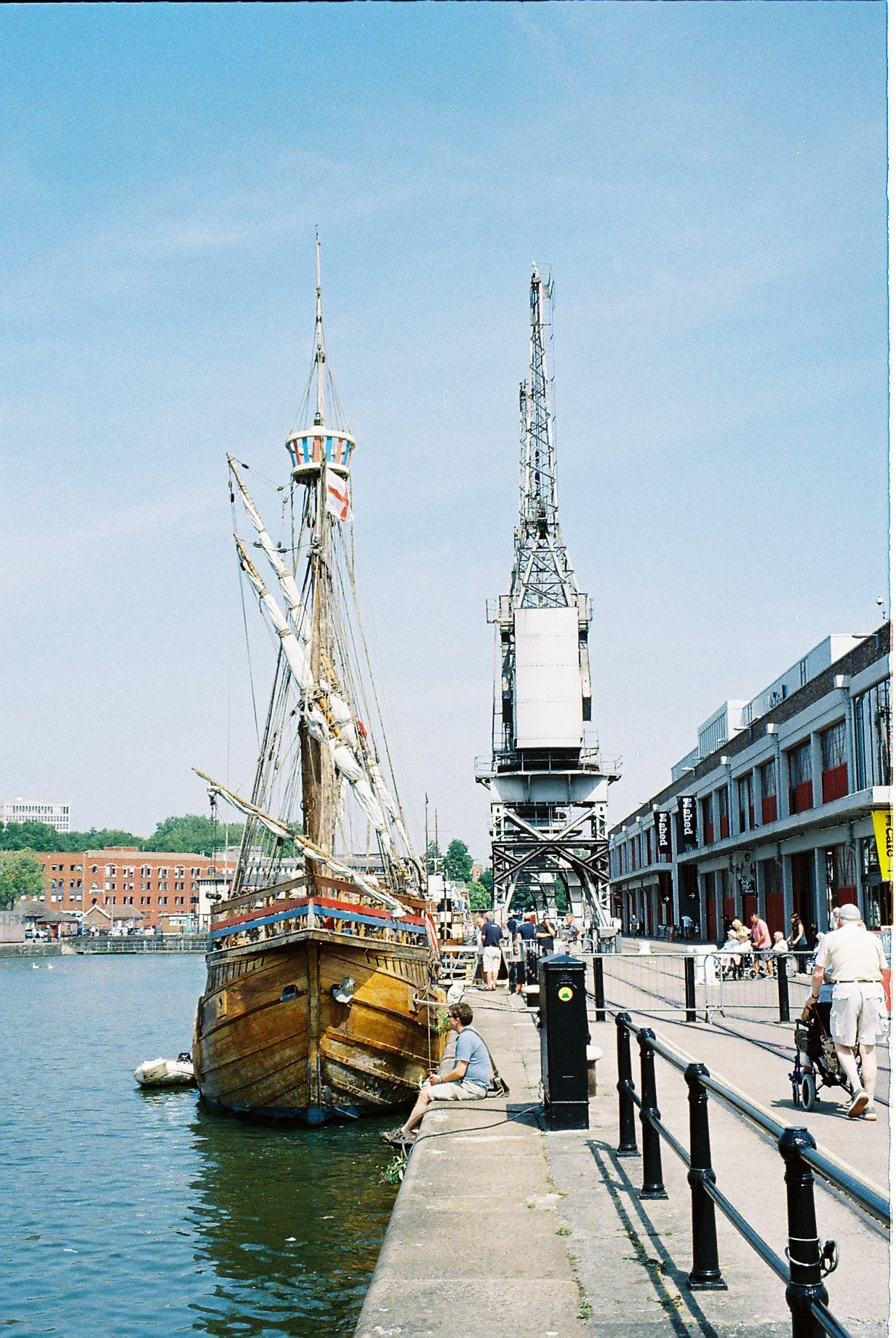
Outside the museum, four electric cargo cranes built in 1951 by Bath-based Stothert & Pitt still line the quay. Three are operational; volunteers run them on selected weekends. A few hundred metres west on Wapping Wharf stands a much rarer machine: the only surviving working Fairbairn steam crane in the world, built by Stothert & Pitt in 1878 and worked until 1973, lifting loads of up to 35 tons of cargo onto and off Victorian ships. It steams on bank holidays and during the annual Bristol Harbour Festival. The Bristol Harbour Railway runs steam locomotives along the quay on selected weekends. Permanently moored outside the museum is a small fleet of historic vessels: the fire-float Pyronaut (1934), the steam tug Mayflower (the world's oldest surviving steam tug, 1861), the diesel tug John King (1935), and the replica caravel Matthew, a working reconstruction of John Cabot's 1497 ship. M Shed is not just a building. It is a working quayside still arranged as a quayside, with the cranes and the boats and the rails all where they used to do business.
Flight Context
M Shed sits at 51.4473°N, 2.5986°W on Prince's Wharf, on the south side of Bristol's Floating Harbour just east of Prince Street Bridge. From the air it is recognisable by the four Stothert & Pitt cargo cranes lined up along the quay outside, a distinctive industrial signature against the otherwise modern harbour redevelopment. The historic vessels are moored along the quay. Recommended viewing altitude 1,500-3,000 feet. Bristol Airport (EGGD/BRS) lies 7 nautical miles south. The SS Great Britain is moored further west on the same harbour, and Bristol Temple Meads station is half a mile east.
From the Air
Located at 51.4473°N, 2.5986°W on Prince's Wharf, south side of Bristol Floating Harbour just east of Prince Street Bridge. Recommended viewing altitude 1,500-3,000 feet. Recognisable from above by the four 1951 Stothert & Pitt cargo cranes lined along the quay outside, with historic vessels moored alongside. Nearest airport: Bristol Airport (EGGD/BRS) 7 nm S. SS Great Britain moored further W on the same harbour; Bristol Temple Meads station half a mile E.
Nearby Stories
- Cosmeston Medieval Village 1.4 km away
- Glastonbury Festival 3.5 km away
- Tintern Abbey 3.6 km away
- Quantock Hills 4.8 km away
- Ebbw Vale Steelworks 10 km away
- New Wardour Castle 12 km away
- Windmill Hill, Avebury 16 km away
- Cotswolds 18 km away