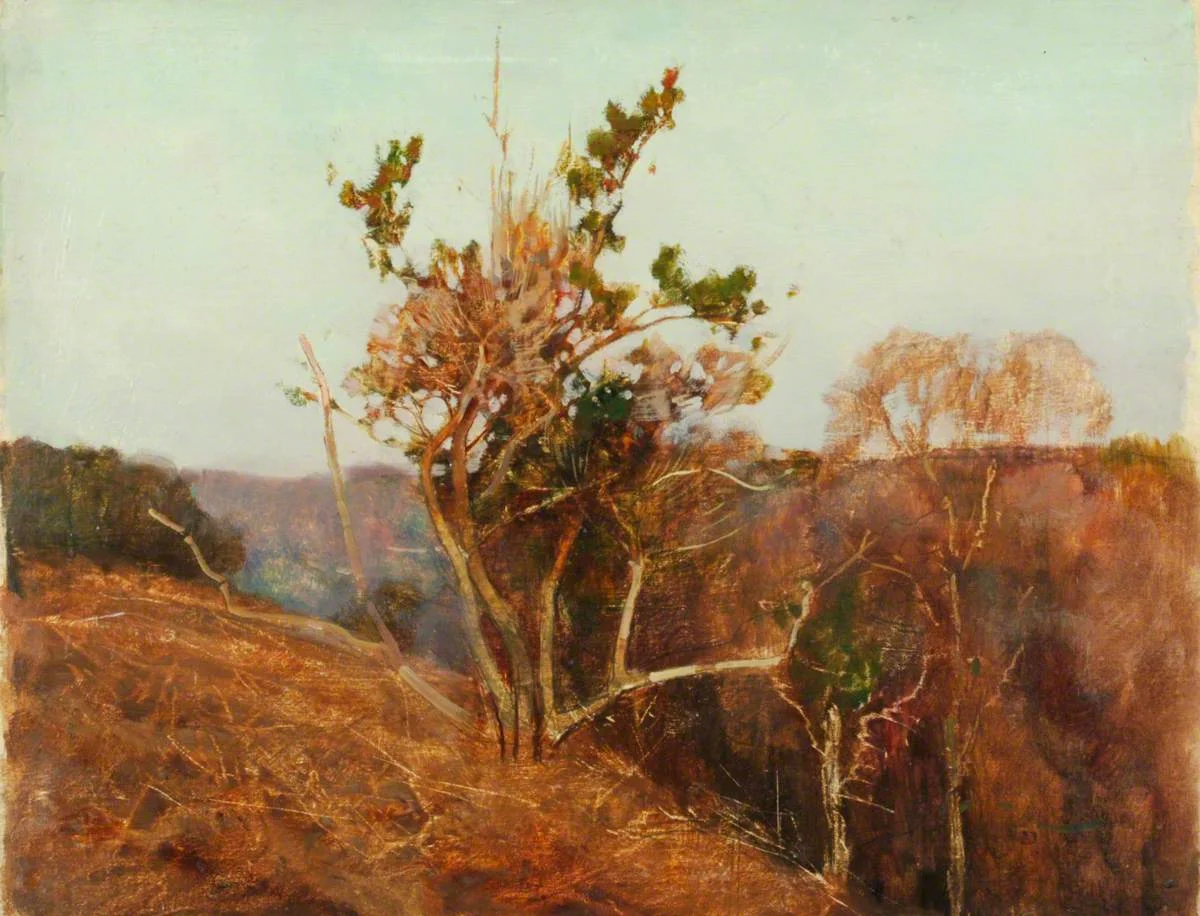
_-_East_Hill,_Ottery_St_Mary_-_1973-164_-_Portsmouth_Museums_and_Visitor_Services.jpg)
Ottery St Mary
On the evening of 5 November each year, the people of Ottery St Mary set fire to barrels soaked in tar and carry them through the town on their shoulders. The barrels can weigh up to thirty kilograms when fully alight. Crowds of more than ten thousand pack the streets to watch a population of seven thousand do something the rest of England gave up centuries ago. The tradition dates from the 17th century and may have started as a way to ward off evil spirits at Halloween, but its modern point is simpler: this is who Ottery still is. The town did not stop being itself when the rest of the country settled down.
Coleridge began here
On 21 October 1772 a son was born in the vicarage at Ottery St Mary to the Reverend John Coleridge, headmaster of the King's School and vicar of St Mary's Church. They named him Samuel Taylor Coleridge. He would grow up in The Chanter's House, the family's home, before going on to write 'Kubla Khan,' 'The Rime of the Ancient Mariner,' and a body of literary criticism that helped shape Romantic poetry. A small stone plaque in the south churchyard wall commemorates his birth. The Chanter's House remained in the Coleridge family until 2006, when it was sold to Max Norris, who spent five years restoring it. As of 2020 reports, the house has ten bedrooms, eleven bathrooms, twenty-one acres of gardens, a Victorian palm house, an aviary, and a library built by Coleridge containing 22,000 books, including diaries, notes, and his own poems. The house, in other words, still remembers him.
The bishop who rebuilt a town
St Mary's Church looks bigger than a town of seven thousand should have. That is because in 1335 John Grandisson, Bishop of Exeter, bought the manor and patronage of Ottery from Rouen Cathedral and converted the church into a collegiate foundation with forty members. Nikolaus Pevsner, the great architectural critic, described the building as 'lying large and low like a tired beast.' It is 163 feet long, its twin transept towers rising 71 feet, built in imitation of those at Exeter Cathedral. Inside are ten misericords from 1350, five carrying Grandisson's arms; two medieval carved Green Men in stone; the tomb of Otho de Grandisson; a wooden eagle given by the bishop himself. The north nave aisle, expanded around 1520, has an elaborate fan-vaulted ceiling with pendant bosses. The work makes the church a Grade I listed building. The town that grew up around it had a bishop's vision for a backbone.
Pixies, ghosts, and other neighbours
Ottery has more living folklore than most cathedrals. Each June, Pixie Day is celebrated. The legend says that when a local bishop ordered bells for the new church from Wales, the pixies feared the bells would end their rule over the land and cast a spell to redirect the monks carrying them off a cliff at Sidmouth. A monk stubbed his toe on a rock and said 'God bless my soul,' which broke the spell. The bells reached the church, but the pixies' magic was not entirely undone. Each June, costumed pixies capture the town's bell ringers and imprison them in 'Pixies' Parlour,' to be rescued by the Vicar. The original Pixie's Parlour, a cave along the River Otter, still exists. Inside St Mary's, the painted effigy of soldier John Coke is said to step down from its niche and wander the church; tradition holds he was murdered by a younger brother in 1632. Even the church bells play the Old Ottery song daily at eight, noon, and four.
Fire and water
On 25 May 1866 a fire that started in a cottage chimney spread to a neighbouring schoolroom and then through the western quarter of the town. By the end of the day, one hundred houses had been destroyed and five hundred people made homeless, ten percent of the population at the time. The cause was a woman burning rubbish in her fireplace; the fire smouldered overnight before flaring up at noon the next day. In July 1980 disaster nearly returned by air. A Vickers Viscount turboprop carrying sixty-two passengers from Santander to Exeter ran out of fuel eleven miles short of the runway. The pilot, who knew the area, banked left, glided over Ottery's southern edge, and put the aircraft down wheels-up in a field near St Saviours' Bridge. The only casualties were two sheep. The aircraft was a write-off. The Air Accidents Investigation Branch praised the commander's handling of the emergency. The town still sits under the Exeter Airport flight path.
Things that endure
The King's School, founded in 1335 by Bishop Grandisson as a choir school and refounded in 1545 by Henry VIII as a grammar school, is now a comprehensive Sports College of 1,100 students. In 1898 six young Ottery men living in London met on the steps of St Paul's Cathedral and resolved to form a society 'to promote good fellowship among Ottery people wherever they may be.' They called it the Old Ottregians Society, motto Floreat Ottregia, 'May Ottery Flourish.' It still exists. The Tar Barrels burn every November, briefly halted by COVID in 2020 and back since. The Pixie Day reenactment runs every June. The Old Ottery song plays from the church bells three times a day. A small Devon town that produced one of the language's great poets has, by simply continuing, become a kind of monument to itself.
From the Air
Ottery St Mary sits at 50.752N, 3.279W in East Devon, ten miles east of Exeter and just north of the B3174. The twin transept towers of St Mary's Church are visible from the air. The town lies on the River Otter in a shallow valley. Best viewed at 1,200 to 2,000 feet AGL when the church, river, and surrounding farmland resolve together. Exeter Airport (EGTE) is 4 nm southwest, and the town sits directly under the airport's flight path; the 1980 Vickers Viscount glided across this same airspace. Bournemouth (EGHH) is 50 nm east.
Nearby Stories
- Ivybridge 7.7 km away
- Okehampton Castle 10 km away
- Fleet Air Arm Museum 12 km away
- Torbay Lifeboat Station 13 km away
- 1940 Norton Fitzwarren Rail Crash 14 km away
- Battle of Portland 23 km away
- Maiden Castle, Dorset 24 km away
- Appledore Lifeboat Station 25 km away