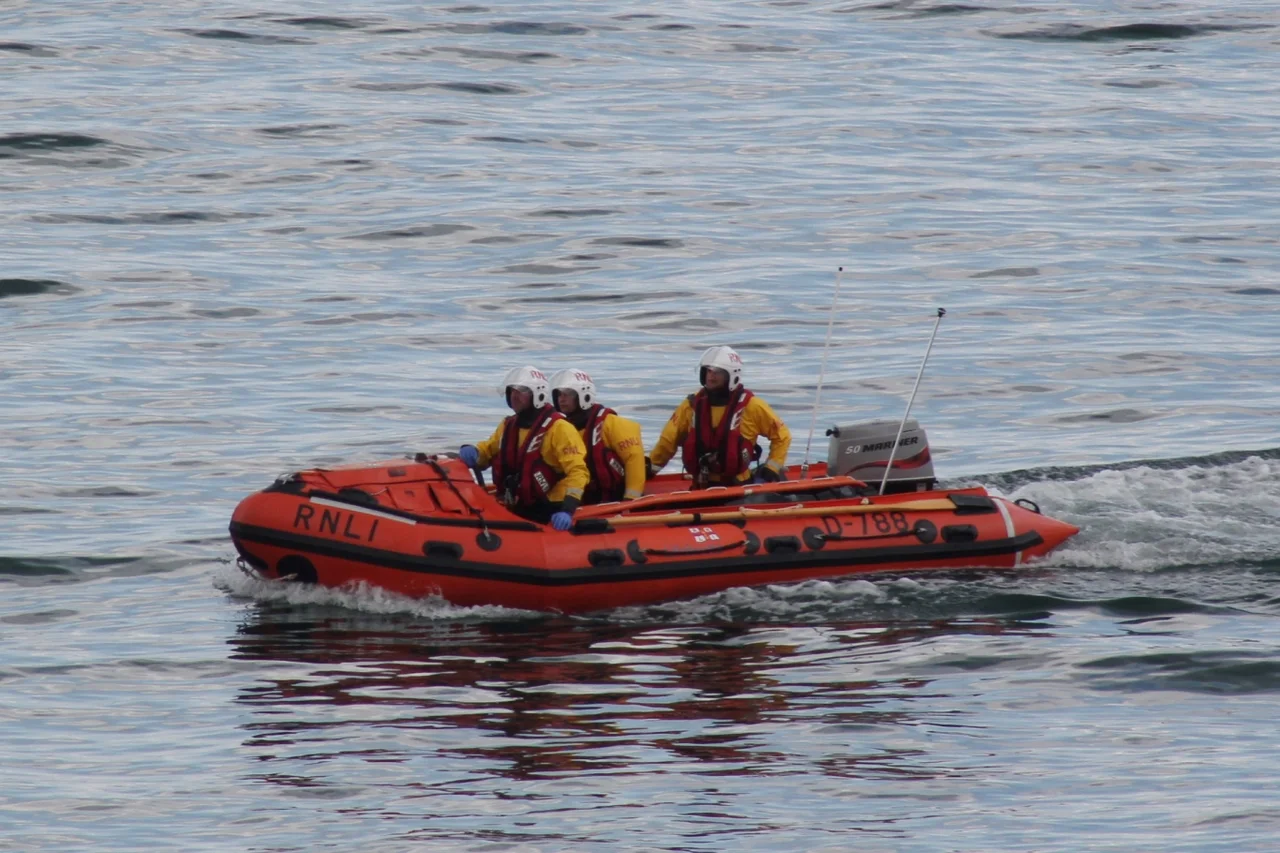

Torbay Lifeboat Station
On the night of 10 January 1866, the wind in Tor Bay turned and rose. Seventy-four vessels had run for shelter into the harbours at Brixham and Torquay. By morning, at least thirty of them had been smashed to pieces against the breakwaters or hurled onto the beaches, and seventy people were dead. The lifeboat China was dragged overland from Teignmouth to Torquay in time to save eleven men from two ships, but the toll of that single night made an argument the Royal National Lifeboat Institution could not ignore. Brixham needed its own boat. The station opened later that year. Since then, the Torbay crew, renamed in 1924, have launched into every kind of weather the Channel can put together. Coxswains have been killed, knocked overboard, awarded medals by foreign governments, lost in the rolling and brought back from it. Twenty-six RNLI medals for gallantry now hang in the station record: one gold, six silver, nineteen bronze. The most recent silver was awarded in 2008. The men and women who earned them are people who choose, when the bell sounds, to go where everyone else is trying to come back from.
The First Boat at Bolton Cross
There was nowhere obvious to put a boathouse in Brixham. The first lifeboat, the City of Exeter, was kept under a tarpaulin at Bolton Cross and carried down to the harbour on a wheeled carriage when a launch was needed. It was a clumsy arrangement, but the boat went out anyway. In 1873 a proper boathouse and slipway were built near the breakwater so the boat could launch straight into the harbour. The old shed became, in turn, a fire station and then a post office. In 1875 the RNLI opened a second station across the bay at Torquay, but by 1922 the new motor lifeboats could cover wider water in heavier seas, and Torquay station closed the following year. In 1924 Brixham was renamed Torbay Lifeboat Station, the name it carries today. The shift from oar and sail to engine, then to twin diesels and modern hulls, kept reshaping what a lifeboat could do. What never changed was who would crew her: men, and later women, drawn almost entirely from the fishing town outside the boathouse door.
Mogridge of the English Trader
On the morning of 23 January 1937, the SS English Trader ran aground on Checkstone Ledge at the mouth of the River Dart. Coxswain William Mogridge took the Torbay lifeboat out at 5:25 a.m. and stood by while tugs tried to pull her off. They could not. By 6 a.m. on the 24th, a strong gale was breaking waves clean over the beached ship, and her captain asked the lifeboat to take everyone off. Mogridge ran the lifeboat under the stern and alongside, lifted off the ship's 32 crew and the 20 men from the tugs who had gone aboard to help, then reversed out into clear water. He landed them at Dartmouth, returned to Brixham, and reached his mooring at 12:15 a.m., nearly 31 hours after he had cast off. Mogridge would go out again in December 1938, into a storm so violent that waves were breaking fifty feet up the cliffs, and find the broken fishing boat Channel Pride by the light of a fire lit on the clifftop. The two fishermen jumped onto his deck just before the wind threw both boats into the rocks. He won the Silver Medal for that one. A year later, against the schooner Henrietta off Dartmouth, he won the clasp.
Hands Two Short
By December 1944 the Second World War had stripped the fishing towns of crew. On the morning of 17 December, after two vessels were reported aground between Paignton and Torquay, the lifeboat George Shee put to sea two hands short. The tug Empire Alfred was just fifty yards from shore but the breakers were running 400 yards out from the beach. The lifeboat had to creep in for half an hour, scraping bottom repeatedly, to take off her 14 crew. Then they turned for the second vessel and ran aground themselves. They forced off in reverse. Motor Mechanic Richard Harris, working alone in the engine room because the Assistant Mechanic had been pulled topside to make up the deck crew, ran both engines sometimes waist-deep in water. They went back in a second time, lifted off the five men on the stranded craft, and brought everyone home to Brixham. Harris received a bronze medal. Coxswain Frederick Sanders received his second silver medal. The boats were on station the whole war. The crews were sometimes barely on board.
Force 9 and Fifty Approaches
On 13 January 2008, the bulk carrier MV Ice Prince was foundering in the Channel in Force 9 winds. She was listing at 25 degrees and rolling badly. The Torbay all-weather lifeboat went out, and Coxswain Mark Criddle took her in. The lifeboat approached the heeling hull roughly fifty times before all eight men on the lifeboat's portion of the rescue were safely aboard. The remaining twelve were lifted off by Coastguard helicopter. Twenty lives, in one of the worst sea states the Channel produces. Criddle received the Silver Medal. He has since been appointed OBE. The current Severn-class lifeboat at Torbay has a range of 250 nautical miles and a top speed of 25 knots, and the station covers up to fifty miles in any direction. The crew live in the town, work in the town, and answer the pagers from wherever they happen to be when the call comes. The station was granted the Honorary Freedom of the Borough of Torbay on 29 April 1988. It is the kind of honour given to people who have, for more than a century and a half, chosen to do what almost nobody is willing to do.
From the Air
Torbay Lifeboat Station sits at 50.3992N, 3.5055W on the inner curve of Brixham harbour, on the southern arm of Tor Bay. Best viewed from 1,500 to 3,000 feet, where the harbour mouth, the Severn-class lifeboat at her pontoon, and the Brixham fishing fleet around her all show clearly. Exeter Airport (EGTE) lies about 22 nautical miles to the north, the natural arrival point. Look for Berry Head's lighthouse just south of Brixham, the curve of Tor Bay opening north toward Paignton and Torquay, and Start Point lighthouse further south down the coast.
Nearby Stories
- Modbury 1.9 km away
- Powderham Castle 8.7 km away
- Okehampton Castle 15 km away
- Battle of Portland 23 km away
- German Submarine U-672 23 km away
- Maiden Castle, Dorset 25 km away
- Battle of Plymouth (1652) 29 km away
- HMS Affray 68 km away