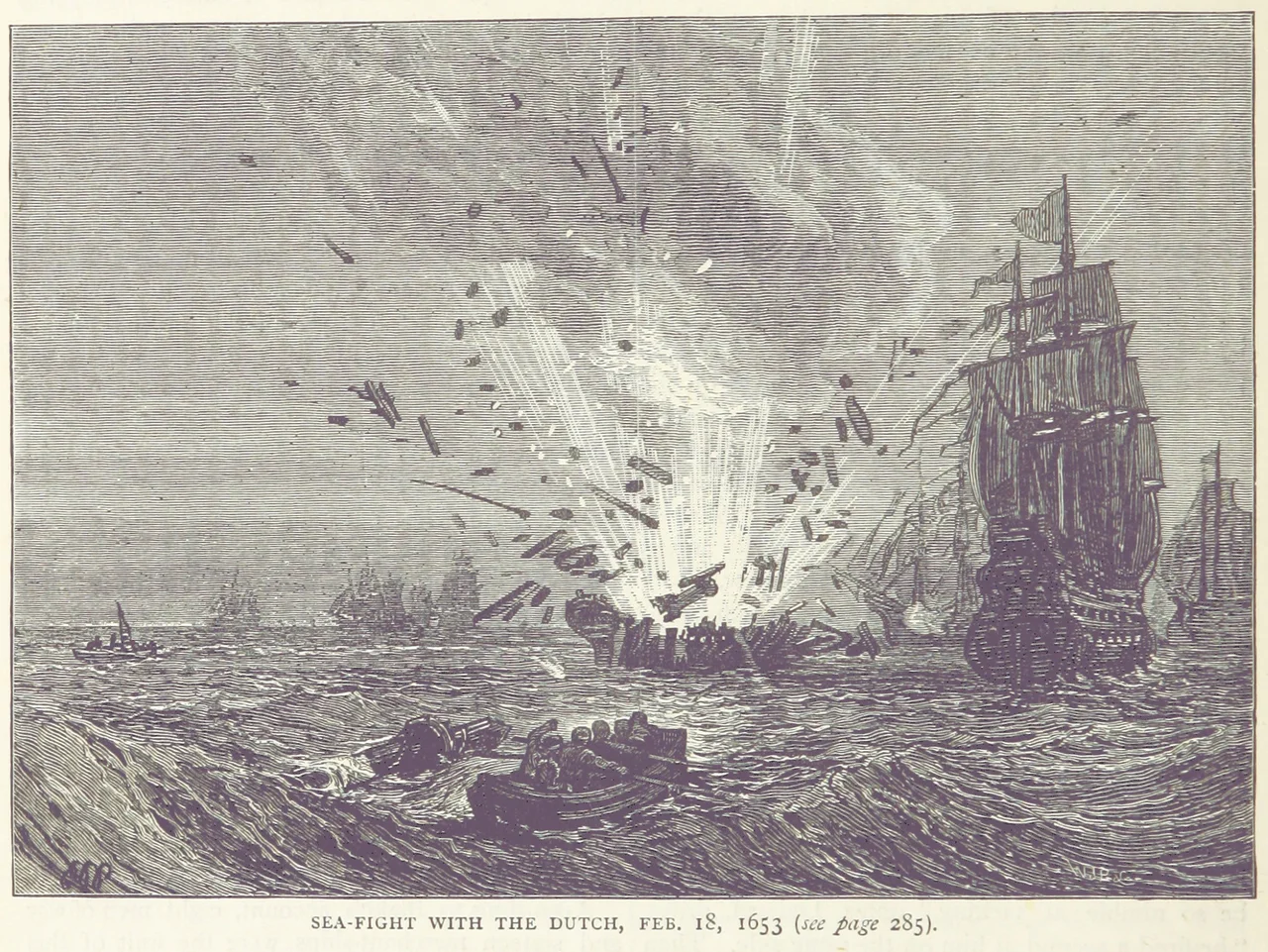

Battle of Portland
Tromp had 152 merchantmen to protect, and the English had cut him off. On 28 February 1653, off the long pebble spit of Chesil Beach with Portland Bill at his stern, the Dutch admiral signaled a general attack and bore down on Robert Blake's flagship Triumph at point-blank range. Brederode fired one broadside, then turned and fired another from the other side, then turned again and fired a third, all of this within a few hundred meters. Blake veered away and decided to fight at long range. Both men would later die for this war. Tromp would be killed by an English musket ball five months later at Scheveningen. Blake would survive the conflict but die of fever in 1657, still in active service. What they began here, in the Channel off Portland, was three days of running gunnery that taught the English how to fight at sea.
The Two Republics
The First Anglo-Dutch War was a fight between two seventeenth-century commercial powers for control of trade routes. England and the United Provinces had been allies in the long struggle against Habsburg Spain, but with Charles I dead, with Oliver Cromwell consolidated as Lord Protector, and with the Dutch having quietly expanded their merchant marine during the English Civil War, the two states found themselves competing rather than cooperating. The Navigation Act of 1651 required goods bound for English ports to travel in English ships, cutting Dutch carriers out of the colonial trade. The English began seizing Dutch merchantmen on flimsy pretexts. The Dutch tripled their war fleet under Maarten Tromp, the veteran admiral who in 1639 had crushed the last Spanish Armada at the Battle of the Downs. War formally broke out in May 1652 at Dover.
The Education of an Admiralty
England lost the first major fleet action at Dungeness in November 1652. Tromp drove Blake into the Thames estuary and emerged from the battle with what English propaganda claimed was a broom lashed to his masthead, signaling that he had swept the Channel clean. The English Admiralty Committee, working under Sir Henry Vane, took the defeat seriously. They reorganized their fleet into squadrons for tighter tactical control, borrowing the structure from the Dutch themselves. They began developing a tactic that would govern naval warfare for the next two centuries, lining ships ahead in single file, each gun able to fire across the enemy's line, the formation now called line of battle. Portland would be the first test of the new system. The English were not yet good at it. But they were practicing.
Brederode Against Triumph
Tromp's convoy had been waiting at La Rochelle for the weather to break. He sailed on 24 February with 152 merchantmen and reached the Channel four days later, where lookouts spotted Blake's fleet trying to bar his way. The Dutch admiral had the weather gauge, the wind in his favor, and he attacked at once. Brederode and Triumph met first, the broadsides at metres. Blake pulled away, reformed, and tried to fight at distance. Commodore Michiel de Ruyter, then a young Dutch captain who would later become the most famous admiral of his age, took Prosperity, the largest English vessel in the fleet, by boarding on the second try. The English attempted to retake her and surrounded de Ruyter, who fought his way out. The day ended with neither line broken and both fleets battered. Off La Rochelle, far to the south, English frigates were chasing the rear of the Dutch convoy. The merchantmen scattered.
Two More Days, and a Wound in the Thigh
The second day was English. With the wind now in their favor, Blake's fleet tried five separate times to break the Dutch line and failed. But while the fleets fought, twelve Dutch merchantmen made a run for it against Tromp's explicit orders, and Blake's frigates caught them. By nightfall most of the Dutch warships had used up their powder and shot, and there was no resupply available. The third day was a slower repeat. Tromp's captains began trying to flee, and he stopped them with shots fired across their bows. Blake disengaged in the late afternoon. He had received a musket ball in the thigh that day. The fourth morning the English looked for the Dutch and could not find them. Tromp had slipped along the French coast in the dark, leaving twelve warships and a number of merchantmen behind. He had saved most of his convoy, but the field belonged to Blake.
The Bitter Lesson
Both sides claimed victory. The Dutch crowds rejoiced at what they were told was a glorious defense. Tromp and his flag officers, returning home, knew better. They told the States-General that the English had begun to use line tactics that no amount of Dutch seamanship could overcome with inferior firepower, and that the only answer was to build heavier warships. They had been replacing losses by hiring armed merchantmen. That would no longer be enough. The English took the Channel after Portland, blockaded the Dutch coast, and forced the decisive Battle of Scheveningen that August. Tromp died on his quarterdeck in that battle, hit by a musket ball before the action had really begun. The peace that followed in 1654 was the first of three Anglo-Dutch wars. The line of battle, tested off Portland by men who were still learning how to use it, would still be the basic tactic of fleet combat at Trafalgar a century and a half later. Some of the Dutch and English sailors who died in those three days have descendants in both countries today. Both fleets fought well. Both lost good men. The Channel was full of bodies for weeks.
From the Air
The Battle of Portland was fought across a long stretch of the English Channel south of the Isle of Portland, between roughly 50.4 deg N, 2.5 deg W and the French coast near La Rochelle. Portland Bill, the limestone promontory south of Weymouth, is visible from altitude. Bournemouth Airport (EGHH) lies forty-five kilometers east; Exeter Airport (EGTE) is sixty kilometers west. Chesil Beach, the great pebble bar curving from Portland toward Bridport, is one of the most distinctive geographical features on the south coast of England.
Nearby Stories
- Corfe Castle 3.9 km away
- German Submarine U-672 11 km away
- Operation Donnerkeil 13 km away
- Maiden Castle, Dorset 14 km away
- Ottery St Mary 16 km away
- Torbay Lifeboat Station 25 km away
- Chapman's Pool Lifeboat Station 26 km away
- HMS Affray 73 km away