
Modbury
In April 2007, Modbury did something no town in Europe had done before: it banned the plastic bag. All forty-three of its shopkeepers agreed, simultaneously, to stop handing out single-use plastic at the till. The news travelled in ways the town did not expect. Reporters arrived from London, then from Australia, then from anywhere with a printing press. Within months, communities from Ilam in Staffordshire to Hebden Bridge in Yorkshire were trying to copy the experiment. For a place of roughly 1,500 people on a quiet ridge between Plymouth and Kingsbridge, it was a strange kind of fame. It was also entirely in character. Modbury has been doing things first since 1199, when the lord of the manor was granted the right to hold a weekly market. That charter has never lapsed.
From Mud or Meeting
The name is Anglo-Saxon and slightly ambiguous. Moot burgh means either "meeting fortified-place" or "mud fortified-place," and scholars have argued both ways. The Domesday Book of 1086 records the settlement as Motbilie, one of the holdings of Robert, Count of Mortain, half-brother of William the Conqueror. Robert handed the manor to Reginald de Vautort, one of his loyal Anglo-Norman followers, and a few generations later it passed by marriage into a complicated tangle involving Joan de Vautort, mistress of Richard, 1st Earl of Cornwall and second son of King John. Through her son, the manor passed to the Champernowne family, who held Modbury through the centuries that followed. Their manor house, called Court House, stood on the north side of St George's Church on the site of an older priory. It did not survive the Civil War; what remained was sold for building stone in 1705.
St George's Spire
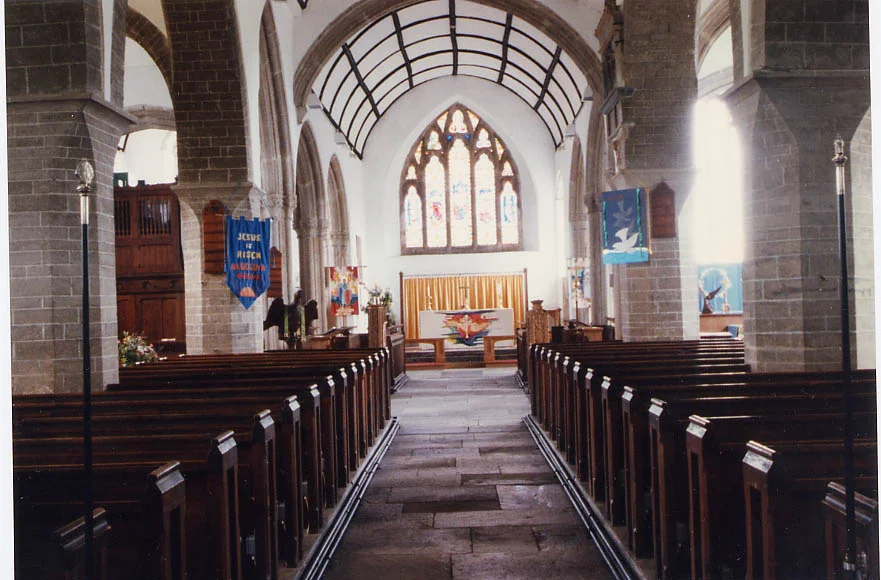
The parish Church of St George is Grade I listed and largely fourteenth century, built of coursed rubble dressed with granite from the moor. Its broach spire was struck by lightning in 1621 and rebuilt as a careful copy of the original, and the nave and aisles still wear their wagon roofs, restored most recently in the sixteenth century according to the tree rings in the timbers. The church survived seven hundred years, but only just. In 2013 it was placed on Historic England's Heritage at Risk Register because of roof damage and damp. A Heritage Lottery grant in 2015 funded an extensive programme of repairs, and the spire that pilots and walkers use as a landmark continues to do its job, visible for miles across the rolling South Hams countryside.
The Governess Who Made a Queen
Katherine Champernowne was born in or near Modbury in the early sixteenth century, the daughter of a prominent local family. As a young woman she entered the household of Anne Boleyn, and after Anne's execution she was appointed governess to the four-year-old princess who would become Elizabeth I. For more than thirty years "Kat" Ashley, as she became after marriage, was Elizabeth's teacher, companion, and surrogate mother. She taught the princess Latin, Greek, French, history, and arithmetic. She was imprisoned in the Tower in 1549 for her role in the Thomas Seymour scandal, released, and brought back into Elizabeth's service. When Elizabeth came to the throne in 1558, Kat Ashley became First Lady of the Bedchamber, the most intimate position in the new queen's household. She died in 1565. Elizabeth, who almost never showed grief in public, was inconsolable. A village girl from Modbury had become, in effect, the mother of the most powerful woman in Europe.
Savery's Engine
Thomas Savery was born around 1650 at Shilstone, the Georgian manor just outside the village, into a family whose members included Members of Parliament and prosperous farmer-traders. He grew up to become a military engineer and an inventor, and in 1698 he patented a device he called the "Miner's Friend, or an Engine to Raise Water by Fire." It was the first commercially used steam-powered machine. Savery's pump used condensing steam to create a vacuum that sucked water out of flooded mineshafts, then used pressurised steam to push it the rest of the way to the surface. It was inefficient, occasionally dangerous, and limited in the depths it could handle, but it worked, and it pointed the way forward. Thomas Newcomen would build on Savery's patent within a decade, and James Watt on Newcomen's a generation after that. The Industrial Revolution began, in a meaningful sense, with a Modbury man and a kettle. Savery died in 1715.
Manor Houses and Long Memory
Modbury's parish keeps several historic seats worth noting. Shilstone Manor, where Savery was born, was restored in the early 2000s after decades of dereliction; it won Country Life's Restoration of the Century award and the historic gardens have been brought back as well. Wympston, granted by King John to John Fortescue in 1209, became the earliest English seat of the Norman Fortescue family, who would rise to become Earls Fortescue. Sir George Baker, born in Modbury in 1722, became physician to King George III. William Battie, also born here, was elected president of the Royal College of Physicians in 1764. And across the Atlantic, Madbury, New Hampshire still carries Modbury's name, brought there in the 1600s by Sir Francis Champernowne, who gave the name of his ancestral village to a farm in the New World. The plastic-bag ban was new. The habit of being noticed was very, very old.
From the Air
Modbury lies at 50.349 degrees north, 3.887 degrees west, in the South Hams district of Devon, roughly 12 miles east of Plymouth and 5 miles east-northeast of Yealmpton. The town sits along the A379 between Plymouth and Kingsbridge, identifiable from the air by the spire of St George's Church and the dense cluster of slate roofs along the ridge. Surrounding countryside is rolling farmland threaded with deep, wooded valleys. Nearest controlled airport is Exeter (EGTE), 35 miles northeast. The closed Plymouth City Airport (EGHD) is 14 miles west. Weather is generally mild and damp with frequent low cloud rolling off the English Channel a few miles to the south.
Nearby Stories
- Davidstow Circuit 3.7 km away
- Golden Hind 3.9 km away
- Powderham Castle 4.4 km away
- Fowey Lifeboat Station 5.1 km away
- Okehampton Castle 12 km away
- Battle of Plymouth (1652) 19 km away
- Goonhilly Satellite Earth Station 44 km away
- German Submarine U-672 73 km away