
Davidstow Circuit
On the high windswept tableland of Bodmin Moor, at the highest airfield ever built in Britain, three Formula One races took place between 1954 and 1955. The track was a converted RAF Coastal Command base called Davidstow Moor. Most days the moor was blanketed in fog so thick that race organisers had to clear sheep off the bank straight before practice. The crowds came anyway - twenty thousand once, for a meeting that was rained out by midday. Davidstow was where, on 2 August 1954, a Lotus Mk8 driven by John Coombs won the first Formula One race in the marque's history. The circuit hosted forty-four races in four seasons, then closed forever in May 1955.
An Airfield in the Clouds
RAF Davidstow Moor opened in 1942 as a Coastal Command base, its long runways laid across moorland nine hundred and seventy feet above sea level - the highest active airfield in the United Kingdom. The site was chosen for clear flying weather; in practice, the moor produced its own. Squadrons flew patrols and anti-submarine sorties over the Western Approaches and the Bay of Biscay. After the war the base was decommissioned, the runways and perimeter roads abandoned to grass and sheep. In the boom years of British motor racing in the early 1950s, when dozens of former airfields were being repurposed as circuits, the Cornish Vintage Car Club (founded only in 1949) and the Plymouth Motor Club (founded in 1908) looked at Davidstow's three-and-a-half kilometres of intersecting runway and saw a racetrack.
The First Day
Racing began on 9 August 1952 over a 4.2 km layout with only three corners. Most drivers said it was not very challenging. The promoting clubs had been labouring in torrential rain for days to prepare the track and facilities; race day dawned with no improvement. The expected crowd of 800 had been surpassed by 3,000 when the gates opened. The weather stayed appalling. Everyone enjoyed themselves anyway, in the British way. For 1953 the layout was redesigned with a chicane before the first corner and trimmed to 3.1 km, the version used for the rest of the circuit's short life. The Whitsun meeting of 1953 was scheduled in hopes of a 20,000 crowd; Bodmin Moor produced fog instead. After sheep were cleared from the bank straight, practice began. Davidstow's first proper race - five laps of sports cars up to 1,500 cc - was won by M. G. Llewellyn in an MG TD. A Kieft beat two Coopers in the Formula Three twenty-lapper that followed, average speed 71.53 mph.
Lotus's First Formula One Win
1954 brought two Bank Holiday meetings with national-status permits and the promise of Formula One. The first, on 7 June, dawned to high winds and driving rain. The crowd of 20,000 came anyway. Only seven cars started the F1 race, and only one of them was a true Formula One car - the rest were 2-litre Formula Two cars promoted on the day. John Riseley-Prichard in a Connaught-Lea Francis Type A won at 74.2 mph. The meeting was then abandoned because the bridge over the track collapsed. The second meeting was on 2 August. The moor produced fog again, which turned to penetrating drizzle. The F1 race was billed as 30 laps but reduced to 20. John Coombs took the chequered flag in a Lea Francis-engined Lotus Mk8 at 72.65 mph. The Mk8 was built as a sports car; its 2.5-litre engine met the Formula One displacement limit and the contemporary regulations allowed it to compete as a Formula One car. That afternoon, in Cornish drizzle, on a converted runway, with one true F1 car in the field, Team Lotus won its first Formula One race. The marque's first proper World Championship F1 win would not come until Stirling Moss took the chequered flag at Monaco in 1960.
Going Out On A High
For 1955 the organisers concentrated on a single meeting, Whit Monday, 30 May. They intended it to be the last, and so it was. But Davidstow bowed out at the top of its game. Peter Collins had entered a Maserati 250F and an Aston Martin DB3S, but withdrew when he was double-booked at Crystal Palace three days before. Three Connaughts and three Coopers formed the F1 grid. The star was Leslie Marr in a Connaught B3 - the streamlined version, one of only two streamlined cars ever to race in the 2.5-litre F1 formula (the other was the Mercedes-Benz W196). Marr was in his element. He won at 85.84 mph from Charles Boulton, Tom Kyffin, and Dick Gibson, and set the fastest lap at 88.21 mph. In the very last race held at Davidstow, a Formula Libre event, Marr left the outright lap record at 1 minute 14 seconds - 89.88 mph, a fraction under ninety. Then he packed up and went home. So did everyone else.
What Remains on the Moor
After 1955 the runways went back to silence. The grass grew over the racing line. The British Formula One scene moved to faster, safer permanent circuits like Silverstone and Goodwood, and Davidstow, with its bridges that collapsed and its weather that ate days whole, was forgotten outside specialist motorsport history. Today an ultralight and microlight flying school operates at the airfield. The site of the original RAF control tower remains, surrounded by moor. Forty-four races, three Formula One events, one Lotus first - the achievements compress neatly. The crowd of 20,000 in driving rain does not. Cornwall in the early 1950s was a long way from Crystal Palace, but for four summers it was the place where a chequered flag came down on the highest, foggiest, briefest racing circuit in British history.
From the Air
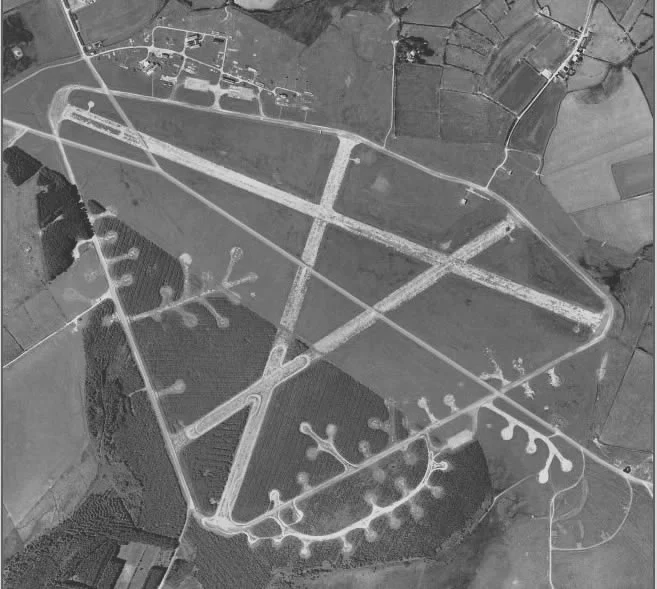
Davidstow Circuit sits at approximately 50.639N, 4.618W on the northern edge of Bodmin Moor, about 970 ft above sea level. The former RAF Davidstow Moor airfield is still recognisable from altitude as a triangular arrangement of long concrete runways and perimeter roads in open moorland, two miles north of the village of Davidstow. Camelford lies four miles south-west; Boscastle is six miles north-west on the coast. The site is currently used by an ultralight and microlight flying school. Bodmin Airfield (EGLA) lies about 15 km south-west and Cornwall Airport Newquay (EGHQ) about 35 km west-south-west. Best photographed from 2,000-3,000 ft when the moor isn't fogged in - which is not most days.
Nearby Stories
- Lanhydrock House 3.5 km away
- Tamar Bridge 4.7 km away
- Appledore Lifeboat Station 9 km away
- Okehampton Castle 15 km away
- Hartland Point Lighthouse 16 km away
- Tehidy Country Park 23 km away
- Godrevy Lighthouse 53 km away
- Action of 17 November 1917 62 km away