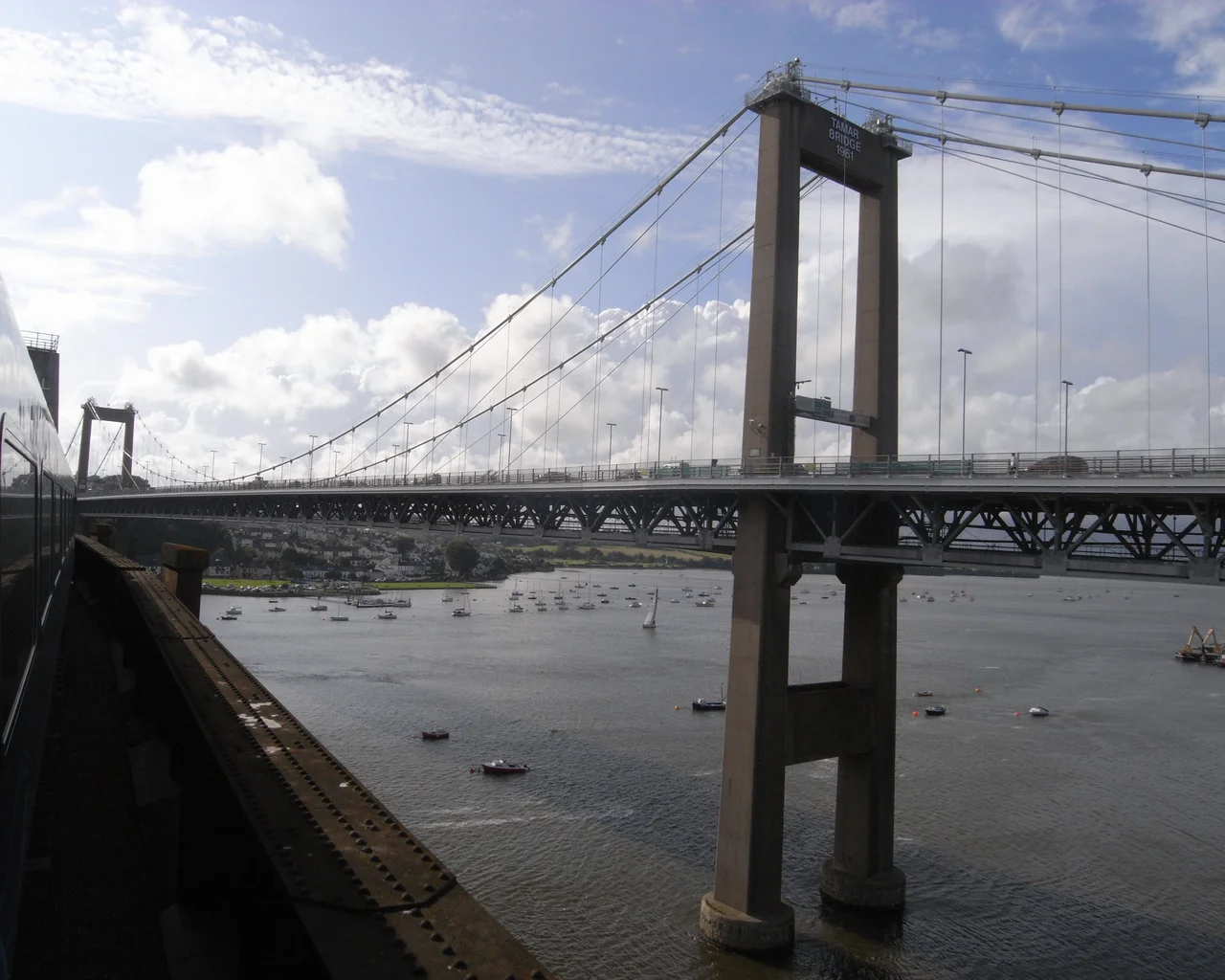

Tamar Bridge
When the British government told Plymouth and Cornwall in 1950 that a bridge across the Tamar wasn't worth funding, the two councils made a remarkable decision: they would build it themselves. The slender suspension span you see arcing across the river today, side by side with Brunel's older railway bridge below it, is the result of that defiance. It opened in 1961, four thousand cars trickling across each day. Within four decades it would be carrying over forty thousand, and engineers from as far as the Hudson River would be visiting to study how Plymouth and Cornwall had pulled off something the engineering world had never managed before.
The Bridge Westminster Wouldn't Build
The problem was old and stubborn. To get from Saltash to Plymouth by road, you either drove north to Gunnislake to cross a one-lane bridge built in 1520, or you queued for the ferries that had been shuttling across since 1791. By the mid-twentieth century the queues were impossible. Motor cars were multiplying and the boats simply could not keep pace. Plymouth City Council and Cornwall County Council asked the government for help. The government, exhausted by post-war priorities and skeptical of the project's viability, said no. So the councils dug into their own treasuries, secured Royal Assent in July 1957, and accepted a tender from the Cleveland Bridge and Engineering Company in June 1959. The bridge would be paid for in tolls, eastbound only, into perpetuity.
Two Towers and a Solar Eclipse
Construction began in July 1959 with the raising of two concrete towers, each 67 metres tall. Cables stretched between them, weighing 850 tons in total, manufactured by British Ropes Ltd in lengths of 2,200 feet. Sections of road deck were floated up the Tamar by barge and lifted into place from hangers below the cables. The technique was so successful that Cleveland Bridge used it again for the first Severn Bridge. Queen Elizabeth The Queen Mother opened the new crossing formally in April 1962, six months after the first car had already paid its toll. Four decades later, when European weight regulations demanded a stronger bridge, engineers added cantilever decks on either side while traffic kept flowing through the middle, a feat slightly delayed in August 1999 when tourists flooded Cornwall to watch the solar eclipse pass over the county.
A Bridge Between Two Nations
Cross the bridge eastbound today and you pay the toll. Cross westbound, into Cornwall, and you cross for free. The asymmetry is older than the tolls themselves, and to many Cornish people it carries a meaning beyond convenience. The Tamar is not just a river. It is the linguistic, cultural, and arguably national border between two Celtic-influenced places that were once independent kingdoms. In March 1998, after the closure of the South Crofty tin mine, the Cornish Solidarity Action Group urged commuters to pay the then-£1 toll entirely in pennies. They wanted Westminster to notice that Cornwall's economy needed the same regeneration grants going to South Wales and Merseyside. The traffic backed up. The point was made. The argument over what Cornwall is owed continues to this day, and the bridge keeps quietly mediating between two answers.
The World's First, Without Closing the Doors
The 1999-to-2001 reconstruction sounds almost too clever to be real. The original concrete-and-steel deck could not legally carry the heavier lorries that European regulations now mandated. A new bridge would cost £300 million and take years. Closing the existing bridge was impossible because forty thousand vehicles depended on it daily. Hyder Consulting's solution was to build two new cantilever lanes alongside the existing deck, divert traffic onto them, then completely rebuild the central road surface, all while keeping the bridge in service. Eighty-two orthotropic steel panels, each six by fifteen metres and weighing twenty tons, were swapped into place over two years at a cost of £34 million. When it was done, the bridge weighed twenty-five tons less than the original. It was the first suspension bridge in the world ever widened by cantilevers, and the first ever strengthened while still carrying traffic. Princess Anne reopened it on 26 April 2002, exactly forty years to the day after her grandmother first cut the ribbon.
From the Air
The Tamar Bridge sits at 50.41 N, 4.20 W, crossing the Tamar estuary between Saltash and Plymouth. From the air it forms a striking visual pair with Brunel's 1859 Royal Albert Bridge immediately to the south, the two spans nearly parallel. Plymouth City Airport (EGHD) closed in 2011, so the nearest active fields are Exeter (EGTE) about 35 nm to the northeast and Newquay Cornwall (EGHQ) 40 nm to the west. Best viewing is at 1,500 to 3,000 feet AGL on a clear day, with the Hamoaze estuary spreading south beneath both bridges.
Nearby Stories
- Davidstow Circuit 3.7 km away
- Golden Hind 3.9 km away
- Powderham Castle 4.4 km away
- Fowey Lifeboat Station 5.1 km away
- Okehampton Castle 12 km away
- Battle of Plymouth (1652) 19 km away
- Goonhilly Satellite Earth Station 44 km away
- German Submarine U-672 73 km away