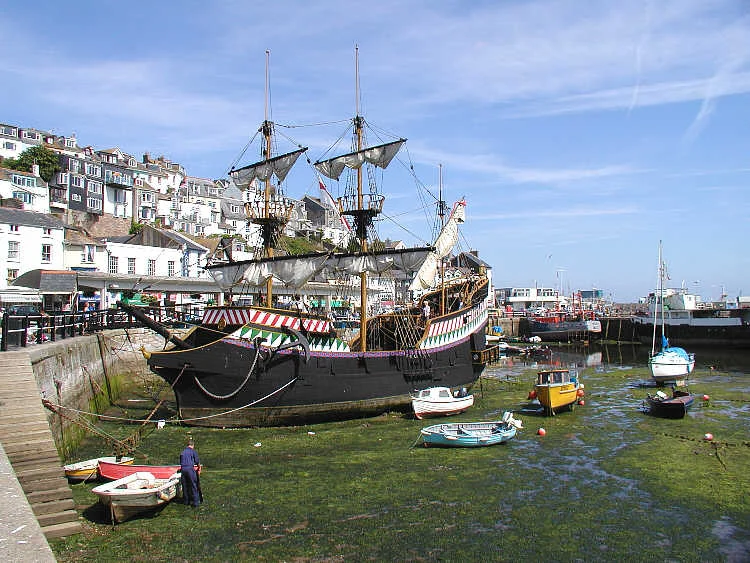

Golden Hind
Queen Elizabeth I had a sentence she liked to repeat to Francis Drake before he sailed in December 1577. "We would gladly be revenged on the King of Spain for divers injuries that we have received." The official purpose of his expedition was, in the careful language of his commission, to find out places meet to have traffic. The unofficial purpose was piracy on a national scale. Drake set out with five ships and 164 men. He returned three years later with one ship, fifty-six survivors, six tons of cloves from the Spice Islands, twenty-six tons of silver, half a ton of gold, and a private fortune for his queen so large that she paid off the entire government debt and had 40,000 pounds left over. The ship that carried it all was a 120-ton galleon originally named Pelican. Mid-voyage, in honor of his patron Sir Christopher Hatton, whose family crest was a female red deer, Drake had her renamed. She became the Golden Hind.
Around the Bottom of the World
The expedition was supposed to pass through the Strait of Magellan and explore the Pacific coast of South America, where the Spanish Empire had grown rich and almost completely unguarded. Drake reached the Brazilian coast in early 1578, hammered his way through the strait, and emerged into a Pacific that no English ship had ever seen. He acted as a privateer, with Elizabeth's unofficial backing. The Spanish, who had never been raided in their own ocean, were not prepared. On 1 March 1579, off the coast of Ecuador, the Golden Hind caught up with a Spanish galleon, the Nuestra Senora de la Concepcion, known to her crew as the Cacafuego. She carried the largest treasure ever captured at sea to that date: over 360,000 pesos, equivalent to roughly 480 million pounds in 2017 money. The transfer of cargo took six days. When it was done, Drake released the Spanish crew, courteously, and sailed north. He reached California, careened the Golden Hind on a beach to repair her hull, met the Coast Miwok people there, and then turned west across the Pacific.
Cloves, Coins, and an Empire's Debts
Drake sailed back to England by way of the Spice Islands, where he loaded six tons of cloves so valuable they were worth their weight in gold. He came up the long arc of the Atlantic, around the Cape of Good Hope, and into Plymouth Harbour on 26 September 1580. Fifty-six of the original 164 men were still aboard. The treasure was unloaded at Trematon Castle nearby, supervised by the Queen's guards, because the value was too great to be processed any other way. Elizabeth received a personal share that came to at least 160,000 pounds, which historians have calculated as enough to retire the entire national debt with 40,000 pounds left over for the new Levant Company. Investors in the voyage saw a return of more than 47 pounds for every pound they had risked. Forty-seven hundred percent. Drake was knighted by the queen on the deck of the Golden Hind at Deptford. The knighting helped inflame tensions with Spain, and four years later, in 1585, the open Anglo-Spanish War began.
The Long Afterlife of a Wooden Ship
The Golden Hind herself did not retire. Elizabeth ordered her kept on public display at the dockyard at Deptford on the Thames, where she sat as a kind of floating monument for the next seventy years. By around 1650, forty-five years after the queen who knighted Drake had died, the ship had rotted enough that she was finally broken up. The good timber did not go to waste. In 1668, the keeper of the stores at Deptford had the best surviving wood made into a chair, now called the Drake Chair, which was presented to the Bodleian Library at Oxford. It is still there. A replica chair sits in the Great Hall of Buckland Abbey, Drake's home in Devon, now run by the National Trust. A table known as the Cupboard in Middle Temple Hall in London is also said to be made from her wood. New barristers, when they are called to the Bar, sign the roll of members of the Middle Temple on that table. They are, in a small way, putting their names on a piece of the Golden Hind.
Three Replicas and a Working Museum
The first reproduction of the Golden Hind was built in 1947 at Peter Pan's Playground in Southend-on-Sea, opened in 1949, and demolished in 1997. A second replica was constructed in 1963 for the television series Sir Francis Drake, filmed around Torbay and Dartmouth. That ship sank under tow in 1987 while being moved for restoration. A successor, built on a steel barge and unable to sail, has stood in Brixham harbour since 1988, and is visited by thousands every year. The most ambitious replica is the Golden Hinde, launched in 1973 at Appledore in north Devon after three years of traditional construction. She is the only full-size, seaworthy reconstruction. Since her maiden voyage to San Francisco in 1975, she has sailed more than 140,000 miles, including a complete circumnavigation completed in 1979 during filming of the miniseries Shogun, and stints at Expo 86 in Vancouver. Since 1996 she has been moored at St Mary Overie Dock on the south bank of the Thames, in Southwark, where school groups climb her rigging and look out across London from the deck of a ship that retraces, in a small way, the route Drake first cut around the world.
From the Air
The Brixham-based replica of the Golden Hind sits at approximately 50.396N, 3.513W, moored permanently in the inner harbour of Brixham, Devon. From 1,500 to 3,000 feet the painted galleon stands out clearly against the modern fishing boats around her, and the view extends north across Tor Bay to Torquay and Paignton. Exeter Airport (EGTE) lies about 22 nautical miles to the north and is the natural arrival point. Plymouth City Airport (EGHD) is further west. Look for Berry Head's lighthouse just south of Brixham, and the natural curve of Tor Bay opening to the north and east.
Nearby Stories
- Modbury 1.9 km away
- Powderham Castle 8.7 km away
- Okehampton Castle 15 km away
- Battle of Portland 23 km away
- German Submarine U-672 23 km away
- Maiden Castle, Dorset 25 km away
- Battle of Plymouth (1652) 29 km away
- HMS Affray 68 km away