.JPG)
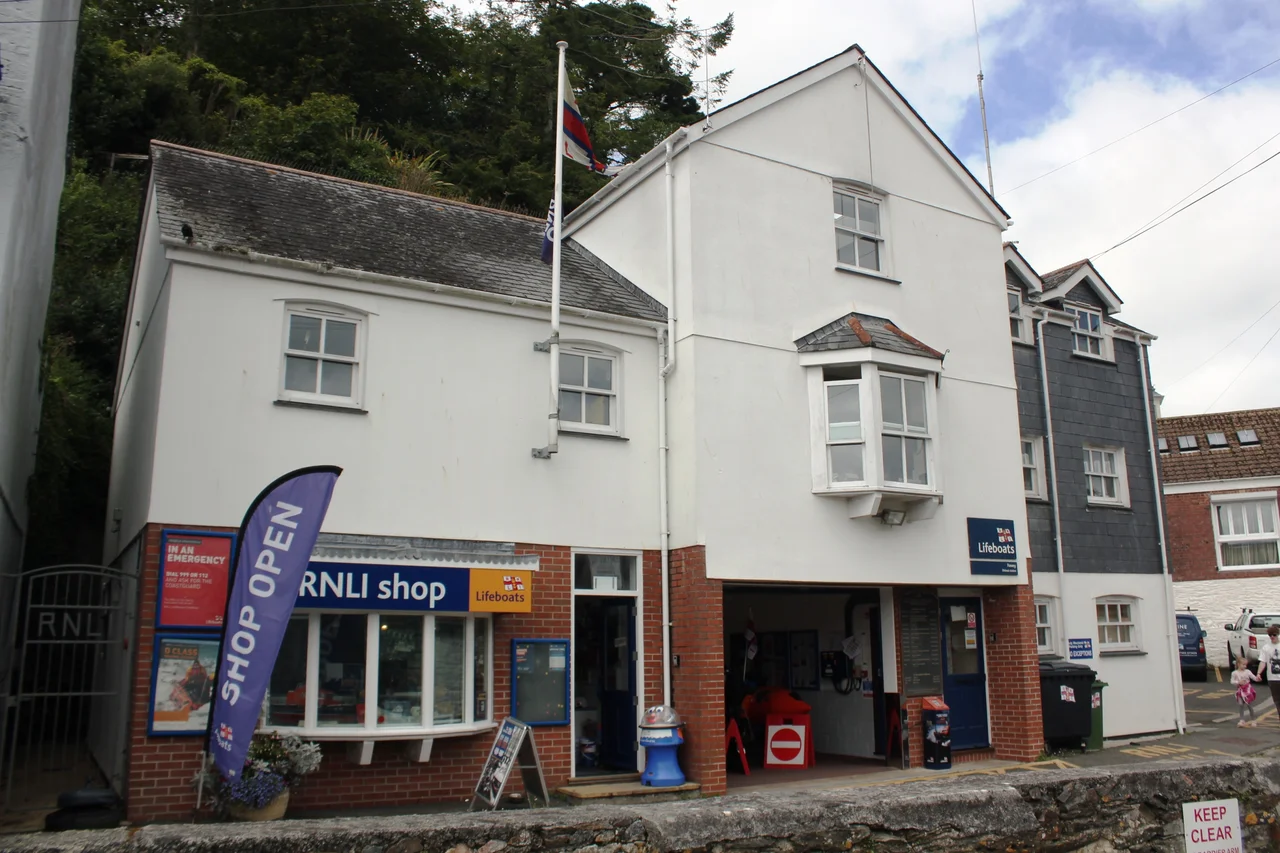
Fowey Lifeboat Station
On 6 May 1856, a ship foundered on Gribben Head between Fowey and St Austell Bay, and people died. William Rashleigh, the local landowner, sat down and wrote a cheque. Fifty pounds towards a lifeboat for Fowey, plus land and building stone for a boathouse. The Royal National Lifeboat Institution accepted. Three years later the first lifeboat arrived at Lostwithiel railway station, was rowed down the river through Fowey and around St Austell Bay to show the public, and was set to work at Polkerris, a fishing village on the eastern shore of the bay. They named her Catherine Rashleigh, after William's wife, who had also given heavily towards the cost. The first launch happened in 1859. Lifeboats have been launching from this stretch of coast ever since.
Polkerris and the Six-Oared Boat
The mouth of the River Fowey faces directly south. When the wind blows hard from that quarter, a sailing-and-rowing lifeboat cannot get out of the harbour against the seas. So the first station was placed at Polkerris, on the more sheltered eastern side of St Austell Bay. The boathouse cost 138 pounds and four shillings, on land Rashleigh donated. The first six-oared boat was replaced in 1866 by a ten-oared craft, Rochdale and Catherine Rashleigh, and the boathouse had to be altered to fit her. The official name kept changing: Fowey, then Polkerris from 1892, then Polkerris and Fowey from 1895, then back to Polkerris in 1904. In November 1865 the Catherine Rashleigh put to sea in a gale to reach two grounded ships near Par. She lost four oars on the way. Coxswain Joshua Heath got the crews ashore over five hours of rowing, returning twice through breaking seas, and the RNLI awarded him a silver medal. Polkerris closed in 1922 when the RNLI moved to motor boats. The old boathouse is a cafe now.
C.D.E.C. and the Motor Age
Fowey itself finally got its own lifeboat in 1922, though the first boat there was still a pulling-and-sailing twelve-oared craft. The first motor lifeboat arrived in August 1928, a temporary loan from Thurso, until Fowey's own boat C.D.E.C. came on station on 6 December that year. C.D.E.C. carried two 40-bhp engines, did eight knots flat out, and could range 78 nautical miles from her moorings. Over twenty-six years she launched 65 times and saved 49 lives. Her replacement in 1954, Deneys Reitz, spent her entire twenty-six-year career at Fowey, launching 155 times and saving 36 lives. A succession of relief boats followed in the early 1980s, including Guy and Clare Hunter, whose stay was cut short when she was suddenly transferred to Penlee to replace the Solomon Browne. Penlee had lost its entire crew in the Penlee lifeboat disaster of December 1981. The Cornish lifeboat service operated as a single fabric; when one piece tore, the others moved to cover the gap.
The Killyvarder Rescue
Before dawn on 23 March 1947 distress signals were reported near Par Sands. The relief lifeboat The Brothers set out from Fowey at 4:40 in the morning. An hour of searching through rain-swept heavy seas brought her to a sunken ship near Killyvarder Rock, with the crew gathered on the only part of their ship still above water. The tide was rising. The lifeboat could not come alongside in the breaking seas, so the crew had to haul the survivors across on ropes through the sea itself. Coxswain John Watters received a bronze medal. The list of honours at Polkerris and Fowey across the decades runs to coastguards, merchant seamen, coxswains and mechanics: gold medals from the original RNIPLS in 1826 and 1829, silver medals in the dozens, bronze medals, framed letters of thanks. The men and women of the RNLI never expected any of it; the lifeboat institution has been a volunteer service throughout its history, with the crews going to sea because someone else was already there and could not get home.
The Brede, the Trent, and a Triple Ceremony
On 16 October 1982 a new kind of boat went on station at Fowey: Leonore Chilcott, the first Brede-class lifeboat ever put into service. The Bredes were intermediate boats, not capable of operating in storms over Force 8, but doing twenty knots in moderate weather with a range of 140 nautical miles. She served five years. Then on 4 October 1997 Fowey held a triple ceremony: opening a brand-new purpose-built lifeboat station at Berrill's Yard, and christening two new lifeboats at once, the Trent-class all-weather boat Maurice and Joyce Hardy and the D-class inflatable Olive Herbert. The Trent could reach 35 knots and operate up to 2.5 hours from her moorings. She served almost three decades at Fowey before being withdrawn in August 2025 and replaced by an inshore boat, the change reflecting how rescue work has shifted toward smaller craft for coastal incidents.
Volunteers and the Channel
The RNLI's aim is to reach any casualty within 50 nautical miles of any station, in any condition, within two hours in good weather. Fowey covers its stretch alongside its neighbours: Looe to the east with an inshore boat, Plymouth to the east with both inshore and all-weather, Falmouth to the west with both. The crews are volunteers. They live in the town and work day jobs, drop everything when the pager sounds, and pull on the orange immersion suits in winter cold. The three-storey station built in 1997 sits in Passage Street, blending in among the older buildings of Fowey with its gabled central section, its small bow window on the first floor, the RNLI shop on the left wing. The shop helps fund the boats. The donations from William Rashleigh's first cheque to the latest visitor's pound coin have never stopped coming. Neither have the calls.
From the Air
Fowey Lifeboat Station sits at 50.34 degrees north, 4.63 degrees west, on the western bank of the Fowey estuary in the heart of the town. The harbour entrance is clearly visible from altitude, opening south to the English Channel between the headlands. Polkerris and Gribben Head lie three nautical miles west across St Austell Bay. Newquay Airport (EGHQ) is fifteen nautical miles northwest; Exeter (EGTE) seventy nautical miles northeast. The Channel approaches here see heavy commercial traffic and tricky weather; best viewing on a clear day when the geography of the estuary mouth and the surrounding cliffs is most visible.
Nearby Stories
- Mount Edgcumbe Country Park 2.6 km away
- Tintagel 4.2 km away
- Wheal Trewavas 6.1 km away
- Tehidy Country Park 14 km away
- Battle of Plymouth (1652) 15 km away
- Okehampton Castle 19 km away
- Goonhilly Satellite Earth Station 32 km away
- Action of 17 November 1917 101 km away