.jpg)
Wheal Trewavas
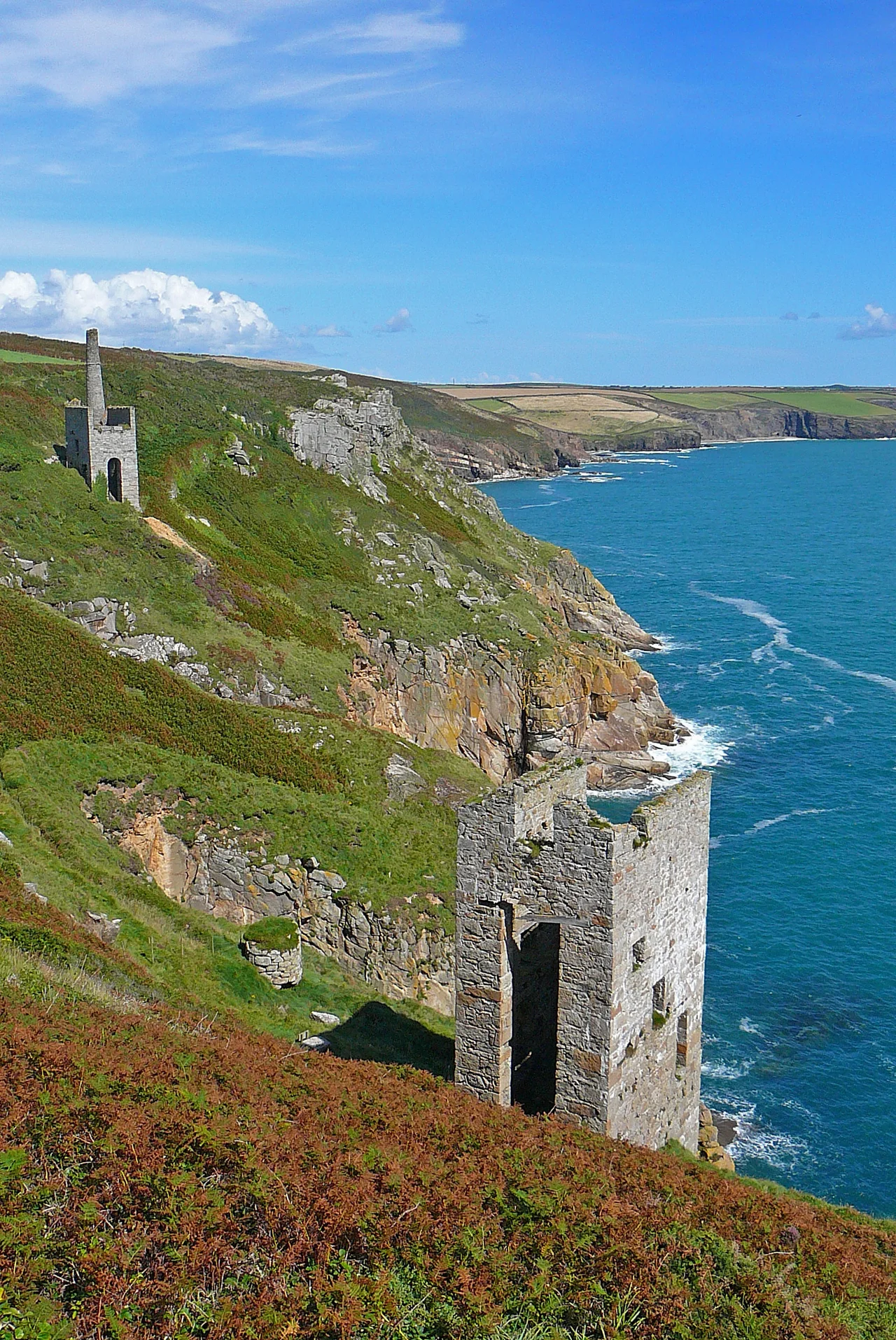
Walk west from Porthleven harbour on the South West Coast Path and after a mile and a half of cliff and gorse, you come on them suddenly: two ruined engine houses standing on the very edge of Mount's Bay, with the sea four hundred feet below and the working ground falling away into thin air. Wheal Trewavas operated for only twelve years - from about 1834 to 1846 - and brought up seventeen thousand five hundred long tons of copper before it stopped. The shafts ran out under the seabed. The miners worked, every shift, below the waves of the Atlantic. What is left today are the chimneys and engine houses of Old Engine Shaft and New Engine Shaft, both Grade II listed, both standing on cliffs that have been quietly trying to take them back into the sea for the better part of two hundred years.
Twelve Years of Copper
The mine exploited four copper lodes running south-east along the coastline, into the cliff and out beneath the seabed of Mount's Bay. About 160 men were employed at its peak - a small operation by Cornish standards, but well placed on geology that paid. The output figure of 17,500 long tons across just twelve years tells you that Wheal Trewavas was a productive venture, not a speculative failure. Cornish copper, like Cornish tin, fed the industrial revolution that the county itself had pioneered. The ore came up, was crushed and dressed on platforms above the cliffs, and went by road to the smelters at Hayle or Swansea. Then in 1846 the operation ended. The reasons were the usual Cornish ones - exhausted lodes, falling prices, water that the pumps could not handle, the capital moving on to mines elsewhere - but the abruptness is striking. After 1846 nobody worked here again.
Old Engine Shaft
The engine house and chimney of Old Engine Shaft are situated on the cliffside, twenty metres above the sea and forty metres from the clifftop. To reach them you scramble down a steep grass slope from the coast path; the engine house perches on a narrow shelf above a vertical drop, the chimney standing separately a few yards away. Beside the engine house is a capstan platform - the level area where, during the operation of the mine, a manually operated capstan was used to lower equipment down the shaft. Imagine that work. The capstan turned by men putting their backs against bars, on a platform with no railing, hauling Cornish boilers and pump rods up and down a shaft sunk through the cliff face and on under the seabed. The chimney here was rebuilt around 1840 to replace an earlier one - a small detail that hints at how exposed the masonry was to weather coming straight off the Atlantic.
New Engine Shaft
A short distance further east along the coast stands the second pair of ruins - the engine house and separate chimney of New Engine Shaft, near the top of the cliff rather than on its face. Both are Grade II listed. The shaft they served went deeper than the first and pushed the workings further out beneath the bay. Cornish engine houses are easy to read once you know what to look for. The tall, rectangular tower held a Cornish beam engine - a vertical steam cylinder under the roof, a great cast-iron rocking beam projecting through a thick wall at the top, and a pump rod descending into the shaft through a wooden head-frame outside. The chimney stood separately so its draft would not interfere with the engine. Both engine and chimney were tied together by a maze of flat-rod linkages and connecting structures that have long since rotted or rusted away. What remains is the bones.
A World Heritage Coast
Wheal Trewavas is a Scheduled Monument and forms part of the Cornwall and West Devon Mining Landscape inscribed by UNESCO as a World Heritage Site in 2006. The inscription recognises that Cornwall, between roughly 1700 and 1914, was the most technologically advanced mining region on Earth - the place where deep mining, steam pumping, and ore dressing reached an industrial scale and from where Cornish know-how spread out to copper and tin and gold camps in Mexico, South Australia, South Africa, and the western United States. "Cousin Jack" mining engineers and "Cousin Jenny" women, leaving Cornish villages, taught the rest of the world how to dig deep and pump dry. The two ruins on the cliff at Trewavas are part of that story - a small operation, productive while it lasted, beautifully placed, and now consumed by the slow argument between Atlantic weather and Victorian masonry. Walk the coast path here in winter and the spray reaches the chimneys.
From the Air
Wheal Trewavas stands on the cliffs at 50.09 N, 5.36 W, about 1.5 nm west of Porthleven harbour and just east of Trewavas Head on the western shore of Mount's Bay. Land's End airfield (EGHC) is 16 nm to the west; Newquay (EGHQ) is 21 nm to the north. RNAS Culdrose is 5 nm to the east. From 2,500 feet the two engine houses are visible as a pair of rectangular ruins on the cliff edge, with the chimney stacks distinctive against the green hinterland of small fields. Look for them between the harbour wall of Porthleven (immediately east) and Trewavas Head (immediately west). The South West Coast Path threads past both ruins. The same flight can take in Wheal Prosper at Rinsey Head, a similar engine house 1.5 nm to the west. Atlantic weather and Mount's Bay's notorious onshore gales can make low-level photography work difficult in winter.
Nearby Stories
- Seven Stones Reef 7.8 km away
- Lost Gardens of Heligan 8 km away
- Great Wheal Charlotte 15 km away
- SS Georgia (1890) 21 km away
- Caerhays Castle 26 km away
- SS Irma (1905) 34 km away
- 1979 Fastnet Race 77 km away
- HMS Affray 101 km away