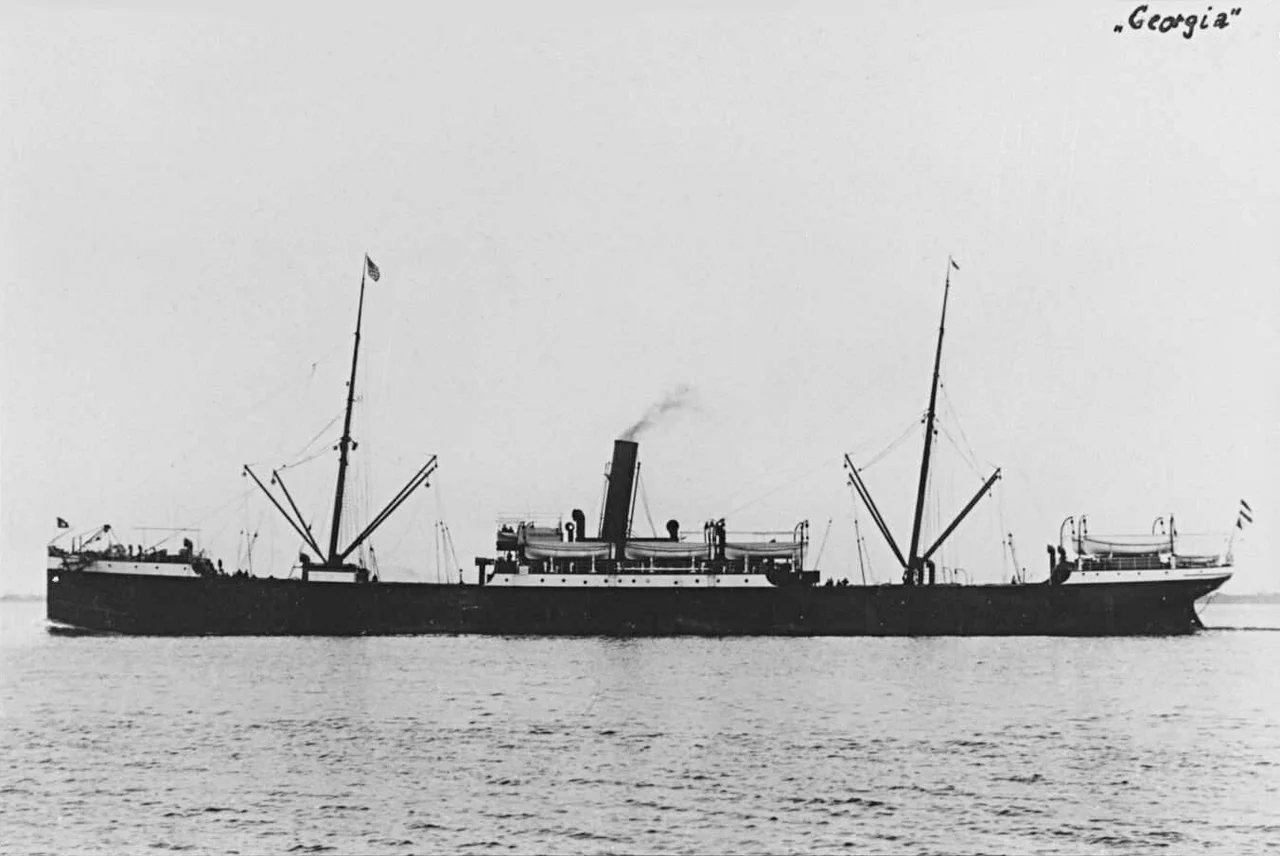

SS Georgia (1890)
There is something almost ordinary about the way she ended. No torpedo fired in fury. No screaming alarms. Just two warning shots fired at 250 yards' range, a courteous request for the captain to bring his papers across to the U-boat for inspection, and an apologetic German commander who said: 'You are carrying foodstuffs to an enemy of my country, and though I am sorry, it is my duty to sink you.' The ship was the SS Housatonic, lately the SS Georgia, originally the SS Pickhuben. The U-boat was U-53. The date was 3 February 1917, and the place was about twenty nautical miles southwest of Bishop Rock, off the Isles of Scilly. By the time the war was finished with her, Pickhuben/Georgia/Housatonic had carried Jewish refugees from the Russian Empire, the German exhibits for the World's Columbian Exposition, Australian wool, and finally the wheat that helped to push the United States into the First World War.
Five Hamburg Streets
Between July 1890 and January 1891, the Hamburg shipping line DR Hansa expanded its fleet with five new cargo ships, ordered from four different builders. Charles Connell of Glasgow built two of them, named Grimm and Stubbenhuk. Blohm+Voss in Hamburg built Baumwall. Joh. C. Tecklenborg in Bremerhaven built Wandrahm. And Barclay, Curle & Co of Glasgow built the fifth, named Pickhuben. All five names were Hamburg streets. The five ships were similar but not identical - all two-masted, three-castle vessels of similar size. Pickhuben was launched on 14 November 1890 with berths for 630 passengers: ten in first class and 620 in third. Her single screw was driven by a three-cylinder triple-expansion engine giving her a speed of 11 knots. She left Hamburg on 15 April 1891 on her maiden voyage, bound for Quebec and Montreal. That summer she sailed via Antwerp carrying mostly Jewish refugees fleeing the pogroms and repression of the Russian Empire - the great westward wave of emigration that would reshape New York and the cities of the American Midwest. On 4 July 1891 she passed the burning wreck of the British barque Octavia from South Shields. No crew remained aboard; her boats were gone. Pickhuben kept a lookout for survivors. She found none.
Australia, the Exposition, and a Rescue
Late in 1891 she was chartered to carry passengers and 4,500 tons of general cargo to Melbourne and Sydney, reaching the latter just before Christmas. She returned to Hamburg carrying 6,876 bales of wool. In March 1892 the larger HAPAG line took over DR Hansa, and in 1895 renamed Pickhuben to Georgia after the American state - the first of two HAPAG ships to bear the name. But before the renaming, in 1893, she had made what was perhaps her most photographed voyage: bringing the German Government's exhibits to Baltimore for the World's Columbian Exposition in Chicago. The cargo included a railroad coach; exhibits from Saxon woollen mills; electrical products; books; and a gallery of artworks, including pictures, bronzes, and statues. In 1894 she sailed for Australia again, and en route - about 80 nautical miles from Cape Town - she found the British sailing ship Abbie S. Hart flying a distress signal. The crew was almost all ill, the Second Officer had died, and Pickhuben towed her to safety in Cape Town. After 1895, sailing as Georgia, she worked routes that read like a tour of European emigration: Stettin via Sweden and Norway to New York; Genoa and Naples to New York; Odessa via Istanbul, Smyrna and Piraeus to New York. Each voyage carried Europeans across the Atlantic, the ship's third-class accommodations packed with the men and women who would build twentieth-century America.
Refuge, Resale, Renaming
When the First World War began in August 1914, Georgia was caught on the wrong side of the new front lines and took refuge in New Orleans. The neutral United States kept the ship safe while German vessels in foreign ports became prisoners of their own neutrality. On 16 April 1915 she was sold to the Housatonic Steamship Corporation for $85,000 and renamed - one last time - Housatonic, registered in New York under official number 213094. A British company chartered her for 'the term of the present war'. She was now a humble grain ship, the Saxon artworks long forgotten in the hold. On 6 January 1917 Housatonic left Galveston, Texas, carrying 144,200 bushels of wheat. She called at Newport News, Virginia, and on 16 January steamed east for Liverpool. On 31 January Germany announced an exclusion zone around the coasts of the Entente Powers - unrestricted submarine warfare. Neutral ships, the announcement said, 'do so at their own risk'.
The Polite Sinking
At 10:30 on the morning of 3 February 1917, U-53 - commanded by Hans Rose - intercepted Housatonic about twenty nautical miles southwest of Bishop Rock. Rose fired two warning shots and forced the ship to heave to. He summoned Captain Thomas Ensor aboard with his papers. He examined them. 'I find that the vessel is laden with grain for London,' Rose told Ensor. 'It is my duty to sink her.' Ensor protested. Rose answered: 'You are carrying foodstuffs to an enemy of my country, and though I am sorry, it is my duty to sink you.' A boarding party planted explosives below decks. All 37 of Housatonic's crew got off in two lifeboats - Ensor commanded one, his Chief Officer the other. Rose, in a gesture of old-world courtesy that the war was already making rare, towed the lifeboats toward land. After about two hours the Royal Navy trawler HMAT Salvator appeared on the horizon and took the men aboard. No American lives were lost on Housatonic. But the sinking of an American-flagged ship by a German U-boat in February 1917 was a constitutional shock. Six weeks later, after three more US ships had been sunk with significant American casualties, President Wilson asked Congress to declare war. On 6 April 1917, Congress did. In 1926, the Housatonic Steamship Company sued the Government of Germany for $839,600 in damages. The American-German Claims Commission awarded $4,500 plus five percent annual interest. A ship that had carried emigrants, wool, art, and wheat across the Atlantic for twenty-six years - and a war that her death helped to start - had collapsed, finally, into a footnote and a settlement.
From the Air
Wreck site at 49.58°N, 6.13°W, about 20 nautical miles southwest of Bishop Rock in the western approaches to the English Channel. Bishop Rock lighthouse on its tall granite needle stands on the western edge of the Isles of Scilly. Nearest airport is St Mary's (EGHE), about 17 nm to the northeast. Land's End (EGHC) lies roughly 38 nm east on the Cornish mainland. Recommended viewing altitude 3,000-5,000 ft AGL over open water. This is the deep-water gateway between the Atlantic and the Channel - the same shipping lane that has carried generations of liners, freighters, and refugees, and where, in February 1917, one polite torpedo helped to bring America into the war.
Nearby Stories
- British Airways Helicopters Flight 5918 6.9 km away
- HMS Brisk (1851) 12 km away
- Tater Du Lighthouse 15 km away
- Battle off Lizard Point 35 km away
- 1979 Fastnet Race 73 km away
- SM U-27 128 km away
- Channel Islands 238 km away
- Tower of Hercules 681 km away