.jpg)
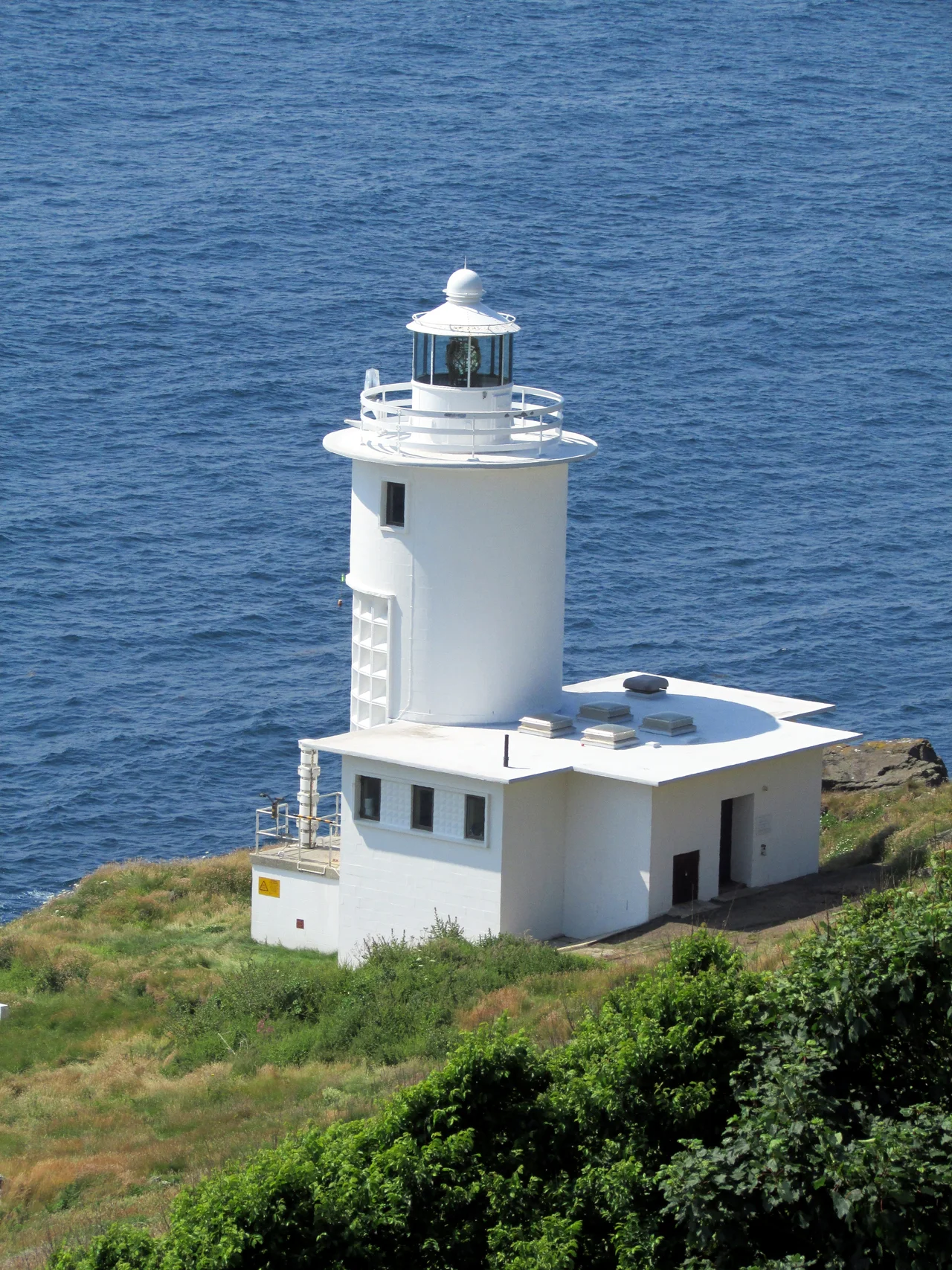
Tater Du Lighthouse
Cornwall has lighthouses older than the union of England and Scotland - Lizard, Longships, Wolf Rock, the Eddystone offshore - all of them built in answer to wrecks that had already happened. Tater Du is the youngest of them, first lit in July 1965, and it joined the chain only because a small Spanish coaster called the Juan Ferrer broke up on Boscawen Point in the dark on 23 October 1963 and eleven of her crew drowned. The Newlyn and Mousehole Fishermen's Association went to Trinity House and made the case that what had happened to the Juan Ferrer could happen again, and they were right. The squat white concrete tower below the headland east of Lamorna is the only lighthouse in Cornwall built within living memory, and it exists because eleven Spaniards did not come home.
The Juan Ferrer
The Juan Ferrer was a coastal trading vessel - a small workhorse type of ship that carried mixed cargo around the western European coasts in the 1950s and 1960s. On 23 October 1963 she came in too close to the cliffs at Boscawen Point in conditions she could not survive. The vessel capsized. Eleven men died. The rocks here are tooth-shaped serpentine and pillow lava, set at the foot of cliffs that hide them from inshore navigators in the dark or fog or driving rain that frequently arrives unannounced on this coast. The fishing community in Newlyn and Mousehole knew the water and the geology, and they knew that the loss of the Juan Ferrer was a structural problem, not a freak accident. The next ship to make the same mistake would meet the same rocks. They pushed Trinity House to act, and Trinity House did. Built with concrete blocks rather than the traditional cut stone of older lighthouses, Tater Du was a quick, modern, no-nonsense answer to a known hazard.
Seventy-Two Voices
The original fog signal at Tater Du was strange to look at and stranger to hear. Seventy-two Tannoy speaker units were built directly into the tower, powered by an alternator coupled to a two-cylinder Ruston diesel engine. When fog rolled in, the lighthouse spoke through its ring of loudspeakers in a great electronic call. Older fog signals had used compressed air through diaphones - the deep moaning notes that defined the soundscape of every working lighthouse coast in the early twentieth century. The Tannoy array at Tater Du belonged to a different era. It was eventually replaced by a single short-range Pharos Marine Omnidirectional emitter, which now sounds the same characteristic pattern - two one-second blasts every thirty seconds - whenever fog reduces visibility. The lighthouse itself was modernised in 1997 and is now monitored remotely from the Trinity House Planning Centre at Harwich, more than three hundred miles away on the Essex coast.
Variscan Cliffs
The cliffs and coastal slope around Tater Du have been a Site of Special Scientific Interest since 1992, notified for the geological record they preserve of South-West England during the Variscan orogeny - the mountain-building event around 300 million years ago that produced the granite that underlies Cornwall. The site is also a Geological Conservation Review location for one specific feature: pillow lavas, the rounded basalt formations that erupt underwater and cool into characteristic bulbous shapes, here exposed in the cliffs. Geologists come to read the rock as a textbook of how Europe assembled itself. Divers come for a different reason. Just offshore, the Inner and Outer Bucks rocks make one of the most popular sub-aqua sites in Cornwall - clear water, dense kelp, the wreckage of the Juan Ferrer and other older losses scattered on the seabed. The nearest place to launch a dive boat is Penzance, since Lamorna Cove around the corner does not permit launches.
The Coast Path
Tater Du is reached on foot, by a steep access road that drops down from the cliff-top to the lighthouse compound. The South West Coast Path runs along the cliffs above. From the path, the lighthouse looks toy-like - a small white tower clinging to a green slope above dark rocks and pale water, with seabirds circling between the lantern and the sea. It does not project the heroic loneliness of the more famous Cornish lights, no offshore reef, no wave-smashed pillar. But every nautical mile of coast it covers was the missing link in a chain of warnings that left the Juan Ferrer's master with nothing to mark Boscawen Point on a black October night. The lighthouse turned sixty in 2025. Three nautical miles north, on a stretch of the same coast, the Penlee Lifeboat slipway stands empty as a memorial. Cornwall's coast keeps its lessons close together.
From the Air
Tater Du Lighthouse sits at 50.05 N, 5.58 W on the western shore of Mount's Bay, about 0.5 nm east of Lamorna Cove and 4 nm south-west of Penzance. The tower is small (49 feet tall) but the white concrete stands out against the dark serpentine cliffs and rough green grass. Land's End airfield (EGHC) is 5 nm to the west; Newquay (EGHQ) is 27 nm to the north. RNAS Culdrose is 10 nm to the east. From 2,500 feet you can see the lighthouse plus the nearby Boscawen Point - the site of the 1963 wreck - and pick out the Inner and Outer Bucks rocks just offshore. Penlee Point and its preserved boathouse memorial lie 2 nm to the north-east. Weather in this western corner of Cornwall can change in minutes; fog rolls in below cliff-top height in spring and early autumn.
Nearby Stories
- Seven Stones Reef 7.8 km away
- Lost Gardens of Heligan 8 km away
- Great Wheal Charlotte 15 km away
- SS Georgia (1890) 21 km away
- Caerhays Castle 26 km away
- SS Irma (1905) 34 km away
- 1979 Fastnet Race 77 km away
- HMS Affray 101 km away