
Lost Gardens of Heligan
On a wet afternoon in 1990, three men pushed through chest-deep brambles into a brick-walled enclosure on a Cornish estate. Inside they found a small room with a wooden door, an old privy used by the estate's outdoor gardeners. On its lime-washed wall, scratched in pencil, were names and a date: August 1914. The gardeners had signed off as they left for war. Most of them never came home, and after they died, no one tended the rhododendrons or repaired the ram pump or watered the pineapple pit. Brambles climbed over the lakes. Sycamores self-sowed into ornamental beds. The gardens vanished. They lay buried for seventy-six years before Tim Smit, John Willis, and John Nelson came looking. What they uncovered would become one of the most beloved gardens in Britain.
Four Squires of Heligan
The gardens at Heligan were the work of four Tremayne squires across nearly two centuries. The Reverend Henry Hawkins Tremayne began laying them out from the mid-eighteenth century: shelter belts, ornamental walks, the bones of the Northern Gardens. An estate plan from 1777 still shows the site of the future ornamental gardens as plain field. A plan from before 1810 shows the shelter belts in place and the Northern Gardens beginning to take their shape. Henry Hawkins's son John Hearle Tremayne added more. His grandson John Tremayne, who lived from 1825 to 1901, hybridised rhododendrons on the estate and planted them around the open space called Flora's Green, where the colossal flowers still rise above visitors today. The fourth squire, John Claude Lewis Tremayne, known as Jack, created the Italian garden in the early twentieth century. Across these four lifetimes the gardens grew into an extraordinary patchwork: productive vegetable and flower gardens, lakes fed by a ram pump installed around 1900, a wild subtropical valley called the Jungle full of tree ferns, an Italian garden with formal pools and statues, and Europe's only surviving pineapple pit, where rotting horse manure provided the bottom heat to ripen pineapples in Cornish soil.
August 1914
Twenty-two outdoor gardeners worked at Heligan in 1914. Most of them signed up for Lord Kitchener's army that summer. Their names on the privy wall in the Thunder Box room are the only record of who they were, written before they left for training and then France. Most of those men died in the trenches. The Tremayne family, who had lived at Heligan for over four hundred years, left the house after the war. They let it out, the tenants could not keep up the work, and through the inter-war years and the Second World War the gardens slid into ruin. By the late 1940s the ram pump had stopped, the pineapple pit was empty, the rhododendrons on Flora's Green were growing wild, the Italian garden was hidden, the Jungle was reverting to ordinary Cornish woodland. In the 1970s the great house itself was carved up into flats and sold off in pieces. The gardens were officially considered lost.
Tim Smit and the Rediscovery
John Willis, a Tremayne descendant, took Tim Smit and John Nelson onto the estate in 1990. Smit had ended a career as a record producer and was casting around for a project; Nelson was a builder. The three men found brick walls under ivy, the ram pump under brambles, and the door of the Thunder Box room with the names on the wall. Smit decided to restore the gardens. Volunteers helped clear them, the ram pump was rebuilt, the pineapple pit was restored to working order. Channel 4 sent producers to film the restoration as a six-part series in 1996, with Vivianne Howard directing and Barbara Flynn narrating. The series captivated British viewers and turned the gardens into one of the country's leading attractions. Smit went on to conceive the Eden Project five miles up the road, where geodesic domes rose in another worked-out clay pit. The Lost Gardens stayed in private hands, leased by a company owned by their restorers, who continue to cultivate them.
The Mud Maid and the Giant
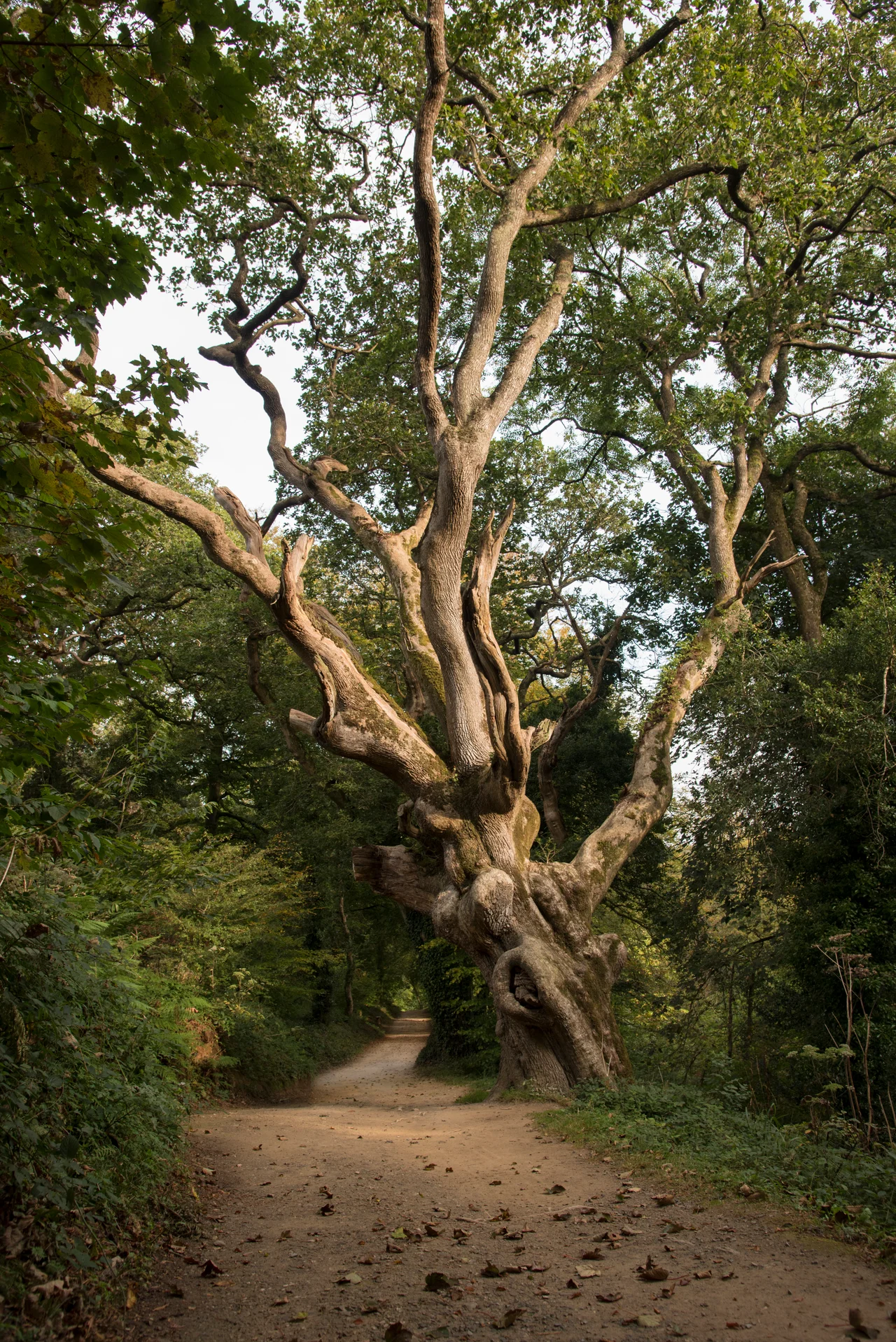
Two figures sleep among the trees. The Mud Maid lies on her back in a clearing, eyes closed, her body shaped from earth and stone and covered with growing plants: her hair is ivy, her dress is moss, her face changes through the seasons as the planting shifts. The Giant's Head emerges from a hillside nearby, vast and stone-faced, his hair living ferns. Both are by the artists Sue Hill and Pete Hill, made in the 1990s as the gardens reopened, designed to age and weather with the estate. They become more themselves each year. Other restored features draw visitors back season after season: the Northern Summerhouse, the Georgian Ride, the apple arches in the vegetable garden, the charcoal kiln in the Lost Valley, the colossal Flora's Green rhododendrons in bloom each May, the Italian Garden, the Jungle's tree ferns rising through the morning mist. The gardens are listed Grade II on Historic England's Register of Parks and Gardens, a recognition of their landscape value.
What the Names on the Wall Mean
The Thunder Box room with the gardeners' names is the heart of the place. Other gardens have older history, finer art, more famous designs. Heligan has the brutal mathematics of a generation lost to a war and a place that grew over while they were dying. The names recall a Cornwall before mass tourism, when families spent their working lives on the land of other families, when twenty-two gardeners might tend a single estate, when the rhythm of the year was set by potato planting and rhododendron hybridising rather than visitor footfall. The restoration is not nostalgic. It is realistic about what was lost and what cannot come back. The men whose names are scratched on the privy wall are not coming home. The garden is. The pineapple pit yields fruit once again. The ram pump still throbs at the bottom of the valley, pushing water uphill the way it has for over a hundred and twenty years. Cornwall recovers slowly and incompletely, and the Lost Gardens of Heligan show what that recovery looks like when it is done well.
From the Air
The Lost Gardens of Heligan centre at 50.29 degrees north, 4.81 degrees west, about one and a half nautical miles northwest of the fishing village of Mevagissey and roughly six miles by road from St Austell. From altitude the gardens appear as a dense patch of mixed woodland in undulating valley country, cutting steeply toward the coast. Newquay Airport (EGHQ) lies fifteen nautical miles north-northwest. Exeter (EGTE) is eighty nautical miles east-northeast. The Eden Project sits five miles northeast. Best viewing in spring when rhododendrons and camellias are in flower, or on misty autumn mornings when the deep wooded valleys hold cloud below their treetops.
Nearby Stories
- Mount Edgcumbe Country Park 2.6 km away
- Tintagel 4.2 km away
- Wheal Trewavas 6.1 km away
- Tehidy Country Park 14 km away
- Battle of Plymouth (1652) 15 km away
- Okehampton Castle 19 km away
- Goonhilly Satellite Earth Station 32 km away
- Action of 17 November 1917 101 km away