
Mount Edgcumbe Country Park
On 27 December 1831, HMS Beagle weighed anchor in a quiet, deep-water cove tucked under the cliffs of a Cornish estate, raised her sails, and slipped out into the English Channel. Her captain was Robert FitzRoy. Her resident naturalist was a 22-year-old Charles Darwin, embarked on what would become the most consequential five-year voyage in the history of biology. The cove was Barn Pool, sheltered behind the Rame Peninsula on the western side of Plymouth Sound, and it belonged then as now to the Mount Edgcumbe estate. The Vikings had used the same anchorage in the year 997. Eight centuries later, a young man who would change the way humans understand themselves looked back at the formal gardens climbing the slopes above the water, then turned his eyes forward toward South America.
Henry VIII's Deer Still Roaming
In 1515, King Henry VIII granted Sir Piers Edgcumbe the right to empark deer on his land. The descendants of those Tudor fallow deer still roam freely across the Rame Peninsula today, more than five centuries later, browsing in the same copses their ancestors knew. They are not a managed herd in any conventional sense. They are wild, they go where they please, and they have done so without interruption since before Shakespeare was born. Around 1695 the Edgcumbes built a Deer Wall, a stone barrier with an outer ditch, to keep the herd out of the amphitheatre at the heart of the formal gardens. The wall is mostly still standing. The deer are still here. So is the family who first welcomed them, in the sense that their stately home, Mount Edgcumbe House itself, sits at the centre of the estate they have shaped for nearly five hundred years.
Follies Built from Sacred Stone
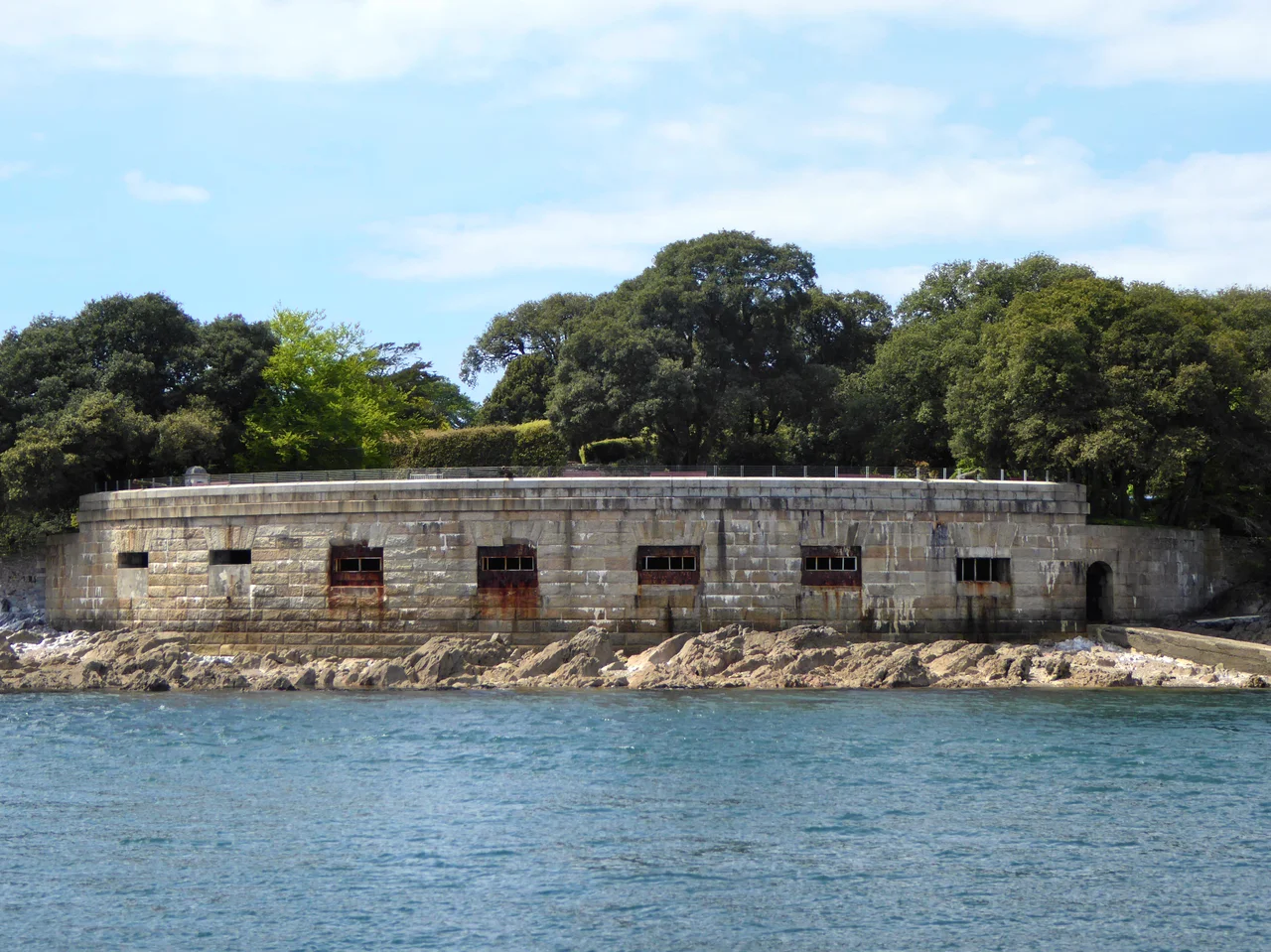
In 1747 the Edgcumbes built a folly on the highest point of the park, an artificial ruin designed to look pleasingly ancient from a distance. The stone they used was not new. It came from the demolished churches of St George and St Lawrence in Stonehouse, across the water in Plymouth, salvaged carvings and weathered ashlar repurposed as picturesque make-believe. A Picklecombe Fort Seat lower in the grounds was built from the same source, complete with a small niche and a piscina from the old sacristies. There is something both reverent and cavalier about it: the stone of demolished sanctuaries given a second life as garden ornament. The Folly replaced an earlier navigation obelisk, and from its summit you can see what the eighteenth-century Edgcumbes saw: the whole of Plymouth Sound spread out below, the breakwater, the dockyard, the city on its limestone shore.
A Garden in Four Languages
Between roughly 1750 and 1820, the Edgcumbe family created a sequence of formal gardens that read as a tour of European taste. There is an Italian Garden, with its Orangery built around 1760 and now serving as a fully licensed restaurant. There is an English Garden, a French Garden, and an Amphitheatre carved into the slopes. The New Zealand and American Gardens were added in 1989, and a Jubilee Garden opened in 2002 to mark Queen Elizabeth II's Golden Jubilee. Among the specimen trees stand mature giant sequoias, Sequoiadendron giganteum, lifted from the western slopes of the Sierra Nevada in California and somehow thriving in the soft Cornish damp. Beyond the formal precincts, 885 acres of country park spread across the Rame Peninsula in deliberately rough condition, walked by hikers following the South West Coast Path for its full nine miles through the property.
Milton's Temple and Queen Adelaide's Cave
Scattered through the grounds are small follies and pavilions, each with its own borrowed atmosphere. Milton's Temple is a circular temple built around 1755, its inscribed plaque carrying lines from Paradise Lost: "overhead up grew, insuperable heights of loftiest shade..." Thomson's Seat is a Doric pavilion from around 1760, looking across to Plymouth Sound, with verses from James Thomson's poem The Seasons cut into its walls. Queen Adelaide's Grotto began life in the eighteenth century as a watch house carved into a sea cave; in 1827 Queen Adelaide visited, and an arched stone building was added in her honour. The Zig-Zags, intricate paths along the dramatic cliff edge, were laid out in the 1760s and grew so famous in the nineteenth century that visitors called them "The Horrors." Some sections have been lost to cliff erosion. Eighteenth-century pleasure gardens were not, as it turns out, designed for permanence.
A Park That Belongs to Everyone
The 7th Earl of Mount Edgcumbe sold the estate jointly to Cornwall County Council and Plymouth City Council in 1971. The park and formal gardens have been free to enter ever since, open from 8 am till dusk every day of the year. The villages of Kingsand and Cawsand sit within the park's boundaries, with their painted cottages tumbling down to the small harbour where the Cornwall-Devon border once ran through one of the kitchen tables. The Cremyll Ferry, in continuous operation since around 1204, still carries foot passengers between the estate and Plymouth, the same crossing it has provided since King John was on the throne. A coastguard station crowns Rame Head, watching for ships in distress as it has done in one form or another for centuries. The deer, of course, take no notice of any of it. They simply roam, as they have always done.
From the Air
Mount Edgcumbe Country Park occupies the eastern end of the Rame Peninsula at 50.353 degrees north, 4.184 degrees west, directly across Plymouth Sound from the city of Plymouth. From the air, look for the long wooded peninsula extending east from Cornwall into the western side of the Sound, with the Italian Garden's geometric paths visible in the lower park near Cremyll and the small white folly crowning the highest point above the Tamar. Rame Head, with its medieval St Michael's Chapel and Iron Age earthworks, marks the peninsula's southwestern tip. Nearest controlled airport is Newquay (EGHQ), 38 miles west-northwest; Exeter (EGTE) is 50 miles east-northeast. The Plymouth Sound area is busy with naval and ferry traffic, and Devonport restricted airspace lies just to the north over the dockyard.
Nearby Stories
- Davidstow Circuit 3.7 km away
- Golden Hind 3.9 km away
- Powderham Castle 4.4 km away
- Fowey Lifeboat Station 5.1 km away
- Okehampton Castle 12 km away
- Battle of Plymouth (1652) 19 km away
- Goonhilly Satellite Earth Station 44 km away
- German Submarine U-672 73 km away