
HMS Brisk (1851)
She started her career carrying a colonial governor to Jamaica and ended it bankrupt in a London auction house, sold off as a failed telegraph experiment. Between those two scenes, HMS Brisk witnessed the eruption of a Kamchatka volcano, captured a slave clipper with more than 800 men, women and children locked in her holds, searched the Zambezi delta for the missing Dr. Livingstone, ferried British troops into the bloodiest phase of the New Zealand Wars, and was finally laid to rest in Woolwich. For a fourteen-gun wooden sloop, she lived a great deal.
From Drawing Board to White Sea
Brisk was ordered on 25 April 1847 from Woolwich Dockyard, designed by the Royal Navy's Committee of Reference as an enlarged version of HMS Rattler - the Royal Navy's first purpose-built screw-propelled warship. Her keel was laid in January 1849. She was originally meant to mount ten guns, but the outbreak of the Crimean War in 1854 prompted a hasty upgrade to fourteen 32-pounders. She launched on 2 June 1851, was completed for sea on 24 August 1853 at a cost of £47,482, and spent her first commission carrying the new governor to Port Royal, Jamaica. Then the war pulled her north. She joined Captain Sir Erasmus Ommanney's squadron in the White Sea, hunting Russian ships and bombarding the port of Kola on 24 August 1854. The next summer her squadron entered Petropavlovsk on the Kamchatka Peninsula, found the harbour abandoned, destroyed the batteries and magazines, and on 7 June 1855 watched the Kozelsky volcano erupt - a moment of geological theatre witnessed by men whose job that morning had been demolition.
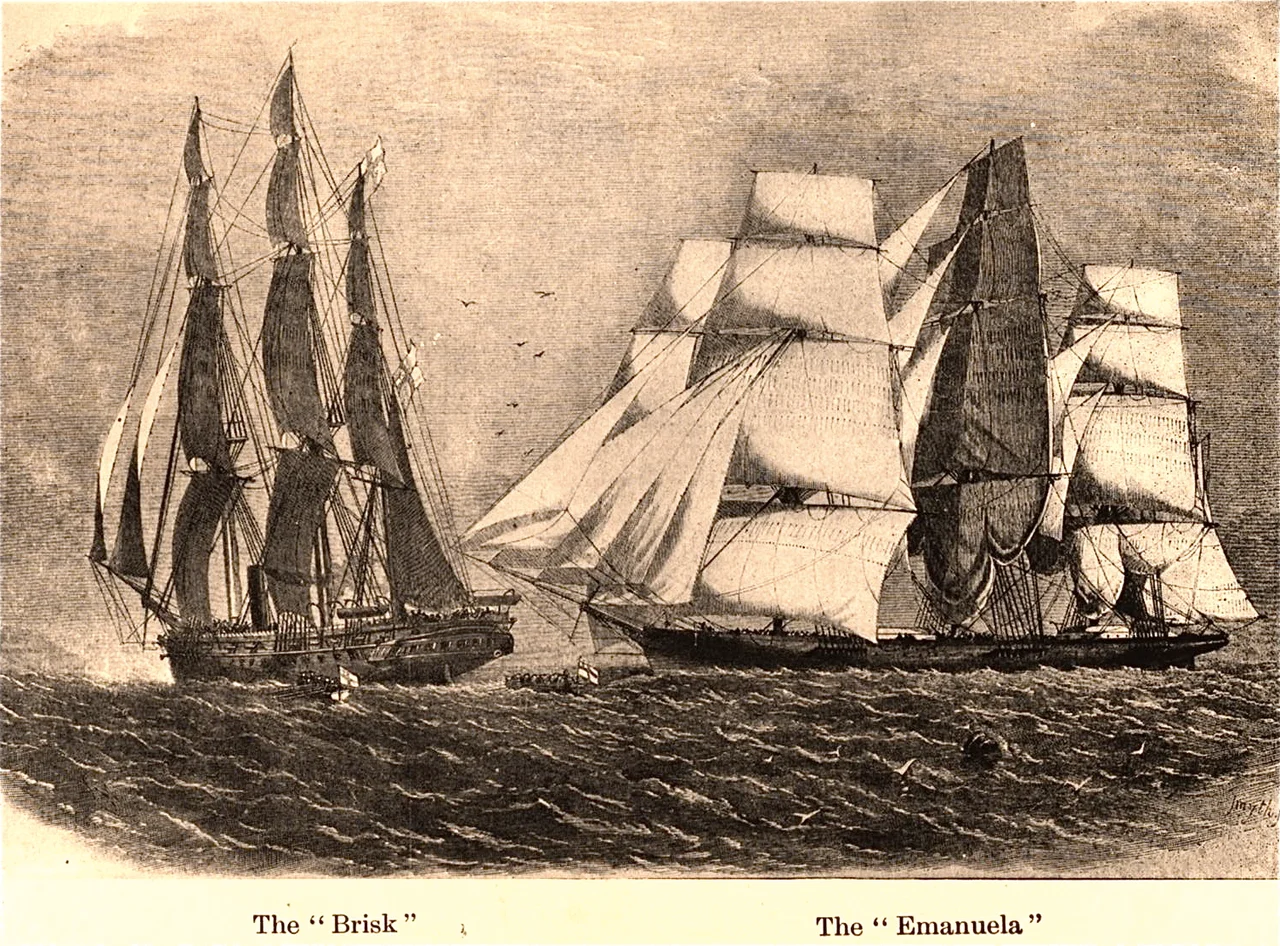
The Emanuela
After the Crimean War she went to Africa. The Royal Navy's West Africa Squadron, working under treaties signed across two generations, was intercepting ships that still carried enslaved Africans across the Atlantic decades after Britain had outlawed the trade. On 15 September 1859 Brisk searched the River Kongone in the Zambezi delta for the missing explorer David Livingstone. She did not find him - though she would two months later pick up survivors of the Barretto Junior, an expedition supply ship wrecked on Mayotte Reef. On 10 August 1860, in the Mozambique Channel, Brisk overhauled the clipper ship Emanuela. More than 800 enslaved people were aboard, packed into the holds. Brisk took the ship as a prize. Those 800 captives - men, women, children carried away from their homes in chains - were not statistics for some abstract ledger. They were people who, that morning, were the property of slavers and, that afternoon, were not. Decades after the Slave Trade Act, the patient, brutal work of the patrol was still going on, sloop by sloop, ship by ship.
The New Zealand Years
By 1865 Brisk was at the other end of the world. Sailing around the Cape of Good Hope, she reached Sydney on 15 January and was promptly ordered on to Auckland. The New Zealand Wars had entered a brutal phase, with British and colonial troops fighting Māori forces over land, sovereignty, and the meaning of the Treaty of Waitangi. Brisk's first assignment was to carry 300 to 400 men of the 2nd Battalion, 14th Regiment from Manukau down to Whanganui. She then ferried Governor Sir George Grey to Kawau. In May, hearing news from the Dauntless that the clipper Fiery Star had gone missing, she sailed for the Chatham Islands to search for survivors. None were found. In August she carried 300 soldiers of the 70th Regiment from Taranaki to Napier, and from there was drawn into the fighting around Ōpōtiki - a campaign on the eastern coast that left long, painful memories among iwi. In early 1866 she took soldiers of the 43rd Regiment to Taranaki. From 10 January to 3 May 1867 she carried Governor Grey on a tour of the South Island. Brisk Bay in Queensland is named for her.
The Last Idea
She left the Australia Station in September 1868 and was decommissioned on 19 January 1869. Then, on 31 January 1870, she was sold to a company with a curious name and a curiouser idea: the International Mid-channel Telegraph Company Ltd. Submarine telegraph cables were the new wonder of the age, but their cost was crushing. What if a moored ship could serve as a floating telegraph station instead - a halfway house in the Channel, signalling traffic back to shore by visual telegraph or relayed wire? Brisk was anchored southwest of Land's End and put to work. The experiment lasted two months. Cable breakages and seasickness amongst the signallers ended it in June 1870. By August the company was bankrupt, and Brisk was sold off in London by the liquidators. A ship that had survived volcanoes, war, slavers, and storms was undone by the unromantic combination of a snapped wire and a queasy operator. It is, somehow, an oddly fitting end.
From the Air
Brisk was moored as an experimental telegraph ship southwest of Land's End in 1870 - roughly the position recorded here at 49.33°N, 6.28°W, in the channel between Land's End and the Isles of Scilly. The position is approximately 12 nm west-southwest of Land's End (EGHC) and about 20 nm east-southeast of St Mary's (EGHE). Recommended viewing altitude 1,500-3,500 ft AGL over open water. Expect Atlantic swell, frequent low cloud, and rapid shifts in visibility - the same conditions that would have made keeping a small wooden sloop on station for telegraph work miserable. The ship herself is long gone; this is the seascape that broke the experiment.
Nearby Stories
- SS Georgia (1890) 2 km away
- Battle off Lizard Point 41 km away
- Battle at The Lizard 78 km away
- 1979 Fastnet Race 111 km away
- SM U-27 164 km away
- Mont Saint-Michel: The Abbey That Becomes an Island Twice a Day 304 km away
- 1955 Le Mans Disaster 484 km away
- Tower of Hercules 643 km away