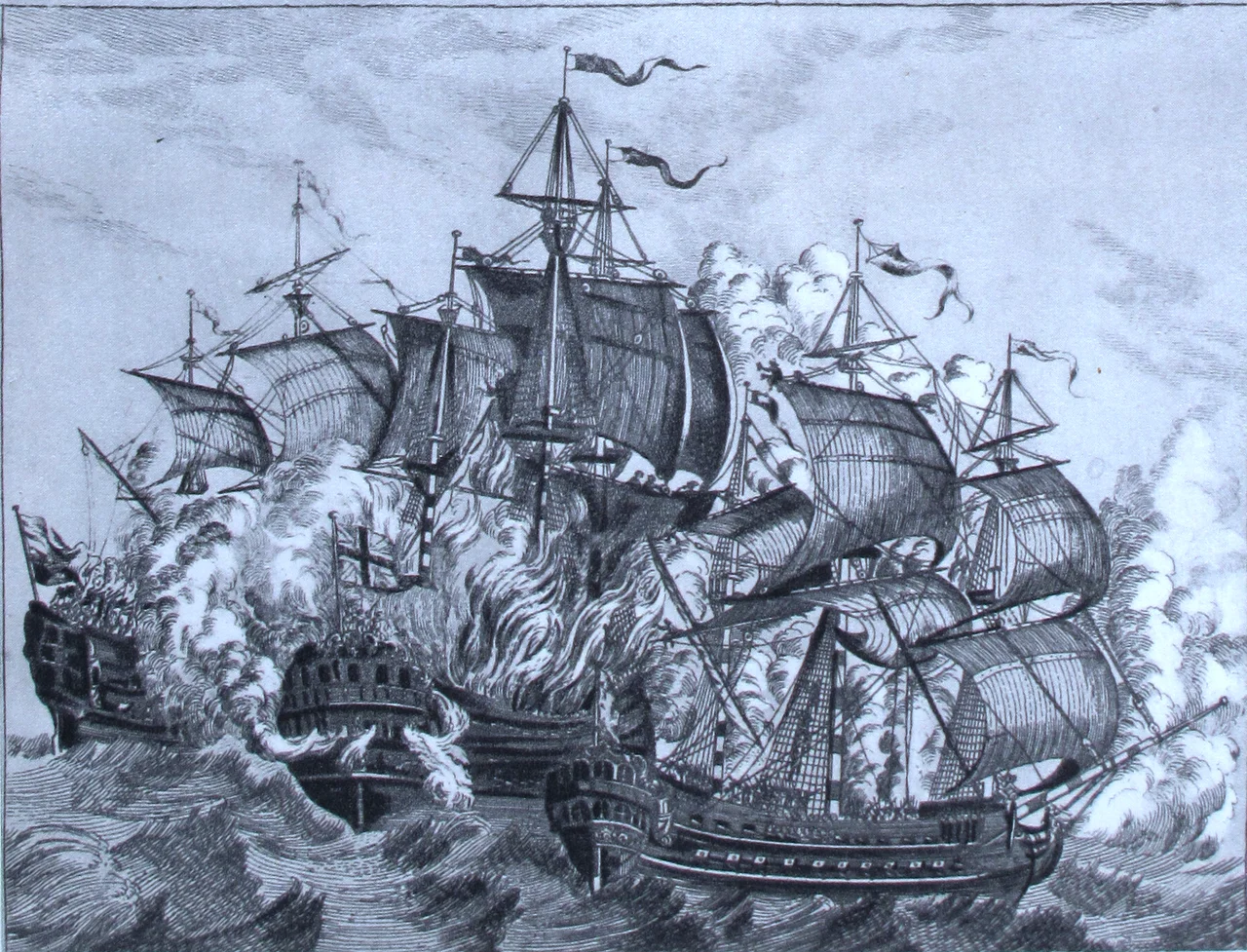

Battle at The Lizard
Three men climbed out of the water at Lizard Point that night. They were all who survived from the five hundred who had sailed in HMS Devonshire. The 80-gun third-rate had been one of five ships of the line escorting a British supply convoy from Plymouth to Portugal when two French squadrons fell on her off the south Cornish coast on the afternoon of 21 October 1707. Devonshire fought seven French ships at once for several hours, refused every chance to strike her colours, and finally caught fire and blew up. The flash and the report carried inland over the Lizard. The remaining merchantmen scattered. By dawn the French were sailing for Brest with their captures and the British Channel fleet was conducting an inquest into how it had lost an entire war's worth of supplies in a single afternoon.
Edwards's convoy
Commodore Richard Edwards sailed from Plymouth on 20 October 1707 with five ships of the line and a merchant convoy of somewhere between eighty and a hundred and thirty sail. The exact number was never recorded; the contemporary lists disagree by more than fifty ships. The destination was Portugal, and beyond Portugal the British armies fighting Louis XIV's grandson in the War of the Spanish Succession. The cargo was the usual mixed list of war supplies, troop reinforcements, cordage, salt provisions, and trade goods bound for the Iberian markets. The escort was Edwards's flag in the Cumberland, an 80-gun third-rate, supported by Devonshire of the same rate, Royal Oak, Chester, and Ruby. The arithmetic was generous on paper. It was less so the next morning.
Forbin and Duguay-Trouin
The French had been watching for a convoy of this size for weeks. Two squadrons of six ships each were waiting at sea: one under Claude de Forbin, the formal senior officer, the other under Rene Duguay-Trouin, of the corsair city of Saint-Malo, the more aggressive of the two. They were among the most successful French naval commanders of the era — Forbin a chevalier of long Mediterranean experience, Duguay-Trouin a Saint-Malo privateer who had spent twenty years burning English shipping and would four years later sack Rio de Janeiro itself. On the morning of 21 October Forbin's squadron spotted Edwards's convoy off Lizard Point. The combined French force was twelve ships of the line against five British. Duguay-Trouin, characteristically, led the attack.
The afternoon
The fight was not a fair one. Royal Oak slipped clear early and ran for Kinsale on the south coast of Ireland with a handful of merchantmen at her heels. Cumberland — Edwards's own flag — was taken. So was Chester. So was Ruby. The 80-gun Devonshire, captained by William Kerr, was left to fight on alone. Surrounded by seven French ships, she refused to strike. She fired for hours through the smoke. At some point — the precise sequence is contested in the contemporary accounts — a fire reached her magazine. She blew up. Three of her crew of approximately five hundred were pulled from the water. The French claimed sixty merchantmen captured out of eighty. The British accounts claimed almost none were taken. The probable truth, recorded by the French maritime historian Jean Polak, is fifteen merchantmen captured outright, with many more scattered and the convoy as a coherent force destroyed. Either way, Edwards's command was gone and so were Devonshire's people.
What it cost
The numbers, even at their most conservative, mark this as one of the heaviest blows the Royal Navy took in the war. Four ships of the line lost or captured in a single afternoon was a casualty rate the eighteenth-century British system was not designed to absorb. The supplies for the Iberian campaign had to be reassembled from scratch. The Channel patrolling pattern that had let two French squadrons of six ships each lie in wait undetected was overhauled in the months that followed. And the dispute over which French commander had won the bigger share of the victory — Forbin or Duguay-Trouin — ran for years in print, with each man publishing his own version. They quarrelled about it until both were old. Their argument was, in its way, the most enduring monument to the men who burned in Devonshire.
Lizard Point today
Lizard Point itself is a serrated headland of serpentine rock — the southernmost point of mainland Britain, the first piece of England a westbound ship reaches and the last piece of England an eastbound ship leaves behind. The lighthouse on the cliff has been guiding ships round the headland since 1751, although in 1707 there was only a system of beacons that the corsair captains, sailing with English Catholic pilots on board, knew at least as well as the Cornish themselves did. The wreck of HMS Devonshire has never been positively located. Somewhere out beyond the shipping lanes — twelve miles south-south-west of the Point, by the most careful contemporary reckoning — the remains of a 1692 ship of the line and the bones of approximately 497 men still lie under several hundred feet of cold water.
From the Air
The battle was fought south of Lizard Point at approximately 49.95 N, 5.21 W, in the open Atlantic 12 to 15 miles offshore. From the air, view Lizard Point itself from 1,500 to 2,500 feet for the lighthouse and the serpentine cliffs. Land's End (EGHC) lies 15 miles west; Newquay (EGHQ) is 30 miles north. The waters here are busy with Channel shipping; coastal weather is volatile, with frequent fog rolling in from the south-west.
Nearby Stories
- Logan Rock 3.6 km away
- Polperro 7.4 km away
- Great Wheal Charlotte 10 km away
- Battle of Plymouth (1652) 26 km away
- SS Irma (1905) 30 km away
- Black Swan Project 75 km away
- HMS Affray 77 km away
- 1979 Fastnet Race 100 km away