
Logan Rock
In April 1824, a Royal Navy lieutenant named Hugh Goldsmith brought ten or twelve of his crewmates ashore at Treen with crowbars and levers. They climbed up to the headland, set their backs against an eighty-ton granite boulder that had been balanced on a cliff edge for longer than anyone could remember, and pushed. The Logan Rock had rocked, gently and famously, at the touch of a child's hand for centuries. The Cornish antiquarian William Borlase had written in 1754 that no human force could move it from its position. Lieutenant Goldsmith was a nephew of the poet Oliver Goldsmith, and he had decided to disprove the claim. The villagers of Treen, whose tourism economy revolved around that single stone, were about to make him very sorry.
Men Omborth
Before the English began calling it a logan, the rock had a Cornish name: Men Omborth, the balanced stone, recorded in 1870 in the slightly mangled form Men Amber. The English word 'logan' is properly pronounced 'logg-un' and probably comes from a dialect verb meaning to rock. In parts of the country, rocking stones were called logging stones. Bray, writing on Dartmoor in 1832, noted the local expression 'to log the child's cradle'. Some have suggested a Norse origin, from the Danish logre, to wag the tail. The Cornish word leghen means a thin flat stone, and shares a root with legh, an old word for rickets, the bone disease that causes a sufferer to sway. The etymology of a stone, like the stone itself, refuses to settle in one place.
An Eighty-Ton Trick
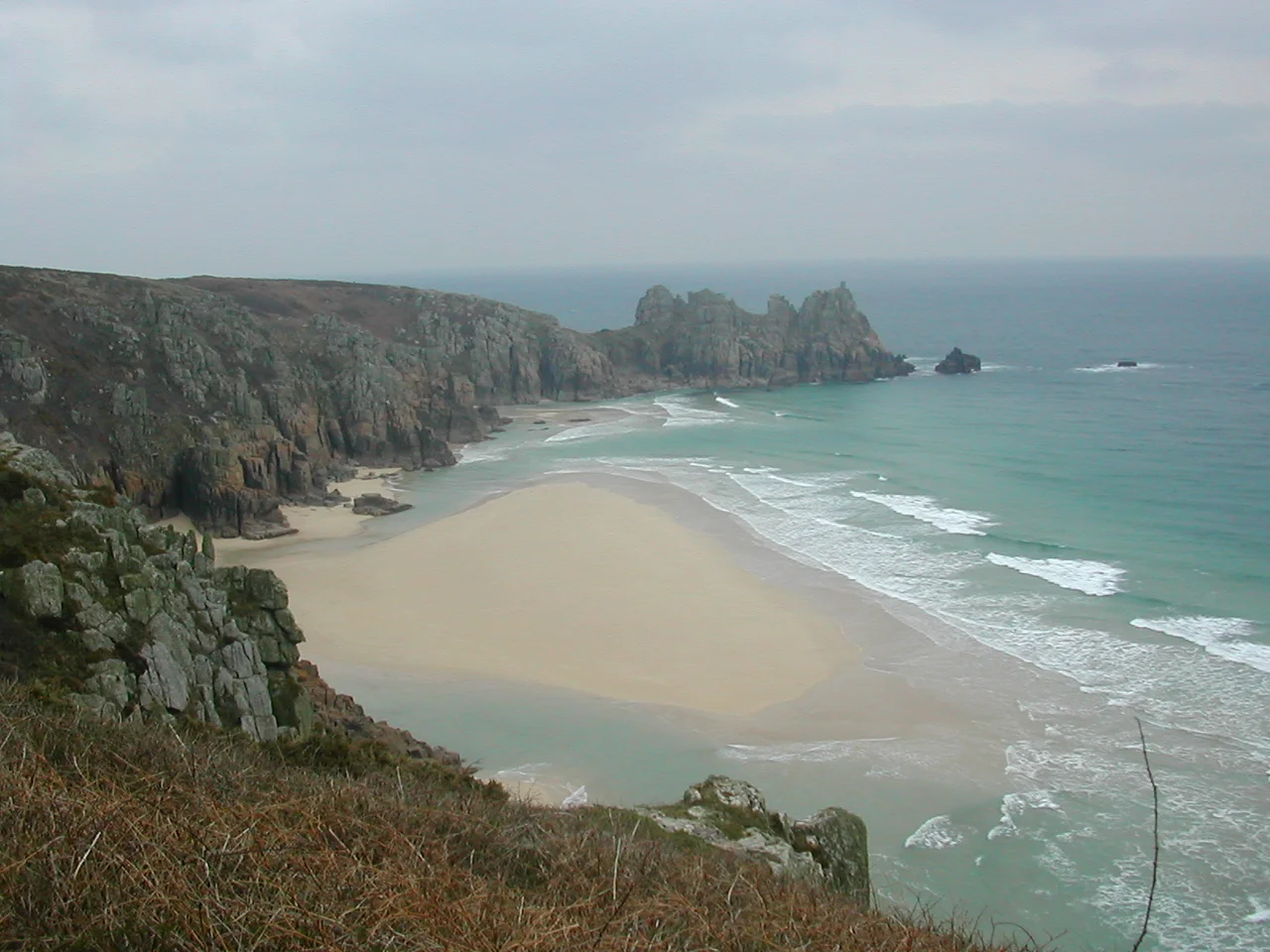
The Logan Rock is an 80-ton block of weathered granite, perched on a clifftop edge above Pednvounder Beach on a headland a mile south of Treen. It sits within the ramparts of Treryn Dinas, an Iron Age promontory fort with five lines of defensive earthworks cutting off the seaward end of the headland. The rock owes its trick to slow patient weathering: a happy accident of joint patterns in the parent granite that left it balanced on a single fulcrum point, free to tilt by inches under modest pressure. Before 1824, by all contemporary accounts, a single push by a child could set the whole eighty tons gently rocking. People had been coming to demonstrate this to visitors for as long as there had been visitors to demonstrate things to. The villagers of Treen made their living from it.
Lieutenant Goldsmith's Long Afternoon
Hugh Goldsmith and his men were from the cutter HMS Nimble. They were determined, as Goldsmith put it, to demonstrate that nothing was impossible when the courage and skill of British seamen were engaged. Bars and levers worked. The rock slid sideways off its perch and lodged in a narrow crevice (it did not, despite later accounts, fall from the cliff). The trick was finished. So, soon enough, was Treen's tourist trade. Sir Richard R. Vyvyan, the local Member of Parliament, was particularly furious. The villagers and their patrons demanded that the Admiralty strip Goldsmith of his Royal Navy commission unless he restored the rock at his own expense. The Lords of the Admiralty, persuaded by the antiquarian Davies Gilbert, agreed to lend equipment but not money.
Putting It Back
From the dockyard at Plymouth came thirteen capstans, with blocks and chains. The Admiralty contributed twenty-five pounds toward the cost. Davies Gilbert raised more by public subscription. Over months of laborious work, sixty-odd men with block and tackle wrestled the boulder back up the cliff. At 4:20 in the afternoon on Tuesday 2 November 1824, in front of thousands of spectators, the Logan Rock was lowered back onto its old fulcrum and pronounced once again in rocking condition. The total cost came to £130, 8 shillings and sixpence; a copy of the original receipt is on the wall of the Logan Rock public house in Treen to this day. Goldsmith was likely on the hook for around £105 of that, a serious sum for a Royal Navy lieutenant. For a while afterwards the rock was kept chained and padlocked, and the village earned, for a few sour years, the nickname Goldsmith's Deserted Village.
It Still Rocks
The Logan Rock still moves, but reluctantly. The anchor holes that the capstans threaded their chains through are visible drilled into the surrounding granite, the way scars become a kind of plaque. Francis Kilvert, the Victorian diarist, visited in July 1870 and noted that it was no longer as easy as it had been. The local historian Craig Weatherhill maintains that a series of rhythmic heaves against the south-west corner will set it going, and once started, the motion can be kept up with the pressure of one hand. Virginia Woolf as a small child rocked it with her father during one of the family summers at St Ives in the early 1890s; she remembered the moment in one of her last memoirs. R. M. Ballantyne wrote about the rock in his Cornish novel Deep Down. Inglis Gundry composed an opera called The Logan Rock that premiered at the nearby Minack Theatre in 1956. Cornish-raised electronic musician Aphex Twin titled a track on his 1997 Richard D. James Album 'Logan Rock Witch'. A stone that should not be possible has been a fixed point in a great deal of subsequent art.
From the Air
The Logan Rock sits at approximately 50.04 degrees north, 5.64 degrees west, on the seaward tip of the Treryn Dinas headland about a mile south of the village of Treen and 4 miles east-southeast of Land's End. From the air, navigate by the curving white sand of Pednvounder Beach immediately to the east and the layered earthen ramparts of the Iron Age cliff castle visible as concentric lines across the neck of the promontory. The Minack Theatre lies less than a mile to the west along the cliff. The nearest airfield is Land's End Airport (EGHC) at St Just, about 5 nautical miles to the north-west. The South West Coast Path traces the cliff edge above and offers the only land access.
Nearby Stories
- Mullion Cove 1.3 km away
- Great Wheal Charlotte 3.7 km away
- Castle Down 5.3 km away
- SS Georgia (1890) 30 km away
- Wheal Coates 41 km away
- 1979 Fastnet Race 55 km away
- HMS Affray 126 km away
- Routes of Santiago de Compostela: Camino Frances and Routes of Northern Spain 713 km away