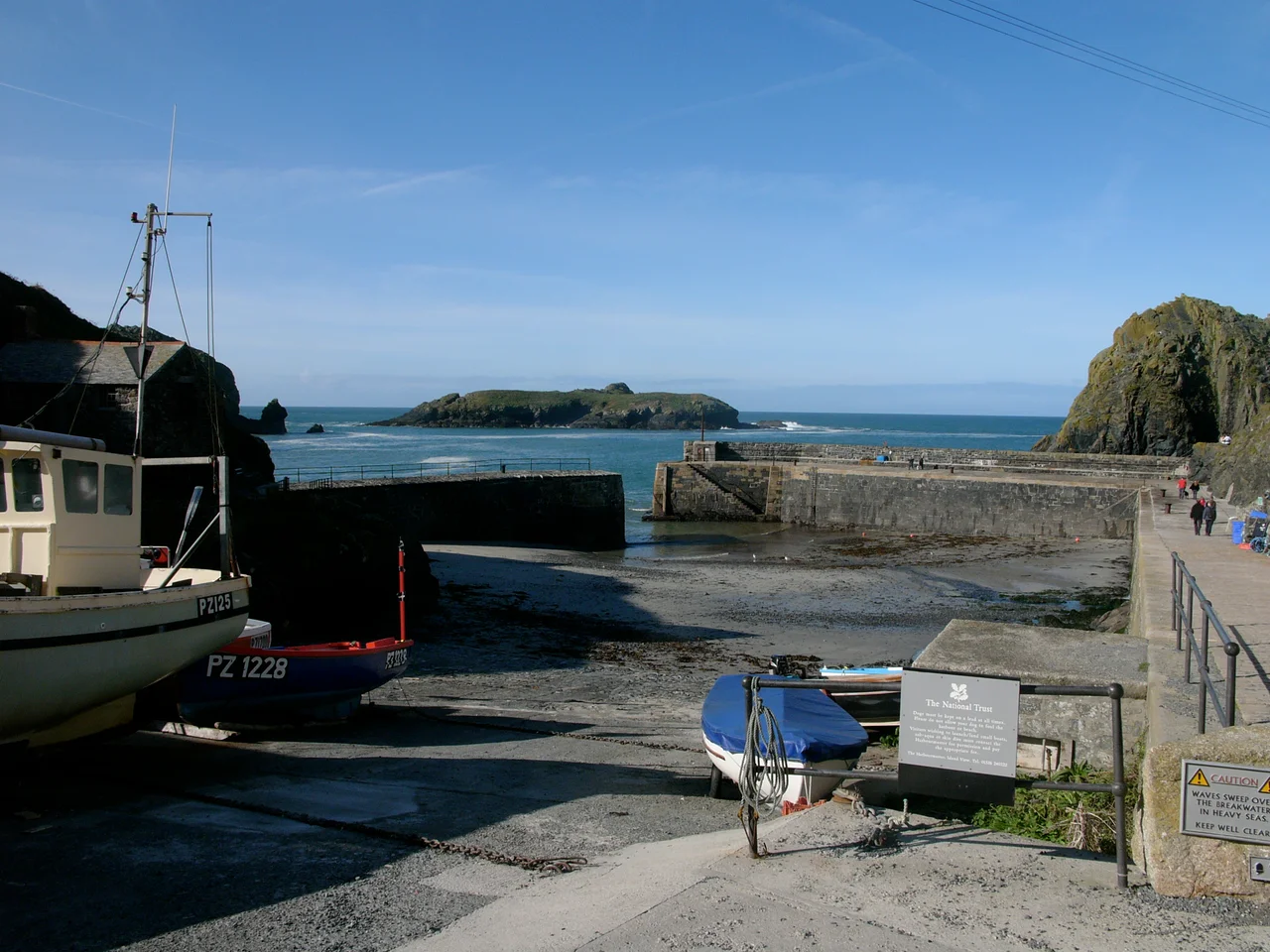

Mullion Cove
In 1895, with pilchards failing season after season and his Mullion tenants near ruin, Lord Robartes of Lanhydrock spent his own money on a harbour. Two stone piers, mostly granite and serpentine bound with a concrete core, curled out from the cliffs and made Mullion Cove - Porth Mellin to anyone speaking Cornish - into a place where boats could actually shelter. The Mounts Bay fishery had a new outpost. The cove had a future. The future would not, in the end, belong to the fishermen. It would belong to the storms.
A Ring of Fire
Long before Lord Robartes, Mullion's high cliffs had a different job. After Spanish galleys raided Mousehole, Paul, Newlyn, and Penzance in August 1595 - burning the church at Paul to the ground and chasing the locals inland - Cornwall woke up to how undefended it was. A chain of beacons was set along the coast, manned at night, ready to be lit at the first sign of invasion. Mullion Cove, perched above Mounts Bay with a long view across the water, was one of the chosen sites. Local legend keeps one watchman in particular alive. Hearing a boat in the dark below, he shouted down: 'Who goes here?' The reply came back: 'Fish and panniers.' He heard 'French and Spaniards.' Within minutes the beacon was blazing, the next beacon was answering, and a Ring of Fire was running up and down the Cornish coast - all because a fishing crew was coming home late.
Soaprock and Native Copper
Mullion's cliffs are layered with stories most beaches do not get to tell. The serpentine here was quarried in the 18th century for a soft, white, magnesium-rich mineral the locals called soaprock or steatite. From the 1750s onward it was shipped, in wooden casks out of Mullion Cove, to the earliest English soft-paste porcelain factories - Bristol, Worcester, Vauxhall in London, Liverpool, Caughley in Shropshire. For the first time English potters could make tea and coffee pots that did not crack when filled with boiling water. Soaprock from these cliffs let English porcelain compete with Chinese imports, decades before china clay arrived. The cliffs also gave up native copper - 94 percent pure, lying in sheets, as if it had been poured molten onto serpentine. Richard Hall found the first piece in the 1720s when his horse kicked at something on Predannack Downs. By 1849 the Trenance Mine here was raising slabs of native copper measuring seven and a half feet long. A 1,300-pound piece from Mullion was shown at the Great Exhibition of 1851 and is still on display in London's Natural History Museum.
The Pilchard Season
From a perch on Henscath headland - a small stone hut, roof shaped like an upturned boat - one man watched the sea every working hour. The Huer. When he spotted the bright, oily flash of a pilchard shoal moving through Mounts Bay, he called and directed the seine boats below. Six oarsmen pulled out, two net shooters paid out nets up to 1,200 feet long that weighed three tons, and a small boat called the Volyer scooped fish from the seine with a tuck net. In 1806 Mullion alone brought in 7,000 hogsheads of pilchards. Most were salt-cured in cellars by the harbour, casked, and shipped to Italian markets - Genoa, Leghorn, Civitavecchia, Naples, Venice. The trade ran on the labour of fishermen who often worked for one-quarter of a catch, and on the wages of children, women, and old people in the cellars. By 1850 the shoals were thinning. By 1877 boats and gear were going up for sale. In 1899 a hurricane on a single April night tore 14 boats from their moorings at Newlyn and scattered them across the bay. One was the Alpha, with 71-year-old William Treneer asleep aboard. He woke to find himself adrift, navigated his boat past Cudden Point, Trewavas Head, Mullion Island, the Rill, and the Stag Rocks at the Lizard, and was finally picked up 48 miles southwest of Plymouth by a Hungarian steamer that fed him and carried him to London. Five days after the storm took him, he stepped off the overnight train at Penzance.
The Sea Is Winning
Lord Robartes' harbour was always going to need maintenance. By 1944 it required extensive repair. From 2003 onward the National Trust, which now owns it, began warning that 'Mullion Cove may not stand the ravages of the sea much longer.' Climate change has raised the bar - literally. Storms hit harder; sea levels are higher; the same Atlantic that the pilchard fleet once read for fish is now slowly reading the granite of the piers. Down the cliff, Torchlight Cave - one of the largest on the Lizard, once explored by Victorian tourists with burning gorse torches and used by smugglers to hide brandy - is harder to reach on foot than it was in the 1800s. The cave has not moved. The sea has. Standing on the harbour wall today, you can read centuries of human work - the soap-rock leases, the copper sheets, the pilchard seines, the Huer's hut - and watch the next sentence being written. The cove holds. The cove holds. The cove holds.
From the Air
Mullion Cove sits at 50.015 degrees north, 5.257 degrees west, on the west coast of the Lizard Peninsula about 13 km south of Helston. From the air the twin curving stone piers are unmistakable - they form a small horseshoe of harbour tucked under high cliffs, with Mullion Island sitting offshore. Nearest commercial airport is Newquay (EGHQ), 65 km north. RNAS Culdrose (EGDR, military) is 11 km north - expect Merlin helicopter activity. Best viewed 1,500 to 3,000 feet in clear weather. Predannack Airfield (a Culdrose satellite, used for helicopter training) is only 4 km south.
Nearby Stories
- Logan Rock 3.6 km away
- Polperro 7.4 km away
- Great Wheal Charlotte 10 km away
- Battle of Plymouth (1652) 26 km away
- SS Irma (1905) 30 km away
- Black Swan Project 75 km away
- HMS Affray 77 km away
- 1979 Fastnet Race 100 km away