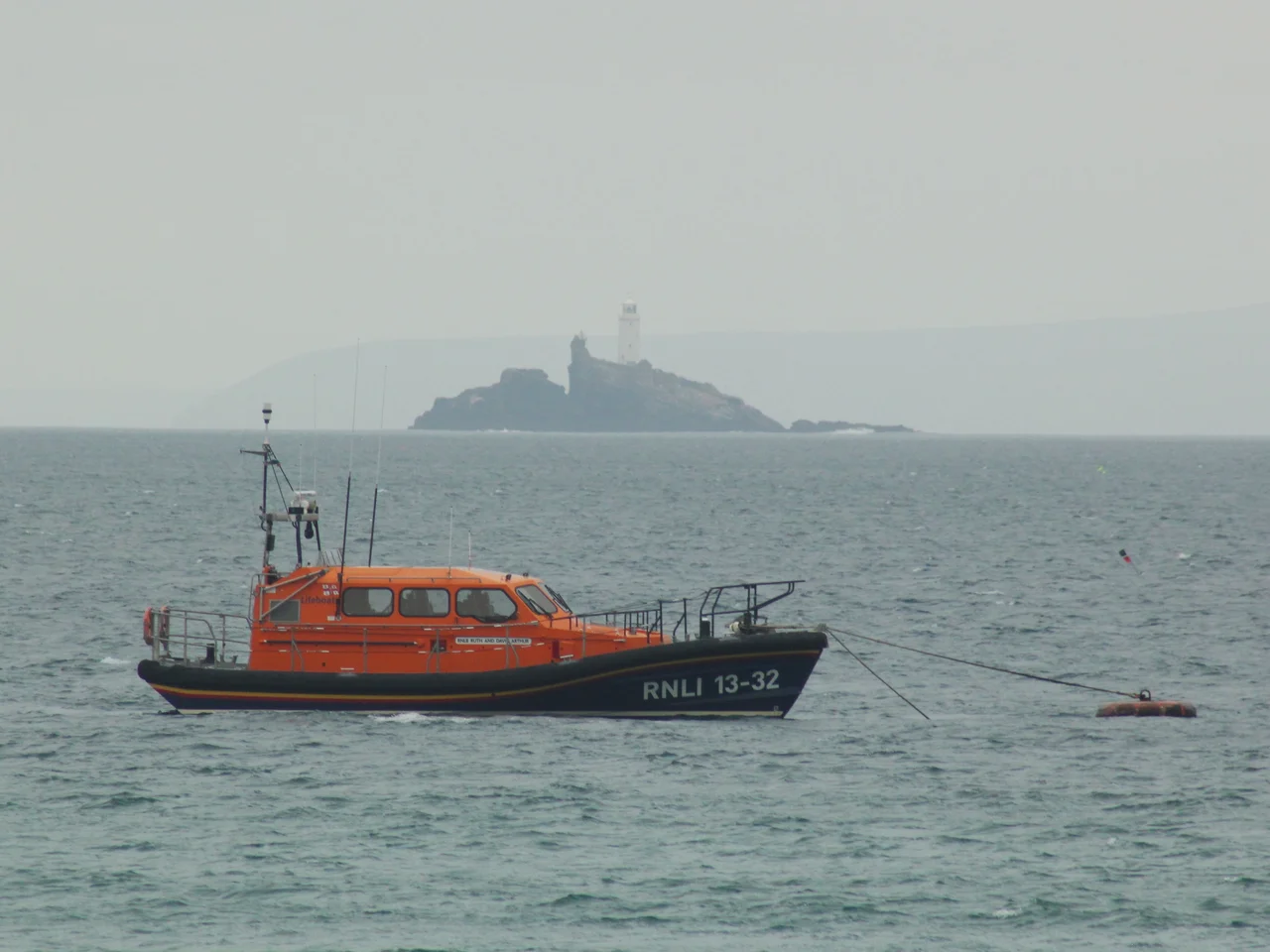

Appledore Lifeboat Station
On the morning of 28 December 1868, the Bideford Bar was a wall of breaking water. The Austrian barque Pace, bound out to sea, lost the fight and was blown aground. The Appledore lifeboat Hope was hauled along the shore by horses, then launched into seas so heavy that at one moment the boat stood vertical on the face of a wave. Coxswain Joseph Cox got nine people aboard, slammed against the wreck, lost the rudder, and rowed back to shore. He landed the survivors, took a fresh crew, and went out again. The lifeboat capsized. They lost most of the oars. They were ready to try a third time when the falling tide let the remaining sailors walk off the wreck. This is what an Appledore rescue could look like.
The first lifeboat in a barn
Appledore's lifeboat service began with a petition. In August 1824 the recently formed Royal National Institution for the Preservation of Life from Shipwreck, the RNIPLS as the RNLI was then known, was asked to provide a boat for the Bideford area. The Volunteer arrived in February 1825 and was kept in a barn at Appledore. By 1829 it had moved to the nearby King's Watch House. A meeting in Northam in June 1831 established the North Devon Humane Society, dedicated to building a proper boathouse and carriage so the boat could be hauled wherever it was needed. The Watertown boathouse was finished by year's end, and a second boat called Assistance arrived in December. On its first major launch in November 1833, the Assistance capsized. The Volunteer launched after it and saved four of its crew. Three drowned. The pattern was set: rescues that saved most lives but not all, in waters that gave no second chances.
What 1868 cost them
December 28, 1868, the day of the Pace, is the date Appledore still tells stories about. Joseph Cox, the injured coxswain, received the RNLI silver medal. He, his son Joseph Cox Junior, and John Kelly received Silver Crosses of Merit from the Emperor of Austria for the Austrian crew they had pulled clear. Another Appledore volunteer, David Cross, survived the Pace rescue only to drown later the same day. He had been trying to take a rope out to another vessel, the Leopard, which had run aground further down the coast. One storm. Two ships. Two lifeboat capsizings. One drowned volunteer. The records list only those whose names appear in official commendations. The rest of the village waited on the beach, watched the boats go in and come out, knew which families to walk toward when the work was done. Coastal towns count their dead by name.
The boys with wristwatches
Two of Appledore's most quietly extraordinary moments belong to children. On 16 August 1955, Robert Cann was ten years old and had just rowed to the lifeboat station when he heard two young swimmers shouting for help. He took his boat out again, got the boys aboard, and because of the tide had to row across to the opposite shore, drag his boat upstream against the current, then row back with the tide on his side. The RNLI awarded him a wristwatch, making him the youngest person ever recognised by the institution. Six years later, on 18 July 1961, thirteen-year-old Richard Bowden rowed his dinghy out to a girl in difficulties and brought her back to shore while she held onto the boat. Both boys came from lifeboat families. Robert's great-uncle Sidney Cann was the coxswain. Richard's uncle John Bowden was the station's second coxswain. The instinct to launch was inherited, and the youngest hands carried it forward.
Boats that fit the bar
The Bideford Bar is shallow, the estuary current strong, and lifeboats stationed at Appledore have always had to be built for it. By 1846 the volunteers had raised £125 for a larger boat, the Petrel, which arrived in October 1847. It turned out too heavy for head-on heavy seas and shipped too much water; it went back to the builder for alterations in 1850. In 1848 a second boathouse went up at Braunton Burrows across the estuary so that boats could reach trouble on either side. The crews always came from Appledore. World War I made it impossible to keep horses and men available at Braunton; the station closed in 1918 and permanently in 1919. The first motor lifeboat arrived in 1922. In 1938 the Watson-class Violet Armstrong was stationed at Appledore with a shallower draught and reinforced stern, both adjustments for the shallow estuary mouth. She did not fit the boathouse and had to be kept moored afloat, with a small boarding boat ferrying the crew out.
Still launching
An inshore lifeboat has been stationed at Appledore since 1972, kept in the boathouse with the boarding boat. The old crew room was added at first-floor level in 1980, then demolished in 2000, and a new station opened in 2001. The station today operates a Tamar-class all-weather lifeboat and a B-class Atlantic inshore lifeboat. To the north, Ilfracombe Lifeboat Station shares the responsibility for the Bristol Channel. To the south, more stations cover the long curve of north Devon and Cornwall. Two hundred years of rescues have written themselves into the small village at the mouth of the Torridge and Taw. The boats are faster now and the bar is mapped to the metre. The water has not changed. Neither, in the way that matters, have the volunteers.
From the Air
Appledore Lifeboat Station sits at 51.0570N, 4.1998W on the south bank of the Torridge near where it joins the Taw at the Bideford Bar. The boathouse and slipway are at the harbour. Best viewed at 800 to 1,500 feet AGL when the estuary's sandbars and the breaking water on the Bideford Bar are clearly visible. RAF Chivenor (EGDC) is 6 nm east, Exeter Airport (EGTE) 36 nm southeast. Westerly winds and Atlantic swell can make this entire coastline lively in winter; the lifeboat exists precisely because of those conditions.
Nearby Stories
- Okehampton Castle 8.2 km away
- Llandow Air Disaster 12 km away
- HMS Montagu 13 km away
- Dunster Castle 14 km away
- 2004 Boscastle Flood 15 km away
- Ottery St Mary 18 km away
- Oxwich Castle 27 km away
- Caldey Abbey 35 km away