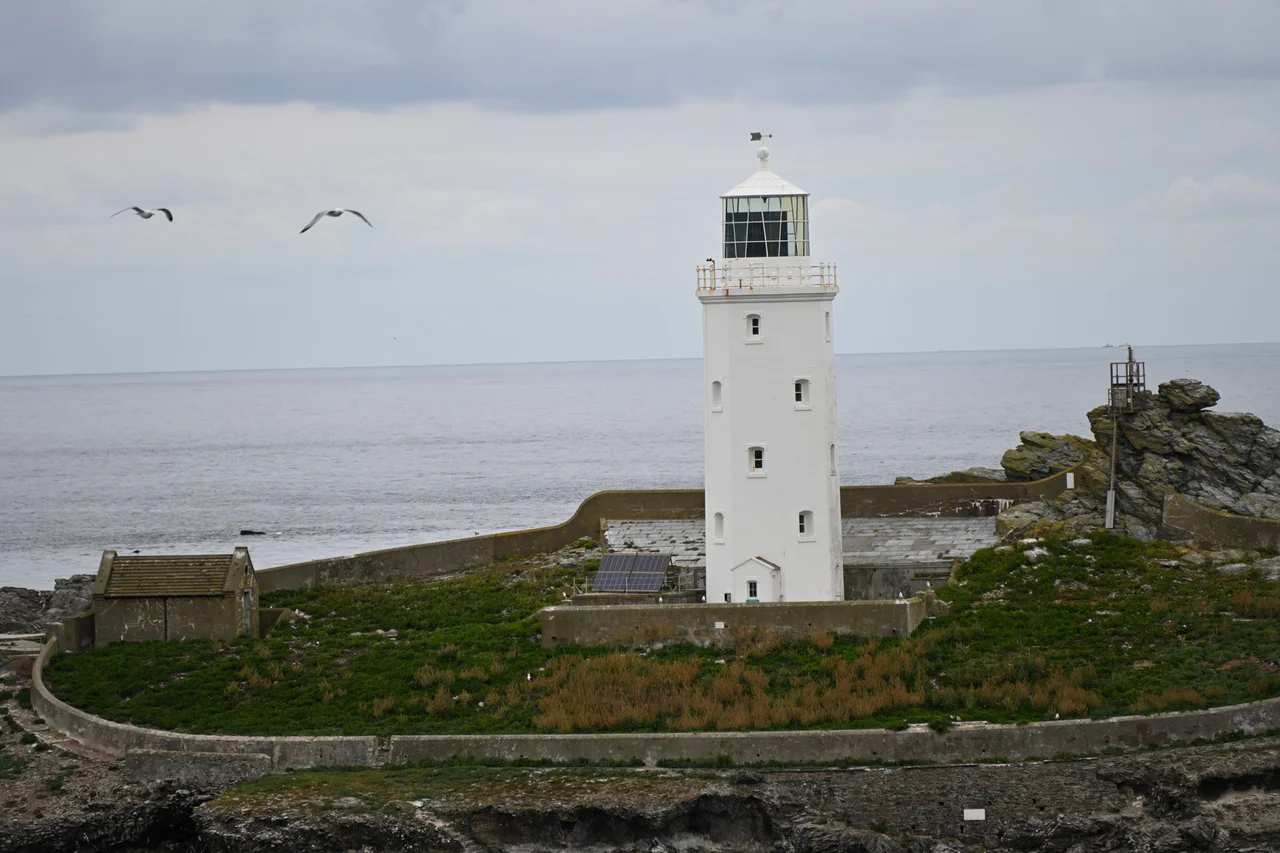

Godrevy Lighthouse
She watched it from the lawn of Talland House for thirteen summers. From 1882, the year she was born, until 1894 - when she was twelve and her mother only one year from dying - Virginia Stephen spent every August at the house her father had taken on the hill above St Ives, looking out across the bay to a slim white tower on a small granite island. The novel she would write thirty-three years later, in 1927, displaced the geography to the Hebrides. But the lighthouse in To the Lighthouse is Godrevy Lighthouse, and the bay and the family and the sense of summer suspended over time are all Cornwall. Woolf herself was clear about it. The lighthouse was first lit on 1 March 1859. By the time she could see it from her window, it had already been doing its work for twenty-three years.
The Stones
Between Godrevy Head and the small island half a kilometre offshore lies a reef called the Stones - a tangle of submerged granite that turns even moderate seas into death. Before the lighthouse, the Stones had been claiming ships for centuries. The disaster that finally forced action came on 30 November 1854, when the iron screw steamer SS Nile, running for shelter from a storm, struck the reef in darkness and broke apart. All forty-odd passengers and crew were lost. The day after the news reached St Ives, a master mariner called Richard Short wrote a furious letter to the Shipping and Mercantile Gazette. "Many applications have been made from time to time concerning the erection of a light to warn mariners against this dangerous reef," he wrote. "Scarcely a month passes by in the winter season without some vessel striking on these rocks, and hundreds of poor fellows have perished there in dark dreary nights without one being left to tell the tale."
Building the Tower
A local clergyman, the Rev. J. W. Murray of Hayle, took the cause to Trinity House with a formal petition. In October 1856, Trinity House agreed. By December 1857 James Sutcliffe had been appointed engineer and the architect James Walker contracted to design the tower. Walker, who had also designed Wolf Rock lighthouse off Land's End, drew an octagonal granite tower 26 metres high with a keeper's cottages alongside. Construction took about a year on the wave-swept island and cost £7,082, 15 shillings and twelve pence. The light first shone on 1 March 1859. Below the main lantern, a separate fixed red light marked a 45-degree danger arc over the Stones themselves. The main beam, powered by a descending clockwork weight that ran down a cavity in the tower wall, was visible 17 miles out to sea. A fog bell hung beneath the lantern.
Two Keepers, One Month Off
Two keepers staffed the lighthouse at all times, working two months on and one month off in rotation. The shift change was the worst part of the job. Landing a keeper on Godrevy meant launching a boat at the right state of tide and weather, rowing across the open Atlantic swell, and timing a single jump from boat to slippery granite ledge between waves. In bad weather, the change could be delayed for weeks. The keepers' cottages no longer exist - they were demolished after automation - but in the lighthouse archives there are still requisition forms for the coal, oil, candles and salt beef that two men needed to outlast a winter on a wave-washed rock 300 metres from the cliff.
Virginia Woolf's Window
Leslie Stephen, Virginia's father, took the lease on Talland House in 1881 partly because it offered the rented summer escape his large family needed and partly, one suspects, because the view from the upper terrace was extraordinary. The lighthouse stood directly out across St Ives Bay. The children swam, sailed, walked the cliffs. Julia Stephen, Virginia's mother, presided over a household full of step-siblings and visiting writers. Then in May 1895 Julia died. Within a year, Leslie had given up Talland House. Virginia never returned to St Ives until she was an adult, and never to the house. In 1927 she published To the Lighthouse, structured around the Ramsay family's interrupted journey to a lighthouse off a Hebridean coast, with an empty central section called "Time Passes" in which a decade and several deaths sweep through an abandoned holiday home. Woolf wrote in her diary that the book was her elegy for her mother. The lighthouse was Godrevy. The bay was St Ives. The grief was real.
Automation and After
In 1933 Trinity House automated the lighthouse, installing a second-order fixed catadioptric lens and an acetylene burner triggered by a sun valve - a device that detected daylight and shut off the gas at dawn. The new light flashed white with a red sector covering the Stones, replacing the old subsidiary red light. The fog bell was decommissioned at the same time. By 1939 the keepers had been withdrawn and their cottages demolished. The tower has run unattended for nearly a century. In 2012 the original lantern room was removed and replaced with a smaller LED beacon mounted on a steel frame alongside. The pure octagonal Walker silhouette is no longer quite right - the lantern is gone - but from the cliffs above Godrevy Point, walking the South West Coast Path on a clear day with the seals barking on the rocks below, the lighthouse still looks exactly like what it was for Virginia Woolf: a small white certainty in a moving sea.
From the Air
Godrevy Lighthouse stands on Godrevy Island at 50.243 N, 5.400 W, approximately 300 m off Godrevy Head on the north Cornwall coast. Tower height 26 m on a granite base less than 5 m above mean high water. Visible from across St Ives Bay (Hayle, Carbis Bay, St Ives - all 3-5 nm distant) and along the South West Coast Path. Best viewed from the eastern cliffs of Godrevy Point at low altitude or from a coastal approach at sea level. Land's End (EGHC) is 14 nm south-west; Newquay (EGHQ) 18 nm north-east. The light's nominal range is 17 nm; expect to see it at night long before reaching the coastline.
Nearby Stories
- Wadebridge 8.1 km away
- Caerhays Castle 8.1 km away
- Sevenstones Lightship 16 km away
- Battle off Lizard Point 20 km away
- MV Cita 22 km away
- Carnewas and Bedruthan Steps 30 km away
- 1979 Fastnet Race 71 km away
- HMS Affray 108 km away