
Wadebridge
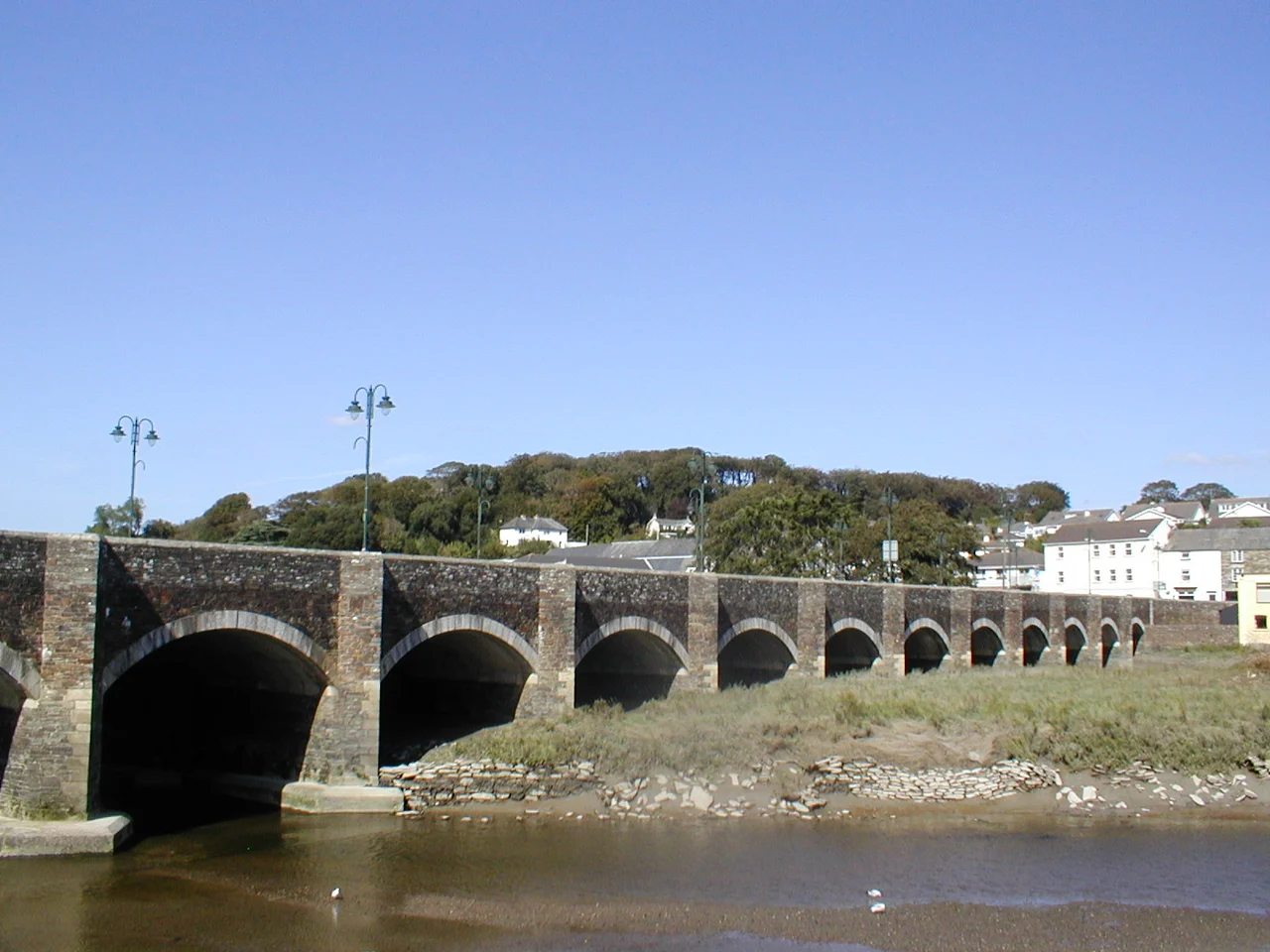
Before the bridge, there were chapels on both sides of the river. People prayed for safe passage at one, waded across the tidal Camel, and gave thanks at the other if they made it. Then the Reverend Thomas Lovibond, vicar of Egloshayle, grew tired of counting the dead - humans and animals lost to the crossing - and built a stone bridge. It was begun in 1468 and completed by 1485 depending on whose chronicle you believe, and the place renamed itself accordingly. Wade became Wadebridge. The bridge is still here, widened twice, refurbished in 1991, and so famously sat that John Leland, riding through Cornwall in the early 1500s, claimed it rested on packs of wool. It actually rests on bedrock. But "the Bridge on Wool" is the kind of detail that survives because it sounds better than the truth.
Cromwell at the Crossing
By 1646, the bridge had been a strategic asset for nearly two centuries, and Oliver Cromwell wanted it. He arrived with five hundred dragoons and a thousand horsemen, took the crossing for Parliament, and moved on. The English Civil War left Cornwall heavily contested - the county was largely royalist, but its rivers were prizes neither side could afford to leave to the other. The bridge survived that, as it survived later widening in 1853 and again in 1952. Edward II had granted Wade a market license in 1312 along with two annual fairs, one on the feast of Saint Vitalis and one at Michaelmas. The town has been a market centre for the surrounding parishes ever since. Today the Royal Cornwall Show, held at the showground just west of town every June, draws crowds from the whole county - the show began in 1793 at Bodmin and moved to its permanent Wadebridge home in 1960.
The Locomotive Named Elephant
The Bodmin and Wadebridge Railway opened on 30 September 1834, one of the first lines in Britain to carry passengers. It cost £35,000 to build, following a study commissioned in 1831 by Sir William Molesworth of Pencarrow. The opening day, the locomotive Camel pulled four hundred passengers along the new track. The line had been intended for cargo - specifically, sand from the Camel Estuary shipped inland for fertiliser, with copper and granite returning down to the port - but the passenger business arrived early and stayed. When the railway company ordered its second locomotive, the maker in Wales saw "Camel" and assumed they wanted animals. The nameplate arrived on the engine already affixed: Elephant. Nobody changed it. For decades, Camel and Elephant ran the line together, a quiet accident of cross-purposes that became the town's favourite story about itself.
The Port That Was
Until the railway took over, Wadebridge was the highest navigable point on the River Camel. Coasters brought goods from Bristol, coal from South Wales, timber from the Baltic, and carried stone and tin and copper back out. The quays handled five-vessel docks by 1843. By 1880, both banks of the river below the bridge had working wharves, the western quay served directly by the railway. Then the deeper water moved downstream, the sand dock was filled in by 1895, and the trade gradually drained away. The last passenger train left Wadebridge in 1967, a casualty of the Beeching cuts. The track-bed became the Camel Trail - eighteen miles of car-free path that now carries walkers, cyclists, and the occasional horse from Wadebridge through Bodmin and out across the moor. The Bodmin and Wenford Railway, a heritage line, still runs steam over part of the original route.
The Pedestrian Street
For most of the twentieth century, Wadebridge was a traffic problem. The A39, Cornwall's main north-coast road, ran straight through the centre of town along Molesworth Street, where shoppers and lorries fought for the same narrow corridor. In 1991 the bypass opened. The traffic vanished overnight. Molesworth Street pedestrianised itself in the years that followed, and the town quietly reclaimed its old shape. A footbridge called the Challenge Bridge spans the river between the Egloshayle playing fields and the Jubilee fields - it was built in 1991 by Anneka Rice and her team in a single sprint for the BBC programme Challenge Anneka. The Molesworth Arms, a coaching inn that has been variously the Fox, the King's Arms, and the Fountain, took its current name in 1817 and still serves drinks on the street where the stagecoaches once changed horses.
Festivals and Faces
August Bank Holiday brings the Cornwall Folk Festival, one of the UK's longest-running, founded in 1972. Its patrons are the Lakeman brothers - Sam, Sean, and Seth - and the festival features contemporary folk, bluegrass, Americana, Celtic music, and acoustic acts in venues all over town. Earlier in summer comes the Rock Oyster Festival on the estuary, then the Big Lunch street party in the pedestrianised centre, with five hundred to seven hundred and fifty people sharing food in the middle of Molesworth Street. The town has been twinned with Langueux in Brittany since the 1980s. Andrew Ridgeley of Wham! and Keren Woodward of Bananarama lived in a converted farmhouse nearby from 1990 to 2017. Steven Roberts, the first British soldier killed in the 2003 invasion of Iraq, was born here. In 2013, Wadebridge was shortlisted as one of Britain's top eco-towns - home to the Wadebridge Renewable Energy Network, a grassroots cooperative aiming to make the place the UK's first town fully powered by solar and other renewables.
From the Air
Located at 50.518°N, 4.885°W on the River Camel, north Cornwall. Recommended viewing altitude 1,500-3,000 ft AGL. Visual landmarks: the medieval bridge spans the river in the centre of town; the Camel Estuary opens to the west toward Padstow; the A39 bypass loops south of the built-up area. The Royal Cornwall Showground is visible 1 nm west. Nearest civilian airports: Newquay (EGHQ) 12 nm south-west, Exeter (EGTE) 55 nm east. Weather note: estuary fog can form quickly when warm air meets the cold tidal river - check coastal METARs before low-level approaches.
Nearby Stories
- Gunnislake 1.5 km away
- Tehidy Country Park 4.2 km away
- Caerhays Castle 8.1 km away
- Bude 15 km away
- Hope Cove Lifeboat Station 26 km away
- Appledore Lifeboat Station 29 km away
- Godrevy Lighthouse 34 km away
- Action of 17 November 1917 82 km away