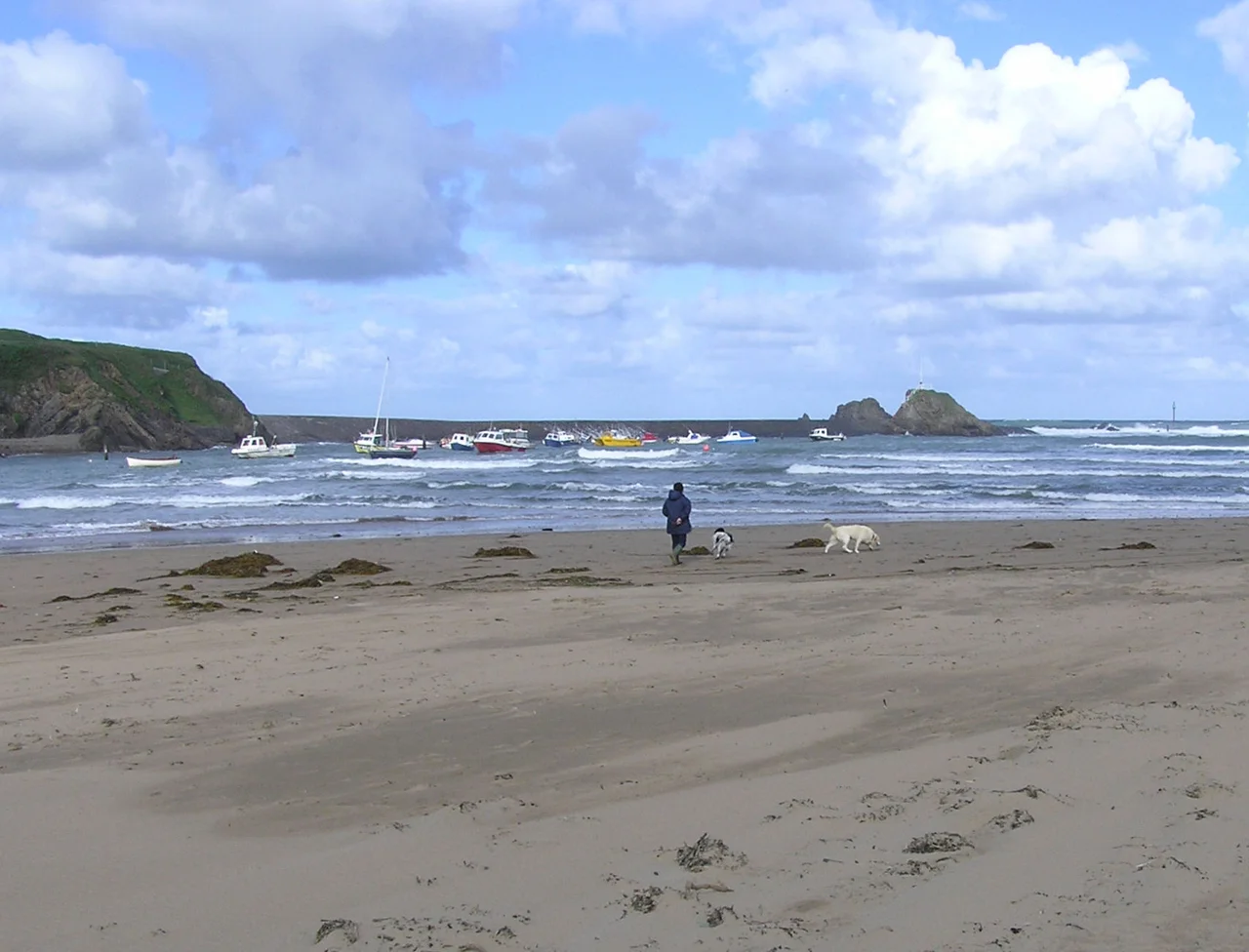

Bude
The Bude Light at the top of Goldsworthy Gurney's old castle still burns at night, but it would have looked nothing like the limelight that made Gurney famous in the 19th century. From this strange concrete-rafted house built on sand, Gurney sent oxygen and hydrogen flames through a ball of quicklime and turned the British Parliament from a guttering candle-lit chamber into a room you could actually read in. The technology took his name. So did half the West End theatre lighting of the Victorian age. And it all started here, on a windswept beach where the River Neet meets the Atlantic, in a town most of the country has never quite been able to reach.
A Difficult Place to Get To
Bude and its older neighbour Stratton are, by a strange statistical accident, the towns furthest from a railway in all of England. The nearest stations are Okehampton at 29 miles, Bodmin Parkway at 32, Barnstaple at 35. The Atlantic Coast Express used to run all the way here from London Waterloo, dropping holiday-makers right at Bude station until 1964. Then Dr Beeching's report came, and the branch line closed on the first of October 1966. The track was lifted. The remoteness returned. Today the A39 — the Atlantic Highway — winds in from the south, and that is the way most visitors come, which means many of them arrive having decided to be here rather than simply passing through.
The Sand That Built the Canal
Before tourism, before surfing, before any of that, Bude existed because of its sand. The yellow grains of Bude Bay are unusually rich in calcium carbonate — pulverised shell and sea-creature, essentially — and Cornish farmers worked out long ago that spreading this stuff on their acidic moorland fields was the next best thing to a miracle. The Bude Canal opened in 1823 specifically to haul tub-boats full of sand inland, up four hundred vertical feet via a series of inclined planes, all the way to Holsworthy and Launceston. It was, in its way, the first carbon capture project in Cornwall: shell-dust pulled from the Atlantic and pressed back into the soil. The enterprise rarely turned a profit, but it shifted enormous tonnages. When cheap chemical fertiliser arrived in the late 19th century, the whole system collapsed almost overnight.
The Sea Pool
Bude Sea Pool sits in the rocks below Summerleaze cliff, a tidal lido carved partly by nature and partly by men with dynamite in 1930. The Atlantic floods it twice a day, scouring it clean and topping it up at high tide, then leaves it for swimmers when the sea retreats. Cornwall Council funded its upkeep until austerity bit in 2010 and 2011, and the pool would have closed had local people not founded the Friends of Bude Sea Pool the following year. It is now one of those rare British survivors of a once-common species: a free, volunteer-run, saltwater bathing pool, kept alive by people who would rather raise the money themselves than lose it.
Rider-Waite-Smith
Pamela Colman Smith died in Bude on the 18th of September 1951. If that name doesn't ring a bell, look at the back of any standard tarot deck and you will find her work. Smith illustrated all seventy-eight cards of what became the Rider-Waite-Smith deck in 1909, working from instructions by the occultist Arthur Edward Waite. For a small flat fee. No royalties. The deck went on to become the bestselling tarot pack in history, the visual template for almost every esoteric image that followed, and Smith died in relative poverty in this small Cornish town. She is one of those artists whose work everyone knows and whose name almost no one remembers, and Bude was where she ended up. Jean Rhys also lived here in the late 1950s, working on the final version of Wide Sargasso Sea.
The Cliffs Themselves
Walk south from Summerleaze toward Widemouth Bay and you are walking over the only Carboniferous sandstone cliffs in Cornwall. Everywhere else along this coast is Devonian slate, granite, Precambrian gneiss — the deep old stuff. Here, for a few miles, the rocks are younger, sandier, more obviously layered. Geologists love this stretch because the strata were folded and twisted into corkscrews during the Variscan Orogeny three hundred million years ago, and you can still see the fold patterns running along the cliff face like a contour map of buried mountains. The whole coastline between Compass Cove and Furzey Cove is protected as a Site of Special Scientific Interest. The breakers that crash against it are also why Bude founded the United Kingdom's first Surf Life Saving Club here in 1953.
A Tunnel, A Festival, A Hub
Modern Bude has at least one further claim to fame, mostly accidental. In September 2018 the seventy-metre perspex walkway connecting Bude Sainsbury's car park to its store — known locally as the Bude Tunnel — became, on TripAdvisor, the town's top-rated attraction. Reviewers compared it earnestly to the Taj Mahal and the Hanging Gardens of Babylon. Christmas lights followed. The joke became a tradition. Less visible but far more strategically important is GCHQ Bude, just north of town at Morwenstow: a satellite intercept station where most of the area's two-hundred-and-fifty civil servants and contractors work. The transatlantic data cables that land at Widemouth Bay carry a significant fraction of the world's internet traffic onto British soil here, then onward to listening rooms most of the town will never see.
From the Air
Bude is at 50.82 degrees north, 4.54 degrees west, on the Atlantic-facing north coast of Cornwall. Recommended viewing altitude is 2,500 to 3,500 feet, where the sandstone cliffs, the canal cutting inland from the sea lock, and the tidal Sea Pool below Summerleaze are all clearly visible. The Atlantic Highway (A39) traces the coast and is an unmistakable navigation reference. Compass Point's octagonal tower stands above Summerleaze Beach. Newquay (EGHQ) is the nearest sizeable airport, roughly 35 nautical miles south. Land's End Airport (EGHC) is further south on the same coast. Atlantic weather can move in quickly here — expect fog and squalls off the Bristol Channel, especially in late spring.
Nearby Stories
- Grimspound 2.5 km away
- Exmoor National Park 8.3 km away
- Padstow 9.7 km away
- The Hurlers (stone circles) 13 km away
- Lundy 19 km away
- Castle Drogo 22 km away
- HMHS Glenart Castle 27 km away
- Action of 17 November 1917 52 km away