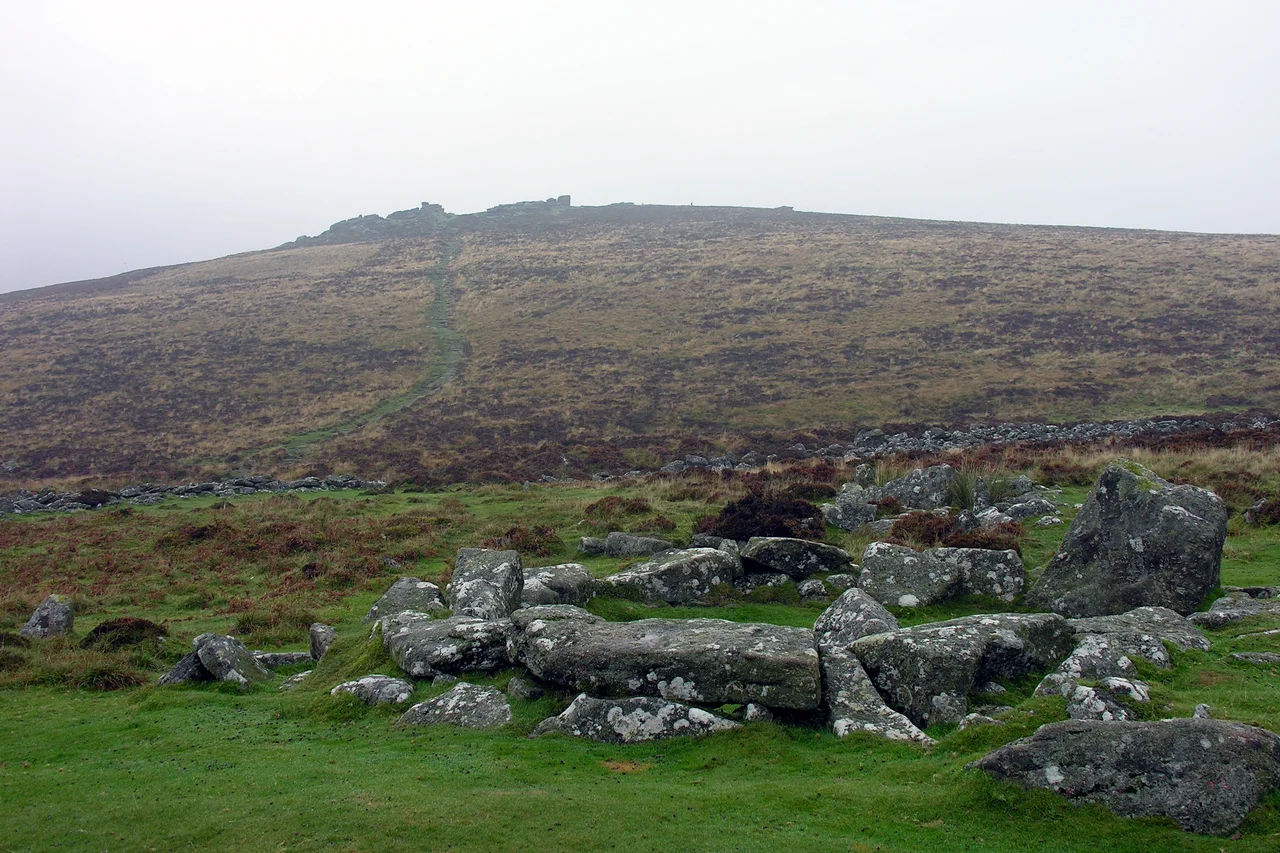

Grimspound
Three thousand three hundred years ago, on a Devon hillside between two granite tors, a community built twenty-four stone houses and a wall to enclose them. Then they left. The wall stayed. The houses stayed. The acidic peat of Dartmoor dissolved their wood, their leather, their textiles, and most of their pottery, but it could not dissolve the granite. When the Reverend Richard Polwhele first recorded the site in 1797 he assumed it was a Druid temple. He was wrong by about a thousand years and an entire religion. The Saxons, finding it long abandoned, had named it for their god of war - Grim, more commonly known as Woden, or Odin. Grimspound. The pound of Grim.
What They Built
Around 1300 BC, late in the Bronze Age, builders raised a perimeter wall of granite enclosing roughly 1.45 hectares of hillside in the valley between Hameldown Tor and Hookney Tor. The wall is massive - in places its rubble is fifteen feet thick - and once stood perhaps 1.7 metres high. Inside, twenty-four roundhouses with an average diameter of 3.4 metres, built of a double ring of granite slabs with rubble infill. The dry-stone technique is still in use today. Hut 3 retains its porchway: two jamb stones still upright, the lintel fallen at their feet. The entrance to the enclosure is the most imposing feature, a paved and stepped corridor 5.5 metres long and nearly two metres wide, lined with megaliths. It faces south, downslope towards Hameldown. Whether the builders meant it as fortress, village, ceremonial site, or all three at once, no one has fully resolved.
The Victorians Dig In
In 1893 the Dartmoor Exploration Committee arrived with shovels. Among them was the Reverend Sabine Baring-Gould, who would later write "Onward, Christian Soldiers." The Committee located the entrance, removed topsoil, sieved hearth ash for charcoal and seeds, and excavated a series of hut circles. Their methodology was advanced for the period - the sieving was decades ahead of standard practice. Their conclusions were less defensible. They first declared the site Neolithic, then revised to call it a cattle enclosure, mostly because they could not see how anyone could defend such a low-lying position militarily. Then, controversially, they reconstructed several of the huts. Researchers ever since have winced at this. R. Hansford Worth, writing later, criticised the rebuilding. Visitors today are seeing what the Victorians thought Bronze Age huts ought to look like, not exactly what survived three thousand years.
Hearths and Daises
Inside the huts, hearths sat either at the centre or opposite the door. Ash analysis revealed oak and willow twigs - and peat. The presence of peat ash matters: by 1300 BC the Dartmoor forests had already retreated far enough that the inhabitants were burning the dried bog. The pottery was too fragile for direct fire, so cooking happened by pot-boiling - pieces of granite heated in the hearth and dropped into water-filled pots sunk into the ground. To the right of each entrance, a raised level area that the excavators called a "dais" - probably the sleeping platform. Four of the huts contained upright "anvil stones" whose function remains unknown. No hut was larger than the others, so no obvious chieftain's house, though the Committee suggested a pillar outside Hut 19 might mark a headman's residence.
What the Soil Took
Dartmoor's soil is acidic enough to destroy almost everything organic. Wood, leather, textiles, bone, seeds, fingernails - all gone. What survives is the granite and the negative spaces it leaves: hut floors, hearth pits, post holes, the rubble of collapsed walls. A flint arrowhead was found nearby. Flint is not local to Dartmoor, which means the Grimspound people were trading or travelling for materials. The pottery shards do not match local clay either. There are no querns for grinding cereals, which hints that grain came in finished form from elsewhere. This was not an isolated community. They were embedded in a network of exchange that stretched well beyond the moor, even as they lived in stone houses on a windswept hillside that, in winter, must have been brutal.
Still There
Grimspound was declared a scheduled monument in 1928. In 1964 Lady Aileen Fox, the eminent Dartmoor archaeologist, restored sections to prevent erosion. A 2019 geophysical survey by the University of Leicester and the Camborne School of Mines tried to map what still lies hidden in the empty parts of the enclosure. There is, archaeologists agree, more to find. But the basic shape of the site has remained startlingly intact since A. C. Shillibear first mapped it in 1829. Bertram Fletcher Robinson, who collaborated with Conan Doyle on "The Hound of the Baskervilles," wrote about Grimspound in Pearson's Magazine in 1904. The Hound's spectral menace owes something to evenings like this one: walking the moor in fading light, between Hameldown Tor and Hookney Tor, past stones placed where they were placed by hands that did not know writing, did not know iron, and would not know England for another two thousand years.
From the Air
Grimspound lies at 50.6131 N, 3.83774 W, at 450 metres above sea level in the saddle between Hameldown Tor (to the south) and Hookney Tor (to the north) on Dartmoor. View from 2,500 to 4,000 feet to make out the circular wall enclosing the hut circles. Nearest airport is Exeter (EGTE), about 16 nautical miles east-north-east. The settlement is roughly a mile north of Widecombe-in-the-Moor, which provides the easiest visual landmark. The wall appears as a darker oval against the moorland. Best in raking light - early morning or late afternoon - when shadows pick out the hut circles. Low cloud is common; fly on a clear day.
Nearby Stories
- Torcross 2.8 km away
- Cotehele 4.6 km away
- HMS Formidable (1898) 9.1 km away
- Holsworthy 9.4 km away
- Eddystone Lighthouse 11 km away
- Tiverton Castle 18 km away
- 1890 Norton Fitzwarren Rail Crash 24 km away
- Lyme Bay Canoeing Disaster 26 km away