.jpg)
HMS Formidable (1898)
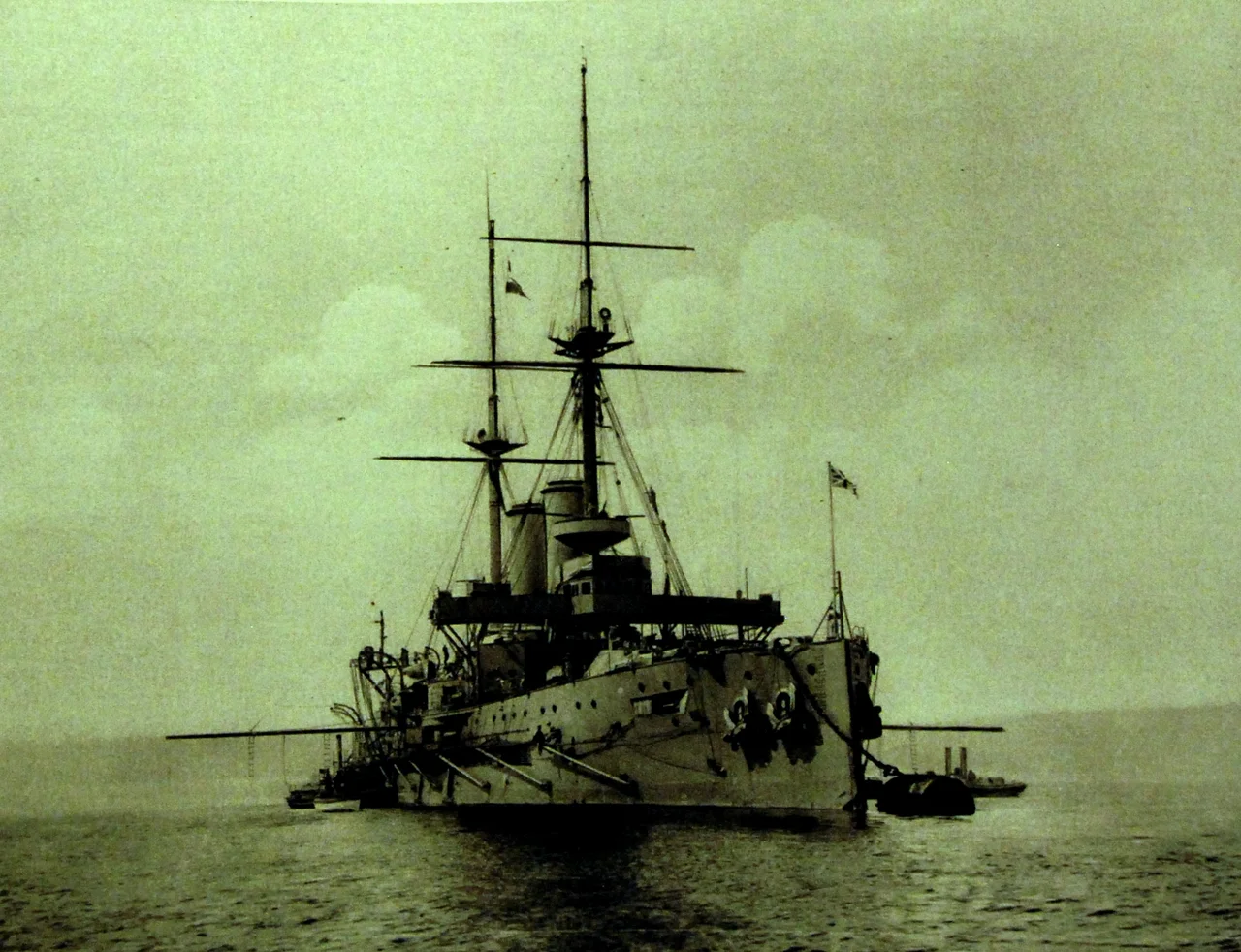
At 2:20 in the morning of 1 January 1915, the watch on HMS Formidable felt the deck shudder under their boots. A torpedo had struck the starboard side, abreast of the forward funnel, and the men aboard the pre-dreadnought battleship had perhaps two and three-quarter hours to live. They were thirty-odd miles off the south coast of Devon, in the cold winter dark of Lyme Bay. Their captain, Arthur Loxley, was on the bridge. The other ships of the 5th Battle Squadron had no idea anything was wrong. Formidable was the last battleship in the line, followed only by two light cruisers, and she turned out of formation alone, trying to get closer to shore. Twenty minutes after the first torpedo, she had taken on a list of twenty degrees. The order to abandon ship had been given. Forty-five minutes after that, the second torpedo struck. By 4:45 that morning Formidable was sinking by the bow. Of her complement of 780 officers and men, 547 went down with her.
Built for a War That Was Already Over
HMS Formidable was the lead ship of her class, laid down at Portsmouth Dockyard on 21 March 1898 and launched that November so the slipway could be cleared for the next battleship. She was 431 feet long, displaced 15,800 tons fully loaded, and carried a main battery of four 12-inch guns in twin turrets fore and aft. Her armor was Krupp steel, thicker and stronger than anything on her predecessors, and her twenty Belleville boilers could push her at 18 knots. She represented the very last generation of British battleship design before HMS Dreadnought, launched in 1906, made every previous battleship in the world obsolete overnight. By the time war broke out in August 1914, Formidable was already an older ship, kept on with a nucleus crew and assigned to the 5th Battle Squadron at Sheerness. The Royal Navy needed her hull and her guns. She covered the British Expeditionary Force's crossing to France in the war's first days. She carried marines to Ostend on 25 August. Then came the watch off Portland, and the training exercises in the Channel that began on the last day of 1914.
The Decision to Stay at Sea
The squadron's commander was Vice-Admiral Sir Lewis Bayly, a respected officer whose judgment that night would end his career. After the day's gunnery exercises off the Isle of Portland, the squadron had no destroyer escort. Submarine activity had been reported in the area. The sea was rough enough to make a periscope difficult to spot, but visibility was otherwise good. Bayly chose to keep his ships at sea on patrol, in line ahead formation at 10 knots. Formidable was the last battleship in the line. The German submarine U-24, commanded by Rudolf Schneider, had been stalking the squadron all afternoon, working into a firing position the British did not know they were giving him. By the time U-24 launched the first torpedo, the squadron's lookouts had been at their posts for hours in the kind of cold that gets into the bones and stays there. They saw nothing until the explosion.
Loxley on the Bridge
What happened on Formidable in those two and a half hours between the first torpedo and her sinking is one of the quieter naval traditions of the First World War. Captain Loxley, knowing the ship could not be saved, ordered her closed up for damage control while he turned for shore. The light cruiser Topaze, twenty minutes behind, finally noticed Formidable was out of line and closed to investigate. By then the list was severe and the order to abandon had been given. Men remained at their stations counter-flooding to slow the rolling. The second torpedo struck near the bow. Topaze and the cruiser Diamond began trying to pull men from the freezing water, but the seas were heavy enough that bringing anyone aboard required courage and luck. Loxley was last seen on the bridge, calmly overseeing the evacuation. He did not leave the ship. The Brixham trawler Provident, fishing nearby, picked up 73 men from one of Formidable's launches around midday. Another of her boats, a pinnace under coxswain William Pillar, made it all the way to Lyme Regis after 22 hours at sea, saving another 47 men. Diamond pulled 37 more from the water. The rest, 35 officers and 512 men, did not come home.
An Inquiry and a Wreck
The Admiralty inquiry into the loss of HMS Formidable concluded what was already obvious. Conducting training exercises in the Channel without destroyer protection was an unacceptable risk and should not be continued. Vice-Admiral Bayly was relieved of his command for failing to take adequate precautions against submarine attack. He was eventually given other responsibilities, but the night of 31 December 1914 followed him. For the Royal Navy, the sinking marked the moment when the old certainties about surface warfare in home waters gave way to a new and patient enemy that did not need to come to the surface to do its work. HMS Formidable now lies on the bottom of Lyme Bay, designated as a controlled site under the Protection of Military Remains Act 1986. She is not a wreck to be entered or disturbed. She is a war grave. Five hundred and forty-seven names. A pinnace that rowed twenty-two hours to reach harbour. A trawler crew, hauling on their nets, suddenly hauling men. Lyme Bay is a calm place most of the year. On 1 January 1915, it was not.
From the Air
HMS Formidable rests on the seabed of Lyme Bay at approximately 50.22N, 3.07W, roughly 30 miles southwest of Portland Bill and 14 miles off Berry Head. The wreck itself is not visible from the air, but the bay is best appreciated from 3,000 to 5,000 feet, where the long curve of coast from Portland Bill in the east to Start Point in the west comes into view. Exeter Airport (EGTE) lies about 25 nautical miles to the north and is the most convenient arrival point. The site is a designated war grave; the coordinates mark the approximate position of her loss. Visibility over the Channel can shift fast; check sea state and cloud base before low-level transit.
Nearby Stories
- Torre Abbey 2.3 km away
- Action of 18 June 1793 5.7 km away
- Portland Bill 7.3 km away
- Casquets Lighthouses 23 km away
- HMS Warrior (1917) 27 km away
- Lyme Bay Canoeing Disaster 29 km away
- HMS Affray 47 km away
- 2007 Alderney UFO Sighting 51 km away