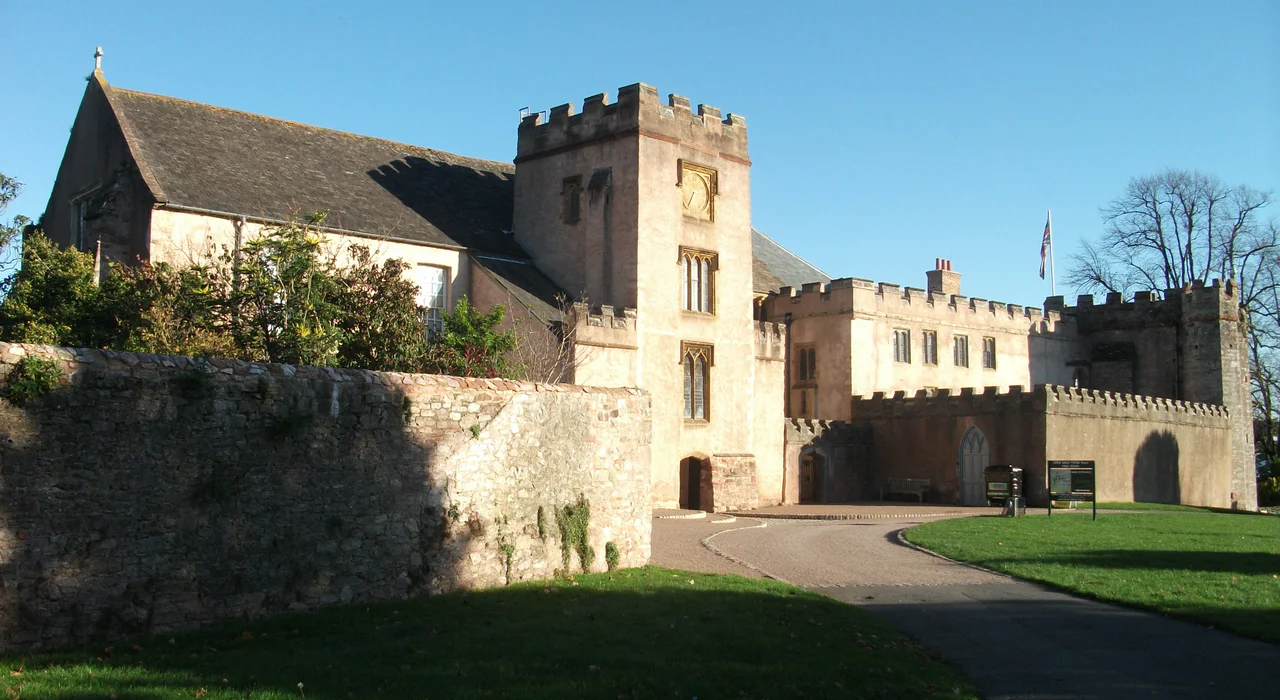

Torre Abbey
Six men in white robes arrived at Torquay in 1196, sent west from Welbeck Abbey in Nottinghamshire with permission from a Devonshire lord named William Brewer to begin again. They were Premonstratensian canons, a strict order that favored white wool and silent meals, and the abbey they planted on Brewer's land would outgrow every other house of their order in England. Three and a half centuries later, when Henry VIII's commissioner walked through the gate in 1539 to take it all away, Torre Abbey was the richest Premonstratensian house in the country. What stands today at the edge of Torquay is the strangest kind of survivor: not the abbey the canons knew, but the long ghost of it, layered with Tudor renovations, Georgian elegance, a Spanish Armada prison story, and a contemporary art gallery hung with William Blake and Pre-Raphaelite paintings.
Six White Robes and a Gift of Land
The Premonstratensians were a French foundation, austere cousins to the Cistercians, and their canons combined monastic life with pastoral work in surrounding parishes. When William Brewer, lord of the manor of Torre, deeded land to the order in 1196, he gave them a small piece of a coastline that nobody yet called the English Riviera. They built a church, cloisters, a guest hall, and an enormous tithe barn to hold the grain that flowed in from their granges. The abbey prospered, in the way medieval English abbeys prospered, by becoming a center of agriculture and trade as much as prayer. By the early sixteenth century, the canons were the wealthiest of any Premonstratensian community in England. That wealth made them visible. When Henry VIII began dismantling the monasteries to fund his crown and remake the church, Torre Abbey could not have hoped to slip past the king's commissioners. In 1539 the canons surrendered the abbey. The lead was stripped from the roofs. The east range and the church were torn down for stone.
The Spanish Barn
Half a century after the dissolution, in the summer of 1588, the Spanish Armada was making its broken way along the south coast of England. One of its ships, the Nuestra Senora del Rosario, was captured by Francis Drake and brought into Torbay. Its crew, 397 men, needed somewhere to be held while their fate was decided, and the enormous tithe barn at Torre Abbey, built with the original thirteenth-century walls still standing, was the only structure large enough. For fourteen days the Spaniards lived inside it. Whether they slept on straw or stone, the chroniclers do not entirely say. What they left behind was a name. The tithe barn has been called the Spanish Barn ever since. It is still there, still roofed, still cavernous, and on a quiet day you can walk its length and feel the way sound moves through a space that has held grain, prisoners, and four hundred years of weather.
The Cary Family's Long Tenure
After the dissolution the surviving abbey buildings became a private residence, converted in 1598 for Thomas Ridgeway MP, and then passed through a chain of owners until 1662, when the Cary family acquired them. The Carys would hold Torre Abbey for the next 268 years. They were Catholics in Protestant England, which made for complications, but they were also persistent restorers. Around 1740 they gave the buildings a Georgian remodeling that mostly survives intact. They added a brewery in the nineteenth century. They walked their gardens, raised their children, and were buried in St Saviour's Church, where monuments to various Carys still stand. Admiral John Jervis, Earl of St Vincent, lived at Torre Abbey for a stretch between 1800 and 1801, while in command of the Channel Fleet and too ill to remain at sea. The abbey became a place for convalescence, for retreat, for the long slow private life that aristocratic Devon offered to those who had earned it. In 1930 Commander Henry Cary sold the mansion and grounds to Torquay Borough Council.
Art Under a Medieval Roof
Torre Abbey reopened in July 2008 after a six-and-a-half-million-pound refurbishment funded by the Heritage Lottery Fund, English Heritage, and the Friends of Torre Abbey. What visitors find inside is unexpected. The permanent collection includes works by William Blake, the Pre-Raphaelite Edward Burne-Jones cartoons known as The Planets, and William Holman Hunt's The Children's Holiday. The abbey houses the entire studio contents of the Victorian sculptor Frederick Thrupp, the largest such collection by any single Victorian sculptor anywhere in Britain. Contemporary art also lives here: Antony Gormley's Field for the British Isles was shown in 2009, and Damien Hirst's Mother and Child, Divided in 2010. The Torre Abbey Contemporary Open exhibition gives South West artists a yearly platform. The medieval church is little more than a ruin now, but the west and south sides of the cloisters still stand, the 1380 gatehouse still welcomes visitors, and a fifteenth-century barrel vault still arches above a chapel that was once a guest hall. The canons would not recognize what their abbey has become. They might, after a moment, recognize that the place is still doing what they hoped it would do: holding work that takes a long time to make, and giving it room to be seen.
From the Air
Torre Abbey sits at 50.4628N, 3.5397W on the western shore of Tor Bay, just inland from the seafront at Torquay. Best viewed from 2,000 to 4,000 feet, where the abbey grounds and Abbey Meadows show clearly against the surrounding hotels and gardens of the English Riviera. Exeter Airport (EGTE) lies roughly 18 nautical miles to the north and offers the most convenient arrival. Look for Torre Abbey just south of Torquay harbour, with the sweep of Tor Bay opening to the east and Brixham visible across the bay on the southern headland.
Nearby Stories
- Torcross 2.8 km away
- Cotehele 4.6 km away
- HMS Formidable (1898) 9.1 km away
- Holsworthy 9.4 km away
- Eddystone Lighthouse 11 km away
- Tiverton Castle 18 km away
- 1890 Norton Fitzwarren Rail Crash 24 km away
- Lyme Bay Canoeing Disaster 26 km away