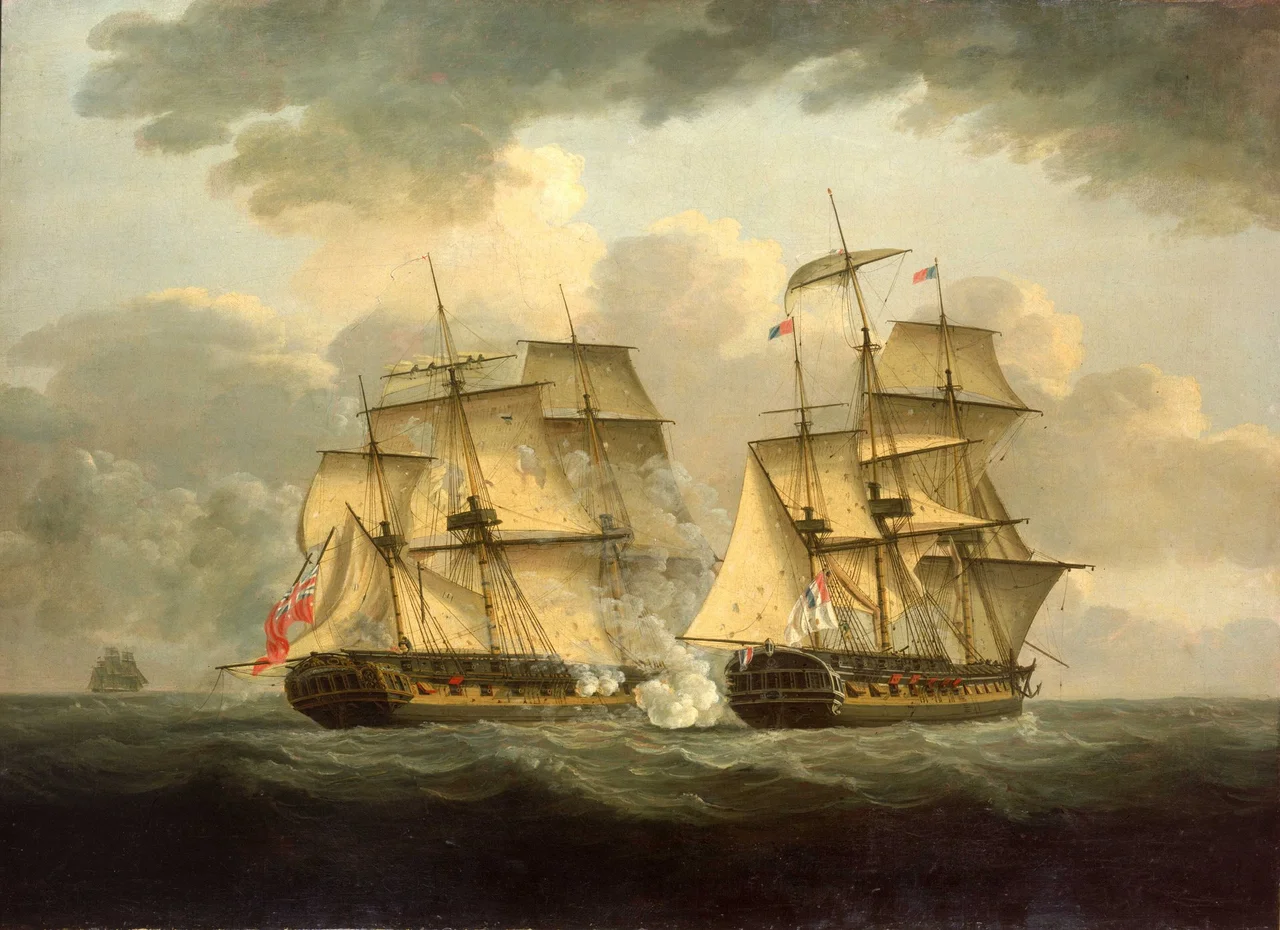
Action of 18 June 1793
It was barely past dawn off Start Point on 18 June 1793, and the French frigate Cleopatre's wheel had just been shot to splinters for the fourth time. Four helmsmen had taken the spokes since sunrise; four helmsmen had been killed. The mizzenmast snapped off twelve feet above the deck. With nothing left to steer her, Cleopatre lurched into the side of HMS Nymphe, her jib boom jamming between Captain Edward Pellew's masts as the two ships drifted together off the Devon coast. Pellew, who had readied his men to repel a boarding party, looked at the tangle of rigging and shouted the opposite order. Climb across. Take her.
A New War, a Different Navy
France had been at war with Britain only four months when this fight broke out. The National Convention had voted to expand the Revolutionary Wars in February 1793, and the French navy that had once been the Royal Navy's equal was no longer the same service. The Revolution had gutted its professional officer corps; trained seamen-gunners had been abolished as elitist. Crews were green. From Cherbourg, two big French frigates - Cleopatre and Semillante - had been picking off British merchantmen across the western Channel and into the Atlantic. The Admiralty sent Nymphe and Venus to hunt them down. On 27 May, Venus under Captain Faulknor caught Semillante off Cape Finisterre and fought her for two hours before Cleopatre came up to drive the British ship off. Now it was Pellew's turn.
Edward and Israel
Edward Pellew was thirty-six and already a name in the service, but the man at his side that morning was his younger brother Israel - an unemployed reserve officer who had volunteered to come along as a passenger. The Pellew brothers would become two of the most consequential frigate captains of the era; Israel would one day capture the French flagship Bucentaure at Trafalgar in 1805, in command of HMS Conqueror. For now they were aboard a thirty-six-gun fifth-rate, freshly resupplied at Falmouth, cruising eastward along the Devon coast in search of the French raiders. At 03:30 on the 18th, with the sky still grey, a lookout aloft saw a sail twenty miles to the southeast. Pellew turned to chase. By 05:00, with the wind freshening, it was clear Nymphe could close. Captain Jean Mullon shortened sail and turned to fight.
Cheers and a Cap of Liberty
What followed had the strange ceremony of an older war. At 06:00 the ships drifted into hailing range. Mullon called something across the water; the words were lost. Pellew's men cheered three times - some accounts say for King George. The French cheered back - Vive la nation, or Vive la republique - and one sailor scampered aloft to lash the captain's red Phrygian cap to the masthead, the cap of liberty, an open dare. Then both crews opened fire. The exchange lasted fifty minutes at close pistol shot. Cleopatre's wheel was wrecked. Mullon went down mortally wounded; his crew refused his order to storm the British ship even before the masts fell. When Cleopatre swung uncontrollably into Nymphe and the two frigates jammed together, Pellew sent his boarders climbing through gunports, over yards, across the bowsprit, into the smoke.
Ten Minutes on the Maindeck
The hand-to-hand fighting on Cleopatre's deck took ten minutes. Without officers, the French crew broke. More than a hundred prisoners were ferried across to Nymphe; another hundred and fifty stayed under guard on the prize. The butcher's bill ran to sixty-three French casualties against fifty British. Captain Mullon died of his wounds. Pellew, his brother, and the wounded prize sailed together into Portsmouth on 21 June with Cleopatre under British colours - the first major French warship taken in the war. Cheap prints flooded London within a week, most of them wildly inaccurate. Lord Chatham took both Pellew brothers to be introduced to King George. Edward came away with a knighthood; Israel, still technically an unemployed volunteer when the fight began, walked out promoted to post captain.
What the Action Bought
Historian William James, looking back from the Victorian era, judged the fight evenly matched - Nymphe slightly heavier in tonnage and broadside weight, but Cleopatre carrying eighty more hands who had been a crew longer. What broke the French was the loss of their officers under fire and the appalling concentration of casualties around the wheel. Both sides, James wrote, fought with equal bravery; the outcome was decided by ten minutes of chaos on the maindeck. Cleopatre served the Royal Navy until 1816. Edward Pellew went on to command HMS Indefatigable, destroyed the French ship of the line Droits de l'Homme in 1797, and ended the long French wars as commander in chief in the Mediterranean. More than half a century later, in 1847, the few surviving men of Nymphe who applied received a clasp to the Naval General Service Medal for that bright cold morning off Start Point when they had cheered three times and gone over the side.
From the Air
The action was fought roughly 15 nautical miles southwest of Start Point, Devon, at about 50.22 degrees N, 3.58 degrees W - open water in the western English Channel between Start Point and the Brittany peninsula. Start Point lighthouse on the Devon coast is the visible landmark to the north; the French Channel coast lies more than 60 miles to the south. Nearest airports today are Exeter (EGTE) about 30 miles to the north and Plymouth's former airfield (EGHQ - closed 2011); Newquay Cornwall (EGHQ has been reassigned) and Bournemouth (EGHH) are the other regional options. Cruise altitudes of 2,500-4,000 feet give long views from the Lizard around to Portland Bill. The southwest approaches are busy with shipping; expect low cloud, sea fog, and occasional squalls year-round.
Nearby Stories
- Dartington Hall 0.3 km away
- Eddystone Lighthouse 3.4 km away
- Cotehele 5.2 km away
- HMS Formidable (1898) 7.8 km away
- Lyme Bay Canoeing Disaster 34 km away
- HMS Affray 48 km away
- Casquets Lighthouses 61 km away
- Battle off Lizard Point 72 km away