
Dartington Hall
Rabindranath Tagore once stayed at Dartington. So did sixty refugee dancers, sculptors, and playwrights from Continental Europe in 1938. Lucian Freud spent two years here as a schoolboy. Oliver Postgate, who would go on to create Bagpuss and the Clangers, was a pupil. Anthony Blunt, the Cambridge spy, recruited the founders' son at Cambridge as a Soviet agent. And under the great hammerbeam roof of the Great Hall - one of the finest medieval rooms in England - a string quartet has played, a Shakespeare scene has been staged, and a wedding party has danced, almost every week since 1925. The story of Dartington is the story of what happens when you put 800 acres of medieval England in the hands of two people who genuinely believe they can change the world.
The Hall the Duke Built
The Martin family held the feudal barony of Dartington from the early 12th century until 1326. When the last male heir died, the estate escheated to the crown, and in 1384 King Richard II granted it to his half-brother John Holland, made Duke of Exeter in 1397. The Duke built the medieval hall between 1388 and his death in 1400. The arms of Richard II were sculpted into the porch vault, where they still survive. The first Duke was beheaded by Henry IV. His son and grandson held the estate before the third Duke was supposedly drowned at sea on the orders of Edward IV in 1475, and the manor escheated to the crown a second time. The Champernowne family acquired it in 1559 and held it in a direct male line for 366 years. By the time the last Champernowne sold up in 1925, the medieval buildings were largely derelict.
The Elmhirsts Arrive
Leonard Elmhirst was a Yorkshireman who had worked with Rabindranath Tagore on rural reconstruction in Bengal. Dorothy Whitney was a New York heiress, widow of the American statesman Willard Straight, and one of the richest women of her generation. They married in 1925 and bought Dartington that same year. The choice of estate was reportedly Tagore's recommendation. The Elmhirsts commissioned the architect William Weir to restore the medieval buildings, and Weir's most spectacular achievement was the rebuilding of the Great Hall's hammerbeam roof - the finest of its date in England, according to Pevsner. With the medieval bones repaired, the Elmhirsts began the experiment that would define the next century. Progressive education. Crafts. Theatre. Agriculture. Peace movements. Eastern philosophy. "Social and spiritual questing," as one observer put it.
The School That Would Not Punish Anyone
Dartington Hall School opened in 1926 with a manifesto unlike any in England: no corporal punishment, no punishment of any kind. No prefects, no uniforms, no Officers' Training Corps. No segregation of the sexes. No compulsory games, no compulsory religion. No Latin, no Greek. No competition. The children learned by helping with estate work. Over time more conventional academics crept in, but the founding spirit held. Alumni would include Lord Young - founder of Which? and the Open University - Lucian Freud and his brother Clement, the children's broadcaster Oliver Postgate, the writer Jasper Fforde, the biographer Claire Tomalin, and the sculptor Sokari Douglas Camp. The Elmhirsts' own son Michael Straight attended, went on to Cambridge, became a speechwriter for Franklin Roosevelt, and revealed decades later in his memoir that Anthony Blunt had recruited him as a Communist agent at Cambridge. The school's reputation later soured under a controversial headmaster and it closed in 1987.
The Gardens, the Yew, and the Henry Moores
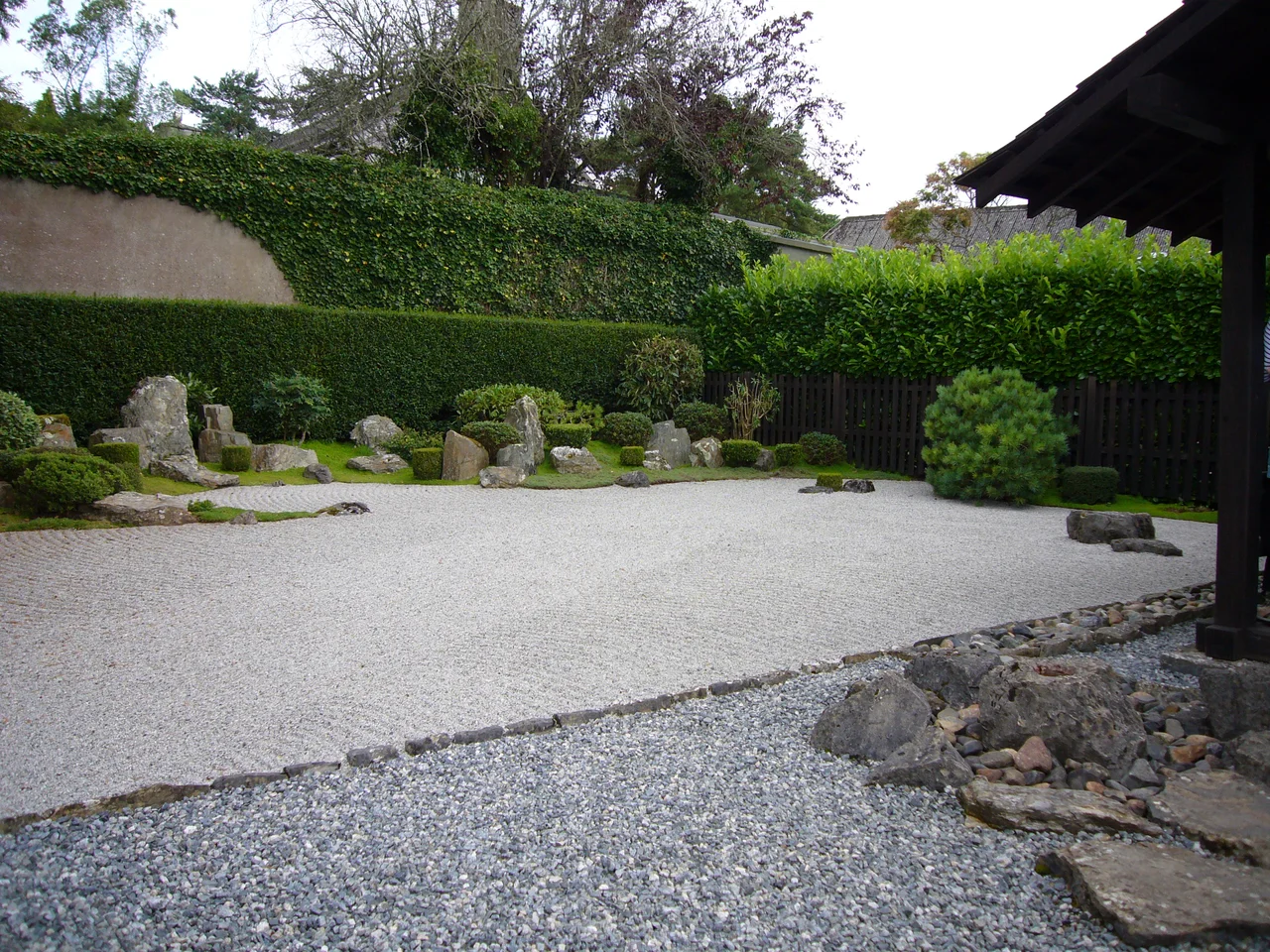
Dorothy Elmhirst created the gardens with the American landscape designer Beatrix Farrand and the English designer Percy Cane. They restored what they took to be a medieval tiltyard and was probably the remains of an Elizabethan water garden. They installed sculptures by Henry Moore, Willi Soukop, and Peter Randall-Page. At the heart of the gardens stands an ancient yew tree, Taxus baccata, reputed to be nearly two thousand years old - which would put its first sprouts around the time of the Roman conquest of Britain. Legend says Knights Templar are buried in the churchyard nearby, though no evidence supports the claim. The Dartington Music Summer School, founded in the 1940s, drew composers including Berio, Nono, Birtwistle, and Lutoslawski. It ran for over seventy years before being reformed into ChoralFest in 2023.
The Trust Continues
The Dartington Hall Trust was established as a registered charity in 1935 to run the estate, and runs it still. The Trust has funded Schumacher College, the Dartington Arts School, the Beaford Centre, the Dartington Crystal factory in Great Torrington, and dozens of other ventures over the decades. Not all have lasted. The school closed in 1987. The arts college closed in 2010. Schumacher and the new Arts School both closed in September 2024. The Trust has also sold off significant artworks - Tagore paintings at Sotheby's in 2010, Ben Nicholsons and Alfred Wallises in 2011 - moves that have generated periodic criticism. What endures is the place itself: 800 acres of Devon, a medieval courtyard, the great hammerbeam roof, the yew tree, the gardens, the river. The experiment may have finished its first century. The estate is preparing for its second.
From the Air
Dartington Hall sits at 50.4518 N, 3.6938 W, in the Dart valley a mile and a half north-west of Totnes. View from 2,500 to 4,000 feet to see the medieval courtyard, the gardens, the surrounding estate, and the Dart winding past. Nearest airport is Exeter (EGTE), about 23 nautical miles north-east. The Great Hall, with its distinctive slate roof and chimneys, forms one side of the obvious medieval rectangle. The gardens fall away to the south. Dartmoor rises clearly to the north-west; the estuary at Dartmouth opens to the south-east. Best in spring when the gardens are flowering, or autumn when the parkland turns.
Nearby Stories
- Torcross 2.8 km away
- Cotehele 4.6 km away
- HMS Formidable (1898) 9.1 km away
- Holsworthy 9.4 km away
- Eddystone Lighthouse 11 km away
- Tiverton Castle 18 km away
- 1890 Norton Fitzwarren Rail Crash 24 km away
- Lyme Bay Canoeing Disaster 26 km away