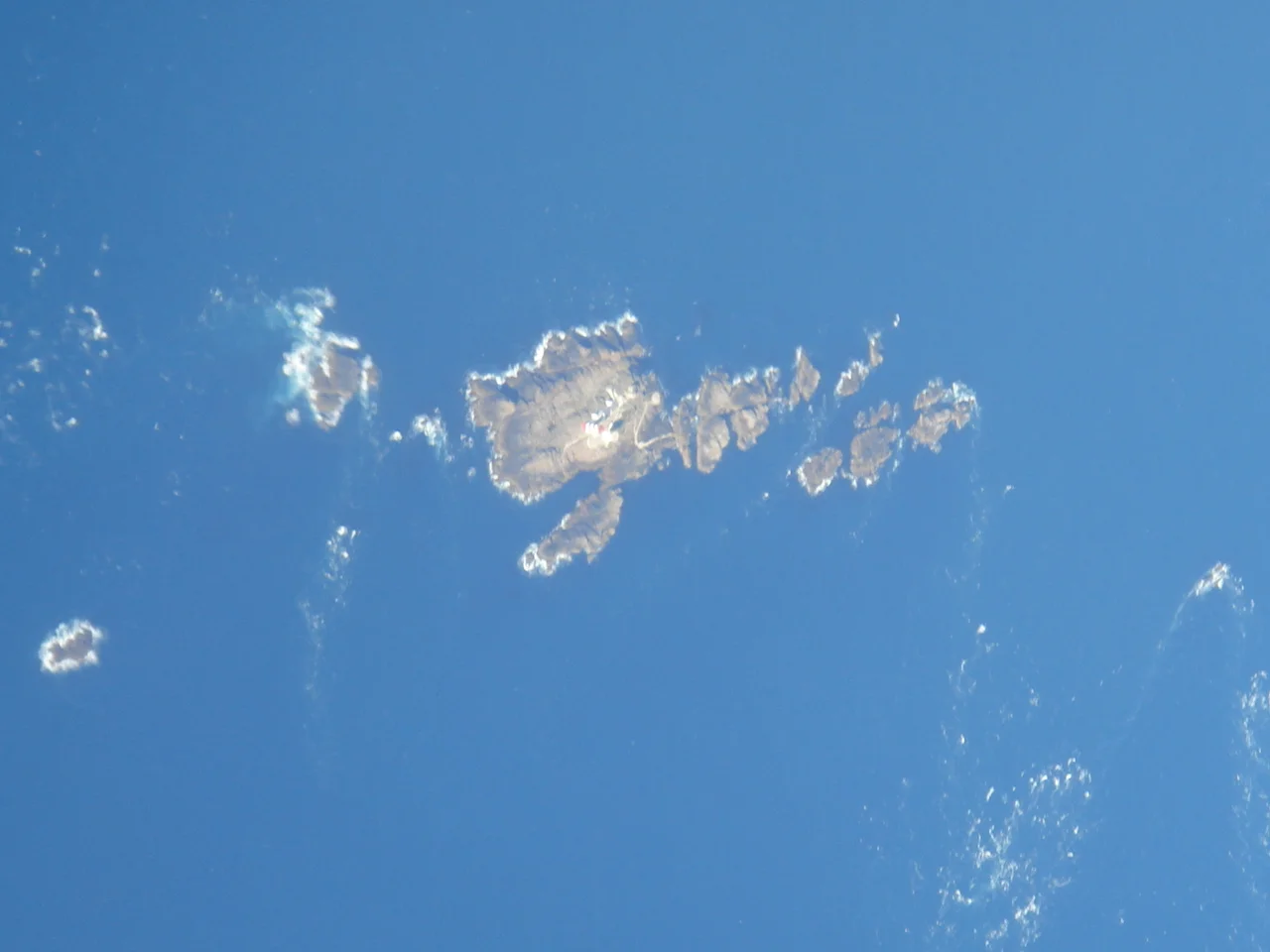

Casquets Lighthouses
The choice to build three lighthouses on one rock was a deliberate exercise in visual fingerprinting. By the early 1720s, the Casquets - a jagged outcrop seven miles west of Alderney - had drowned enough ships that the rationale for a light was obvious. The harder problem was how to keep mariners from confusing it with the French lights to the south or the brand-new double tower at Portland Bill to the north. Three coal fires arranged in a tight cluster created an unmistakable signature: a distinctive triangle of flame that could only be the Casquets. They were named St Peter's, St Thomas, and Dungeon. They were lit, simultaneously, on 30 October 1724. Three centuries later, on 13 July 2024, Trinity House quietly unveiled a tercentenary plaque inside the active tower.
Three Coal Fires Above a Drowning Rock
The towers were quarried from the rock itself, the two western ones taller than the third so all three flames sat at the same elevation. The arrangement was the work of Thomas Le Cocq, who held the right to operate the lights from Trinity House for £50 a year - and charged passing ships accordingly (foreign vessels paid double). Each tower had a coal brazier inside a glass lantern designed to keep the wind off the fire and the sailors' eyes on the light. The system was elegant in theory and fragile in practice. The glass kept getting soot-blackened. After HMS Victory went down with over a thousand souls in 1744, an inspection found broken panes replaced with wood and larger braziers from Trinity House sitting unused - Le Cocq had been economising on coal.
A Family Living on a Rock
By the 19th century the lights were being mechanised. A single clockwork mechanism, connected to all three towers by a clever rigging of ropes and sheaves, revolved the lamps in synchrony. The compound on the rock had grown into something between an outpost and a small holding. There were living quarters for the keeper's family, an agent's house, a carpenter's shop, storage rooms (mostly inside the two western towers) for provisions brought 'in fair season,' and a vegetable garden. The soil for the garden had been carted out from Alderney; nothing grew on bare Casquet stone otherwise. The family kept poultry, caught a great many fish - eaten fresh or cured for winter - and ate Trinity House rations of salt beef, flour, malt, and biscuit. A shutter telegraph let them signal Alderney. Different coloured flags told approaching boats which of the two (later three) landing rocks was safe to use, hour by hour.
From Coal Brazier to LED
A new revolving apparatus arrived in 1818, needing to be wound every ninety minutes. In 1847 a 12-hundredweight fog bell was bolted to a small square tower near the Dungeon light, ringing once every five minutes when visibility dropped. In 1858 the towers got individual clockwork drives. The transformative upgrade came in 1877: the North West Tower was raised again and given a first-order dioptric optic from the celebrated Chance Brothers of Birmingham. The old lantern was not discarded - one panel was reused at Bideford, another at South Stack. A disc siren replaced the bell by 1902, sounded through a 22-foot vertical trumpet. A diaphone, powered by Blackstone semi-diesel engines, replaced the siren in 1922 and would run until 1970. A radio beacon went up in 1928. Helicopter access arrived in 1972, ending decades of boats-only resupply, and a helipad was eventually built on top of the old St Thomas tower.
Solar, Wind, and a Quieter Rock
Automation came in 1990. The keepers left. The old diaphone was decommissioned and an electric fog signal took its place on the parapet. In 2010 Trinity House began a two-year modernisation that converted the station to run entirely on solar and wind power. The visible range was reduced from 24 nautical miles to 18, and the fog signal was permanently silenced on 11 May 2011 - a small ceremony for an old voice. The active light still revolves through the 1877 optic, but the source is now LED, with a second LED flasher on the lantern roof as a standby. The South West Tower carries a helipad, and another sits on a flat section of rock nearby. The rocks themselves are marked on radar with a racon flashing Morse T. The whole station is monitored from a control room in Harwich, hundreds of miles away. On the rock itself, the gardens are gone, but the three towers still stand together, as they were built to be seen.
From the Air
Les Casquets lie 8 nm west of Alderney at 49.722°N, 2.377°W - the conspicuous group of jagged rocks off the western tip of the island. The active North West Tower is 23 metres tall, with the light 37 metres above mean sea level, flashing five times every 30 seconds. From the air the three towers are visible in clear weather as a tight cluster on a low rock outcrop, with helipads on the southwest tower and on the rock itself. Best viewing altitude 1,000-3,000 ft. Nearby airports: Alderney (EGJA) 8 nm east, Guernsey (EGJB) 25 nm south-southeast, Cherbourg-Maupertus (LFRC) 30 nm east.
Nearby Stories
- 1993 Cherbourg Incident 6.2 km away
- Channel Islands 7.4 km away
- Abbey of Saint-Sauveur-le-Vicomte 17 km away
- German Submarine U-672 21 km away
- HMS Formidable (1898) 38 km away
- HMS Affray 57 km away
- Needles Lighthouse 83 km away
- HMS Brisk (1851) 251 km away