
Needles Lighthouse
The original lighthouse for The Needles, lit for the first time on 29 September 1786, was a tall tower built on the clifftop above Scratchell's Bay, 496 feet above sea level. It was meant to warn ships approaching the western entrance to the Solent. There was just one problem. From sea level, the light was often obscured by fog, low cloud and the sea mist that wraps the chalk pinnacles of the Isle of Wight for half the year. A lighthouse you cannot see is just an expensive building. By 1859, after 73 years of frustration, Trinity House had built something better: a 33-metre granite tower standing directly on the outermost chalk stack of The Needles, almost at sea level, where the lamp could not be hidden by the very weather it was meant to cut through.
The First Light Above Scratchell's Bay
In 1781 a group of merchants and shipowners petitioned Trinity House for navigation lights around the western approaches to the Solent. The response was positive, but it took until 1785 for construction to begin on three new lighthouses: one above The Needles, one at Hurst Point, and one on St Catherine's Down on the Isle of Wight. The last was left unfinished and never lit. All three were designed by Richard Jupp. The Needles lighthouse on the cliff was lit by thirteen Argand lamps with parabolic reflectors. The light was initially white, but on 1 March 1840 it was changed to red so that mariners would not confuse it with the newly built lighthouse at St Catherine's Point. The fog problem never went away. The cliff was too high, the weather too thick, the light too often invisible when ships needed it most. After seventy years of complaints, Trinity House finally agreed to start again, lower down.
Building on a Chalk Stack
The new lighthouse was designed by James Walker and completed in 1859, at a cost of £20,000. It is a circular tower of granite blocks with straight sides, 33.25 metres high, standing on the outermost of the chalk pinnacles known as The Needles. Before the masons could begin, a sizeable section of rock had to be cut away to create a level base. Tunnels were excavated into the chalk behind the tower to provide storage rooms. The original light source was an oil burner with four concentric wicks, set inside a large first-order fixed catadioptric optic provided by Henry-Lepaute of Paris. By 1884, a green sector had been added and the light made occulting, eclipsing at regular intervals to make it easier to identify. The tower itself was originally left as plain granite, neither painted nor coated, the chalk-coloured stone matching the rocks beneath.
Half a Million Candlepower
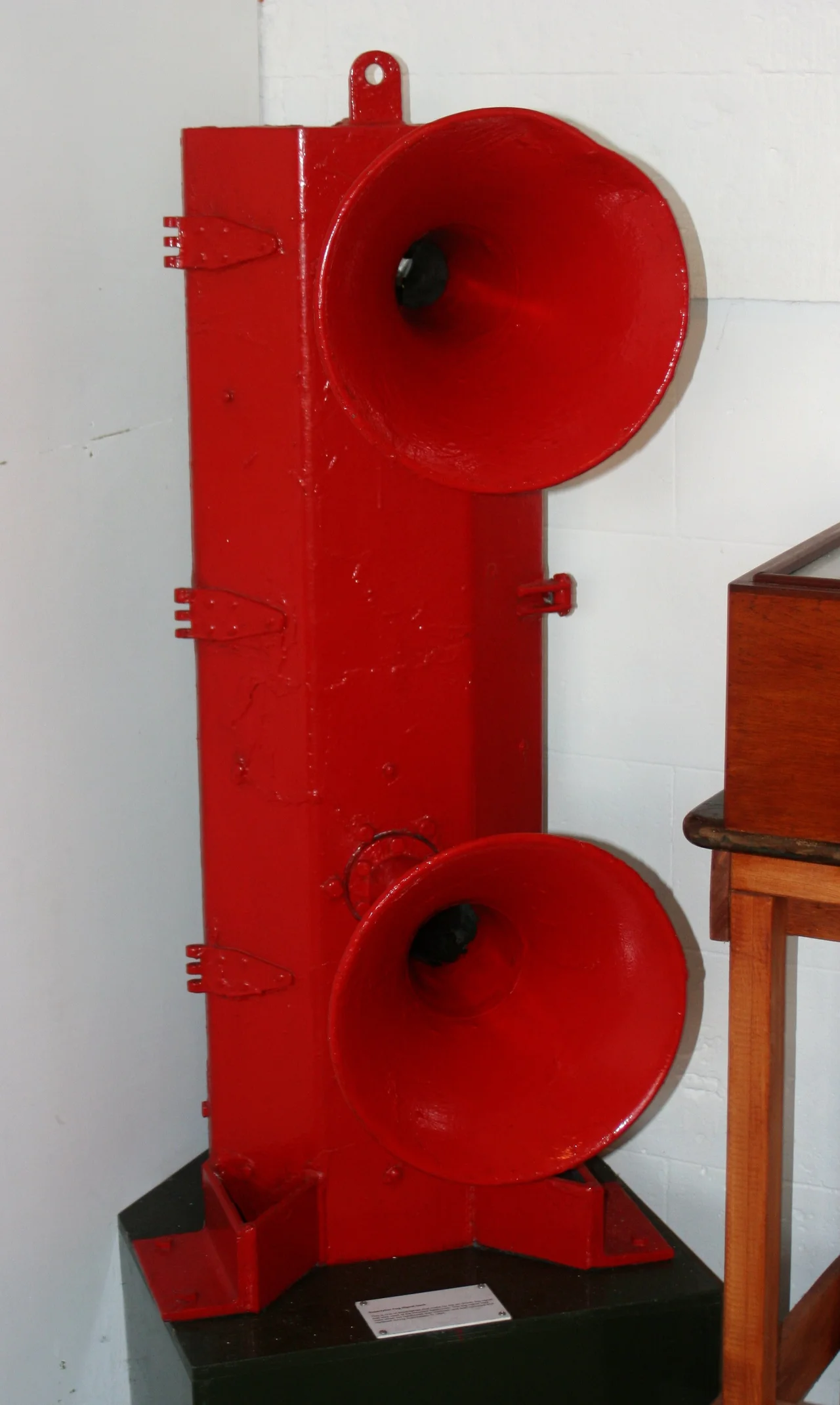
In 1922, a more powerful incandescent paraffin vapour burner was installed, lifting the light's intensity from 35,000 to 500,000 candlepower. A 1906 reed fog signal had already added a long blast every fifteen seconds from three acoustic horns protruding through the lantern roof, powered by a pair of oil engines in the basement. During the Second World War, German aerial attack badly damaged the lantern, lens and lamp. The lighthouse was repaired after 1945: a new electric light was installed in 1946, powered by diesel generators producing 100-volt direct current. In 1948 a new second-order fixed catadioptric optic was made by Chance Brothers to replace the lens destroyed by the German attack. The fog signal kept evolving too: by the time the reeds were replaced in the 1990s, two sets of supertyfon air horns mounted on the parapet sounded twice every thirty seconds. In 1994, electric emitters took over.
Three Men, One Month On, One Off
Before automation, the lighthouse was staffed by a three-man crew operating a 24-hour watch, serving one month on and one month off. They lived in cramped quarters in three levels below the light, on a granite tower surrounded by surging Atlantic-driven water. In 1987 a helipad was added to the top of the lighthouse, manufactured and installed by Multiforce, a firm run by twin brothers Martin and Neil Hammond. During installation the workforce had to live on the lighthouse, with the keepers retaining the right to dismiss any workers if the cramped conditions became intolerable. By the early 1990s the Needles was the last Trinity House lighthouse still powered by 100-volt direct current from its own generators. Soon after, automation arrived and the keepers were gone, the way they had been gone from almost every British lighthouse by the end of the decade.
Underpinning the Chalk
By 2010 the lighthouse had a more fundamental problem than fog or war damage. The chalk stack on which it stood was eroding, and engineers concluded that without intervention the entire structure would eventually slide into the sea. In April that year Trinity House announced a £500,000 underpinning project. Over twelve weeks from early June, civil marine contractors Nuttall John Martin excavated a trench around the base of the tower, then installed a ring of stabilising posts reinforced with concrete. The lighthouse would stay where it was. In 2023 a further upgrade removed redundant equipment, and in May of that year the range of the light was reduced as part of the modernisation. The Needles Lighthouse continues to mark the western approaches to the Solent, a granite tower clamped to a chalk pinnacle, with a helipad on top, holding its ground against the same sea that has been working at the Isle of Wight for 7,000 years.
From the Air
Located at 50.66 degrees North, 1.59 degrees West, on the outermost chalk stack of The Needles at the western tip of the Isle of Wight. The lighthouse is unmistakable from any altitude: three or four chalk pinnacles rising from the sea, with the granite tower on the seaward end. Bournemouth Airport (EGHH) is 13 nm west. Southampton (EGHI) is 16 nm northeast. Best viewed at 2,000 to 5,000 feet on a clear day; the contrast between white chalk, blue water and the dark granite of the tower is striking.
Nearby Stories
- Romsey Abbey 5.8 km away
- Shaftesbury Abbey 7 km away
- The Tank Museum 9.7 km away
- HMS Warrior (1917) 12 km away
- Fishbourne Roman Palace 22 km away
- Farnham 32 km away
- Operation Donnerkeil 58 km away
- D-Day: The Longest Day 145 km away