
Fleet Air Arm Museum
The fuselage of Short 184 number 8359 hangs in Hall 1, unrestored, the canvas torn in places, the timber visibly scorched. The little floatplane was built by Westland Aircraft just up the road in Yeovil in 1916, and it flew at the Battle of Jutland that May, the first aircraft in history to carry out a torpedo attack on enemy warships from the air. It went to the Imperial War Museum in London and was damaged when a Luftwaffe bomb hit the building during the Second World War. Now it sits at the Fleet Air Arm Museum at RNAS Yeovilton, on the very airfield where Westland still builds helicopters, telling a hundred and ten years of naval aviation in one room.
The Working Airfield
The Fleet Air Arm Museum is unusual among British military aviation museums in that it shares its location with an active Royal Naval Air Station. RNAS Yeovilton lies seven miles north of Yeovil in the flat Somerset countryside between the Mendip Hills and the Quantocks. Helicopter squadrons fly from it daily. The museum has dedicated viewing areas where visitors can watch military aircraft, especially the Wildcat and Merlin helicopters operated by the Royal Navy, take off and land alongside the static collection inside the halls. The entrance is flanked by anchors from two fleet carriers, Ark Royal and Eagle, that served the Royal Navy until the 1970s, the era that the museum spends most of Hall 3 recreating in considerable detail.
Four Halls, A Century of Aircraft
Hall 1 traces the development of naval aviation from fabric-covered biplanes and airships to modern jets, with the Short 184 as its centrepiece and a row of restored cockpits and engines along the walls. Hall 2 covers the Second World War, including a side room with a Yokosuka MXY-7 Ohka II suicide aircraft, models of Japanese aircraft and the final letters of kamikaze pilots presented with appropriate gravity. Two Korean War aircraft sit alongside. A 2023 refresh transformed Hall 3 into a walk-through replica of a 1970s fleet carrier, entered through a converted Wessex helicopter that vibrates on its mounts, with a simulated lift ride to the top of the carrier island, a series of projection rooms, and a Supermarine Seafire and other historic aircraft as the carrier's air group. Hall 4 holds the largest single object in the collection: British Aerospace prototype Concorde 002, the first British-assembled Concorde, which made its maiden flight in 1969 and is displayed alongside a BAC 221, a Bristol Scout, and a Hawker Hunter T8M used in Concorde development.
The Stories Behind the Aircraft
Smaller displays around the museum carry some of its most affecting material. Operation Skua reconstructs the recovery of Blackburn Skua L2940, lost on operations and salvaged decades later. The Battle of Taranto display, the Fleet Air Arm's most celebrated exploit of the Second World War, includes a Fairey Swordfish biplane of the same type that crippled the Italian fleet at anchor in November 1940. Barracuda Live: The Big Rebuild gives the public a window onto the active restoration of Fairey Barracuda DP872, lifted from a Norwegian fjord seven decades after she went down. Pioneers to Professionals tells the story of women in the Royal Navy, from the Wrens of the World Wars to the women who fly front-line aircraft today. Saved: 100 Years of Search and Rescue gathers three helicopters whose crews have plucked civilians and sailors from the sea, alongside a soft play area for children that turns the same theme into something young visitors can clamber over.
Aircraft of the Falklands and the Future King
From 2023 a temporary Falklands exhibition has brought together five aircraft that served in the 1982 conflict, including types that flew from HMS Hermes and HMS Invincible during the recapture of South Georgia and the Falkland Islands. The Flight of the Red Dragon exhibition documents King Charles's own service in the Fleet Air Arm, when as Prince of Wales he qualified as a Royal Naval helicopter pilot and flew with 845 Naval Air Squadron from HMS Hermes in the mid-1970s. The Reserve Collection, housed in climate-controlled Cobham Hall across the road from the main museum, holds further aircraft under restoration, open to the public at least once a year. The aero-engine collection ranges from a Clerget 9B rotary of First World War vintage to a Rolls-Royce/Snecma Olympus 593 of the type that powered Concorde.
Watching the Helicopters
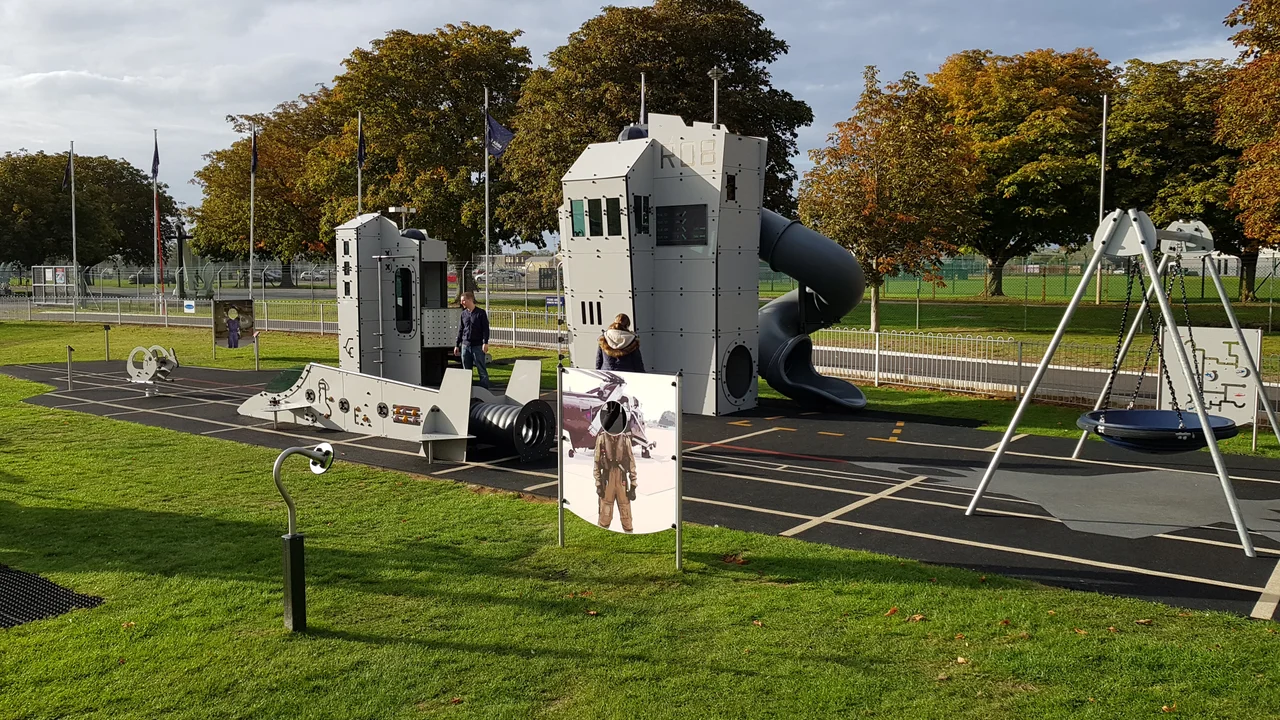
The Fleet Air Arm Museum opened in 1964, with its first hangar dedicated by Prince Philip, and has grown steadily since. It is now operated as part of the National Museum of the Royal Navy alongside Portsmouth and Hartlepool. What makes Yeovilton particularly worth visiting is the combination of static collection and operational airfield. A visitor can walk from Concorde 002 through to the carrier mock-up, then out to the viewing area and watch a Wildcat helicopter lift off a few hundred metres away, on its way to a North Sea exercise or a routine training sortie. The museum has cafes, an extensive shop, and an outdoor adventure playground; the airfield outside it has the engines of the modern Royal Navy at work. There are few places in Britain where so much aviation history sits so close to so much aviation present.
From the Air
Located at 51.014°N, 2.645°W at RNAS Yeovilton in southern Somerset, seven miles north of Yeovil. The museum sits on the south side of the active airfield (EGDY) - permission required for any approach within the Yeovilton MATZ. Best viewed from above 3,000 feet outside the MATZ. The airfield itself is a striking visual feature, with long parallel runways. Nearest civilian airfields: Henstridge (EGHS) 10 nm east, Bristol Airport (EGGD) 26 nm north-north-west, Compton Abbas (EGHA) 22 nm east. Montacute House and St. Michael's Hill are 5 nm to the south.
Nearby Stories
- New Wardour Castle 2.6 km away
- Cosmeston Medieval Village 9.6 km away
- Ottery St Mary 9.7 km away
- Royal Naval Cordite Factory, Holton Heath 9.8 km away
- Quantock Hills 11 km away
- M Shed 14 km away
- Maiden Castle, Dorset 17 km away
- Silbury Hill 20 km away