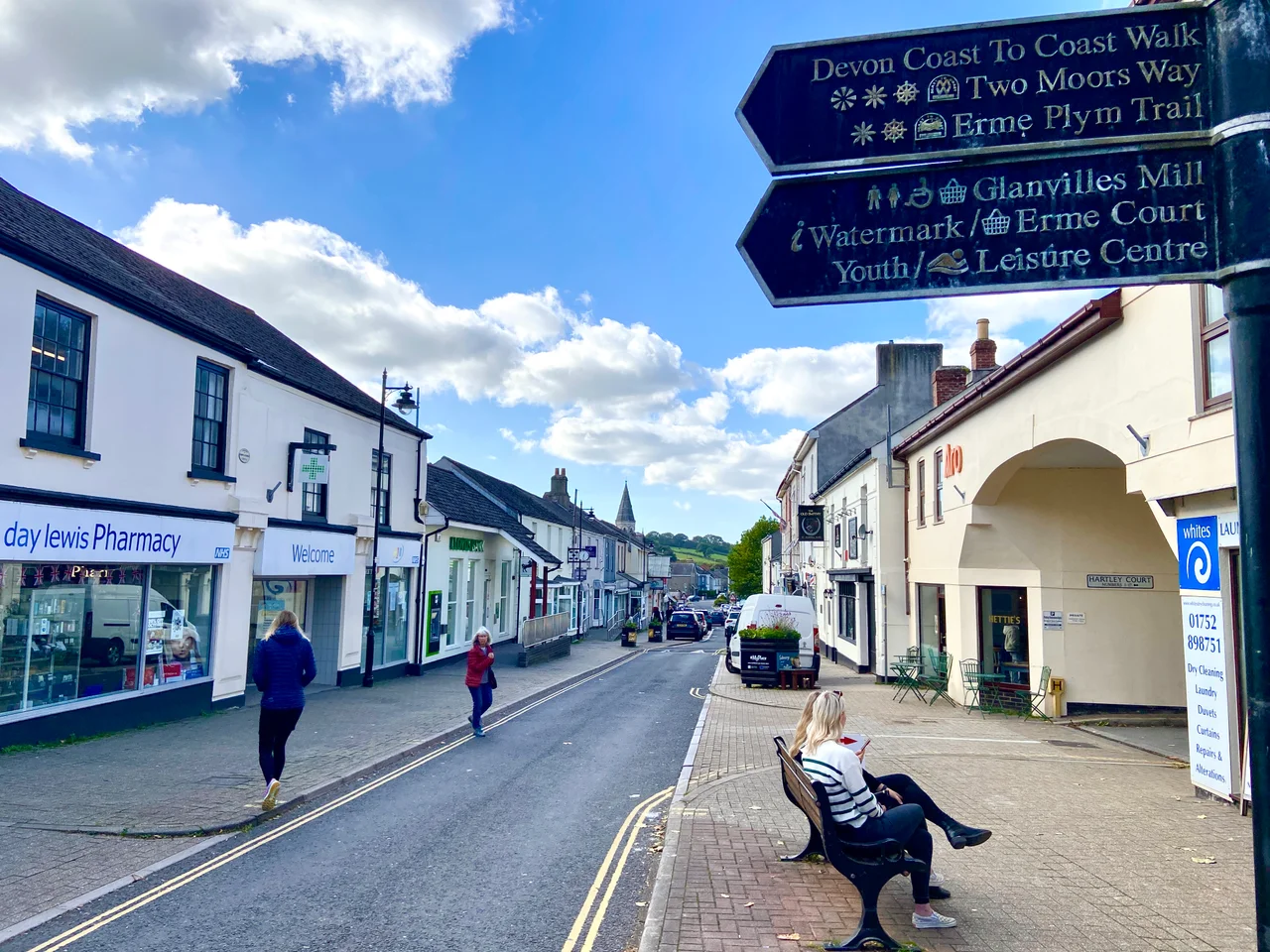

Ivybridge
The town is named for its bridge, and the bridge is named for the ivy that grew along its parapet. There is something pleasingly literal about Ivybridge, a place where the founding act and the founding name have remained visible to anyone who cares to look. The little 13th-century hump-backed crossing still stands at the heart of town, still carries cars one direction at a time, still spans the River Erme just as it has since the year Edward I was on the throne. The earliest written mention, in 1280, describes a parcel of land "on the west side of the River Erme, by the Ivy Bridge." Eight hundred years later, the bridge is the river crossing, the town is the bridge, and somewhere along the parapet, ivy still grows.
Where Four Parishes Met
For most of its existence, Ivybridge was not a place but a meeting point. Until 1894, the village belonged to four neighbouring parishes at once. Harford reached down from the north, Ugborough from the east, Ermington from the south, Cornwood from the northwest, and all four boundaries converged precisely on that small medieval bridge. A traveller standing at the centre of the parapet could have been in four parishes within the space of a few steps. The bridge was the only river crossing for centuries, the staging post on the road from Exeter to Plymouth, the place where horses were changed and travellers rested. In 1836 a small central area broke away to form its own parish of Saint John, and in 1894 the four-parish patchwork finally resolved into one. Ivybridge had become itself.
The Mill on the Erme
Power came from the river. By the sixteenth century the Erme was turning a corn mill, a tin mill, and an edge mill, each one harnessing the same falling water for different work. Glanville's Mill ground flour where the modern shopping centre now stands, lending its name to the streets that replaced it. Then in 1787 a paper mill rose at Stowford, and for 226 years it defined the town. Generations of Ivybridge families went to work at the mill, came home smelling of pulp and steam, and watched their wages build the terraced houses that still line Fore Street. The mill expanded through the Victorian boom, was rebuilt in the 1860s with extensive investment, and outlasted the era that created it. It closed in 2013. The vast brick buildings are now being converted into homes and shops, a paper mill ending its second life as the address of people who never made paper at all.
Brunel's Granite Piers
Isambard Kingdom Brunel built a railway viaduct across the Erme valley in 1848, and pieces of it are still standing. When the line was upgraded in 1894 the wooden superstructure was replaced, but Brunel's granite piers remained, and they remain to this day, marching across the valley alongside the operational viaduct that carries the modern Great Western trains to London Paddington. The railway transformed Ivybridge. The 1848 station made it possible for the mill workforce to grow, for goods to leave, for ideas to arrive. The population, which had been 1,574 in 1921, climbed past 12,000 by the end of the century. Western Beacon rises 1,076 feet above the town, and from its summit you can see the whole valley unfold: the river threading between the hills, the granite piers, the houses spreading east and west because the railway to the north and the A38 to the south have boxed in any other direction of growth.
The Memorial No One Forgets
Two memorials stand near the centre of town. The first, unveiled in 1922, marks the Ivybridge men who died in the First World War, equidistant from three of the churches that buried them. Every November the town gathers here, as towns across Devon do, to remember. The second memorial is newer and less expected. It commemorates the American servicemen stationed in and around Ivybridge in 1943 and 1944, men who trained in the lanes and pubs and farmhouses of the South Hams before crossing the Channel on D-Day. Many of them died on Omaha Beach. They were here only briefly, billeted in a town most had never heard of, but Ivybridge keeps their names alongside its own. Also from Ivybridge: Edmund Hartley, born here in 1847, who earned the Victoria Cross in the Basuto Gun War. Hartley Court on Fore Street bears his name.
The Walking Town
Ivybridge sits at the southern threshold of Dartmoor, and recent decades have reinvented it as the place where the moor begins. The Two Moors Way starts here, a 102-mile walking route that crosses Dartmoor, traverses central Devon, and finishes on the cliffs of Lynmouth on the North Devon coast. From the town centre you can follow the old china clay railway up to Redlake in the heart of the moor, or take the riverside path through Longtimber Woods, where the Erme runs between mossy granite boulders that travelled down from Dartmoor in some forgotten geological age. The Ivybridge Brewing Co. brews in town, working with people who have a diverse range of disabilities. The Watermark opened in 2008, doubling as library, cinema, and community space. The mill is gone but the bridge, the river, and the ivy are still here, where they have always been.
From the Air
Ivybridge sits at 50.389 degrees north, 3.921 degrees west, at the southern edge of Dartmoor National Park, roughly 13 miles east of Plymouth and 28 miles southwest of Exeter. From the air, look for the River Erme cutting south through a wooded valley between Western Beacon (1,076 ft) and the moorland to the north; the A38 expressway runs east-west across the valley's southern flank, and the mainline railway viaduct crosses just to the north. Nearest controlled airport is Exeter (EGTE), 28 miles northeast. Plymouth City Airport (EGHD) closed in 2011 but the airfield site remains visible to the southwest. Devon's South West Peninsula weather brings frequent rain off the Atlantic; visibility can drop quickly when fronts move in from the Channel.
Nearby Stories
- Davidstow Circuit 3.7 km away
- Golden Hind 3.9 km away
- Powderham Castle 4.4 km away
- Fowey Lifeboat Station 5.1 km away
- Okehampton Castle 12 km away
- Battle of Plymouth (1652) 19 km away
- Goonhilly Satellite Earth Station 44 km away
- German Submarine U-672 73 km away