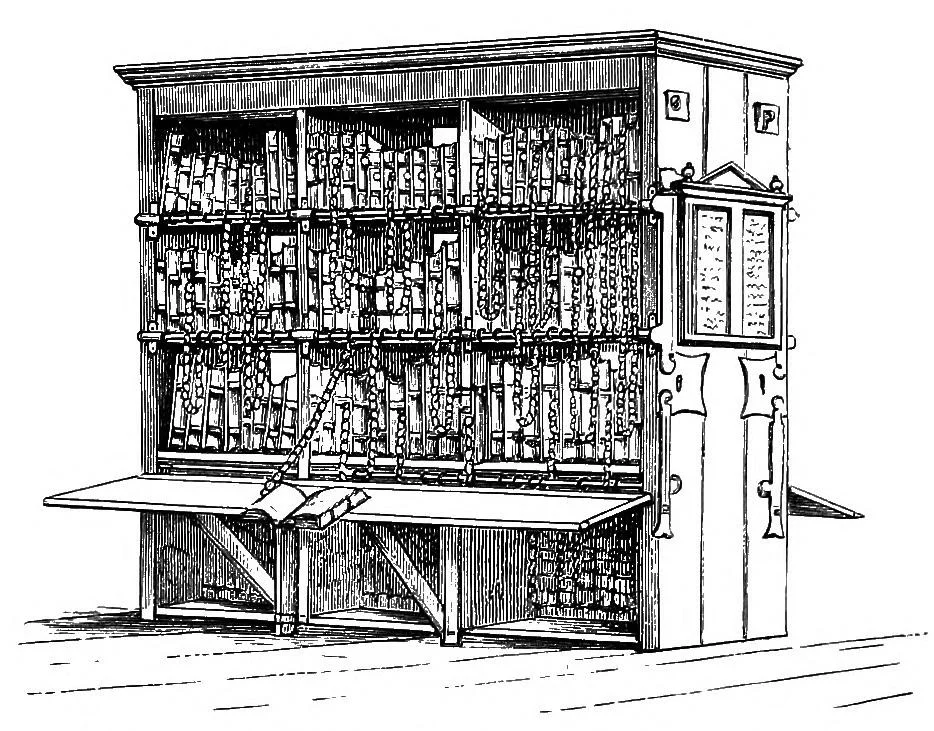

Hereford Cathedral Library
There are about a dozen surviving chained libraries in the world, where books were once secured to their shelves by iron chains running from the front cover to a horizontal rod, so that readers could pull a volume forward and read it at a lectern without being able to walk off with it. Most chained libraries today survive only as collections - the chains long since stripped off and dropped into a box somewhere. Hereford Cathedral Library is the last one with everything still in place: 229 medieval manuscripts and around 1,500 printed books, each one still attached to its rod by its iron chain, each rod still mounted on its original seventeenth-century oak shelf, each lock and ringbolt still in working order. The shelves are arranged with the books spine-inward and the chained edge facing out, so the chains drape downward in long parallel lines like the strings of harps. It is the largest intact chained library in the world.
The Mappa Mundi
The library shares a room with another object that draws hundreds of thousands of visitors a year. The Hereford Mappa Mundi, drawn on a single sheet of calf vellum around the year 1300, is the largest medieval map of the world known to survive anywhere. It measures 158 by 133 centimetres. Jerusalem sits at the centre, as theology demanded. East is at the top, because the rising sun and earthly Paradise lay in that direction in medieval Christian cosmography. The British Isles - the mapmaker's own home - are crammed into a lower left corner with Hereford itself faintly marked. Around the edges drift a riot of medieval marvels: the Sciapods of India who used their single giant foot as a parasol; the Blemmyes of Libya whose faces grew in their chests; sirens, dragons, the Pillars of Hercules, the rivers of paradise, the Tower of Babel, Noah's Ark resting on Mount Ararat. The map is a Christian encyclopaedia of the visible and invisible world in one image. It is signed - extraordinarily for a medieval object - by its maker, Richard of Haldingham and Lafford. In 1988 the Dean and Chapter announced they might have to sell the map to fund cathedral repairs; the resulting public outcry, supported by Sir Paul Getty's million-pound gift and a National Heritage Memorial Fund endowment, led instead to the construction of the present purpose-built building, opened by Queen Elizabeth II on 3 May 1996, which now houses both the Mappa and the chained library.
Thomas Thornton's Chains
The library itself is far older than the chains. The cathedral's collection has been accumulating since the twelfth century. Its oldest book - the Hereford Gospels, written in Anglo-Saxon characters around the year 780 and lavishly illuminated - was the only volume to survive a catastrophic cathedral fire in 1055, and remains the oldest book in the library by more than three centuries. By 1582, an inspection during Elizabeth I's reign found the medieval collection "poorly organised and poorly kept," and in 1590 the books were moved to the Lady Chapel. In 1611, the canon Thomas Thornton - who had served as vice-chancellor of Oxford University in 1583 and again in 1599 - introduced the chaining system that gives the library its modern fame. Books in the seventeenth century were extraordinarily valuable, and theft from cathedral libraries was a constant problem. Thornton's solution was both practical and beautiful: each volume was fitted with a small iron eye-bolt in the front cover, the bolt connected by a chain to a horizontal rod running along the front of the shelf. A book could be lifted forward and laid on the desk beneath, but it could not be removed. The 229 chained books include the rare thirteenth-century Hereford Breviary, the only surviving copy of that liturgical text, and an early manuscript of the Wycliffite Bible - the first complete English translation, made in the 1380s when translating the Bible into English was still a heresy.
A Cathedral Library at Work
Hereford Cathedral Library is unusual in another way: it is still functional. Most chained libraries elsewhere are museum pieces, sealed-off curiosities. Hereford continues to operate as the diocesan theological reference library, with around 9,000 modern books printed since 1850 available for clergy and scholarly study alongside the chained medieval and early modern collection. The post-1850 books include works on Herefordshire local history, music manuscripts used at the cathedral itself between the late seventeenth and nineteenth centuries, and a steady stream of donations from across the diocese. The 1611 chaining system was never extended past the early nineteenth century; by then book values had collapsed, theft was less of a concern, and the practice of chaining was abandoned across England. What survives at Hereford is therefore a frozen moment - a working library captured in the form that libraries took for two centuries between the late medieval period and the industrial age. Visitors who walk into the modern Sir William Whitfield-designed pavilion can see the Mappa Mundi first, in its temperature-controlled case, and then move through to the chained library itself, where the chains gleam under low light and the books wait, as they have for four hundred years, for someone to lift them down.
From the Air
Hereford Cathedral and its library sit at 52.054 degrees north, 2.716 degrees west, in the centre of the small city of Hereford on the south bank of the River Wye in Herefordshire, close to the Welsh border. The cathedral's central tower and spire are the most obvious landmark from the air. The Wye loops dramatically through the city. Gloucestershire Airport (EGBJ) lies about twenty-five nautical miles southeast. Birmingham Airport (EGBB) is about forty nautical miles northeast. Hereford itself has no major commercial airport, but the small Hereford Airfield (Shobdon) lies about ten nautical miles north-northwest. Recommended viewing altitude 1,500 to 2,500 feet for a clear look at the cathedral, the river, and the surrounding orchard country of Herefordshire.
Nearby Stories
- Pershore Abbey 2.4 km away
- Halifax V9977 Crash, Welsh Bicknor 3.4 km away
- Halesowen Abbey 6.5 km away
- Ebbw Vale Steelworks 9.8 km away
- Chedworth Roman Villa 13 km away
- Stokesay Castle 14 km away
- Builth Castle 16 km away
- Dolforwyn Castle 19 km away