_22.jpg)
Dolforwyn Castle
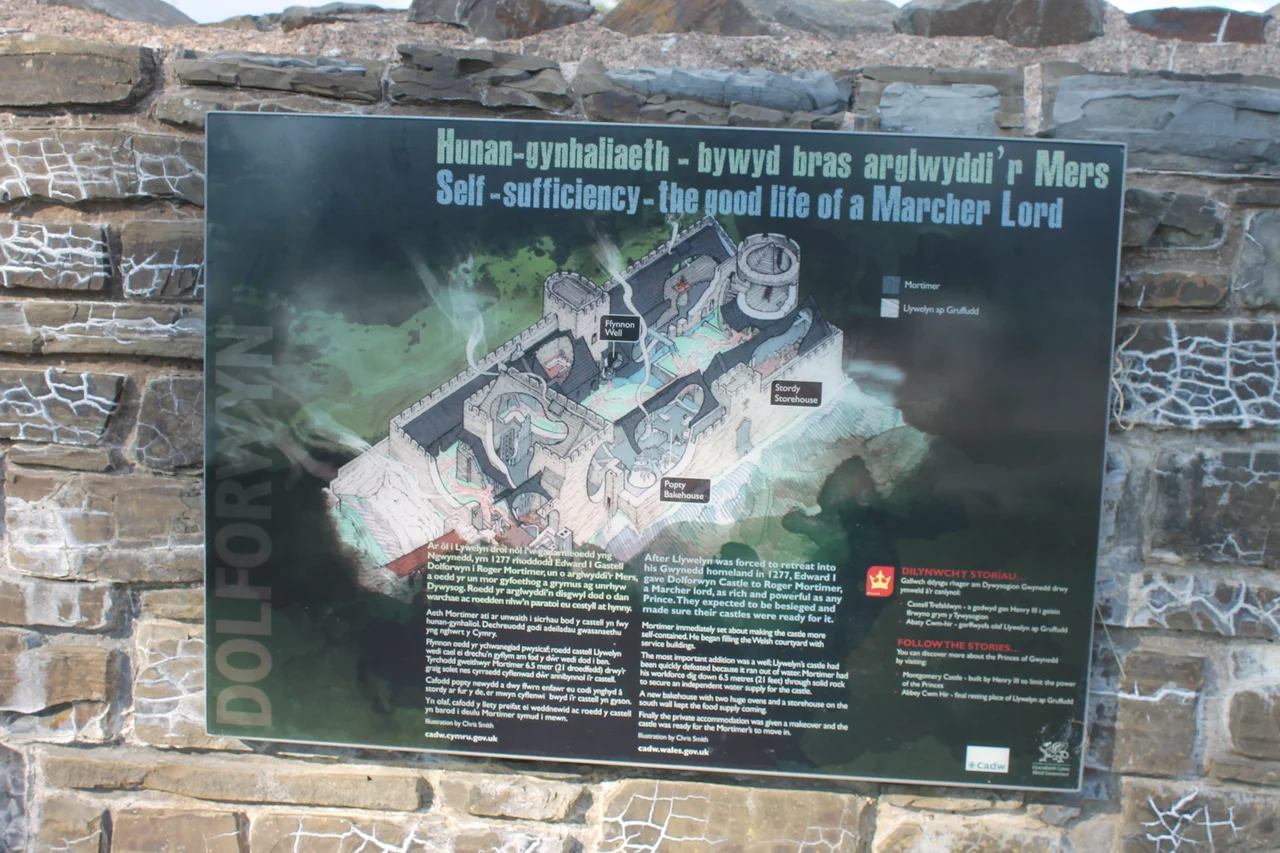
Llywelyn ap Gruffudd paid 174 pounds, 6 shillings, and 8 pence to build Dolforwyn Castle. The accounts survive, which is unusual; the castle has been gone for seven centuries, which is not. Llywelyn was the last native Welsh prince to hold the title Prince of Wales without an English crown's permission, and Dolforwyn was the last castle he raised himself. He built it between 1273 and 1277 on a wooded ridge above the Severn Valley, in defiance of an English king who had specifically forbidden it. Within four years the castle had fallen, Llywelyn was dead, and the line of native Welsh princes had ended with him. The siege took eight days because the masons had not dug a well.
The Prince's Statement
Llywelyn's power base lay in Gwynedd in the north, but to be Prince of all Wales he needed presence in the strategic middle ground around the upper Severn. In 1257 he invaded the area, and by 1263 he had taken the districts of Cedewain and Ceri from the Marcher lords. Henry III recognised him as Prince of Wales in the Treaty of Montgomery of 1267, the high point of native Welsh power. Dolforwyn was Llywelyn's exclamation mark. Built on a rocky platform 240 by 90 feet on a ridge above the village of Abermule, it consisted of a rectangular keep at one end and a circular tower at the other, joined by curtain walls. By 13th-century standards it was fairly modest, lacking the sophisticated concentric defences that Edward I would later impose on Wales. But the site was unmistakable, and so was the message: Llywelyn was building castles in valleys the English considered their frontier.
The Siege That Brought Master James
Edward I became king in 1272 and saw Dolforwyn for what it was. In the spring of 1277 he sent Roger Mortimer, Henry de Lacy, Earl of Lincoln, and Otto de Grandson to take it. The siege began in early April and was over within days. The castle had been built without a well, and the rock-cut cistern carried only limited reserves. Cut off from water, the garrison surrendered on 8 April. The catapult stones from that siege were excavated by archaeologists at the end of the 20th century, scattered across the inner ward where they had landed seven hundred years before. The siege had a strange afterlife: a letter sent from Dolforwyn during the campaign, attributed to either Henry de Lacy or Otto de Grandson, is thought to be the document that brought Master James of Saint George to Wales. Master James would go on to design or build Flint, Rhuddlan, Conwy, Caernarfon, Harlech, and Beaumaris, the iron ring of Edwardian castles that finally locked Wales down.
The Maiden's Meadow
Dol-forwyn means maiden's meadow in Welsh, and a story attached to the place long before Llywelyn built his castle there. The antiquarian Thomas Pennant recorded a local legend that the maiden Sabrina had drowned at Dolforwyn and given her name to the River Severn that flows below it. John Milton picked up the tale in his 1634 masque Comus, in which Sabrina is saved by water nymphs and made the river's tutelary goddess. The Severn flows past the castle ridge in great curves, and from the parapet you can see it for miles in either direction. After the English took the castle they handed it briefly to Gruffydd ap Gwenwynwyn, the Prince of Southern Powys whose feud with Llywelyn had partly enabled the whole campaign, then to the Mortimers, who held it through the 14th century. Inventories from the period list an armoury in the round tower, a chapel, a hall, a lady's chamber, two granaries, a bakehouse, and a brewhouse. People lived here. By 1398 a survey called it ruinous and worth nothing. By the time the Earls of Powis inherited the title in the 17th century, the castle was almost forgotten.
Three Decades of Spades
John Davies Knatchbull Lloyd's grandfather bought the site in the 19th century. Lloyd gave it to the Welsh Ancient Monuments Board, the predecessor of Cadw, in 1955. For more than fifteen metres of debris had built up over the original floors. Between 1981 and 2002 archaeologists from the University of Leeds and then the University of York dug the castle out over three or four weeks each summer, season after season, until the rectangular keep and the round tower stood revealed. They found a leather book cover, a silver coin from the reign of Edward II, a die, English mortar mixed in with Welsh masonry where the new occupants had patched their captured stronghold, a wheat-drying oven, and dozens of spent catapult balls. They also found the cistern, six metres deep, which might have saved the castle if it had been dug a little deeper still. Walk the ramparts today and the views Llywelyn wanted are still there: the Severn coiling east toward Welshpool, the Cambrian Mountains heaving up to the south, and the empty hill country where a Welsh prince once thought he could hold his line.
From the Air
Dolforwyn Castle stands at 52.55 degrees N, 3.25 degrees W on a wooded ridge above the village of Abermule, Powys, about 4 nm northeast of Newtown. The castle ruin sits at roughly 700 ft elevation overlooking the upper Severn Valley. Best viewed at 1,500-3,000 ft AGL to pick out the rectangular keep platform and circular tower stub. Montgomery Castle lies 4 nm to the northeast on the same valley. Powis Castle (Welshpool) is 8 nm to the north. Nearest airfields: Welshpool (EGCW) to the north, Shawbury (EGOS) further east, Caernarfon (EGCK) to the northwest beyond Snowdonia.
Nearby Stories
- Cymer Abbey 3.3 km away
- Builth Castle 7.6 km away
- St Mary Magdalene's Church, Battlefield 9.3 km away
- Caratacus' last battle 9.5 km away
- Borth Lifeboat Station 13 km away
- Museum of Cider 18 km away
- Battle of Maserfield 24 km away
- Talley Abbey 27 km away