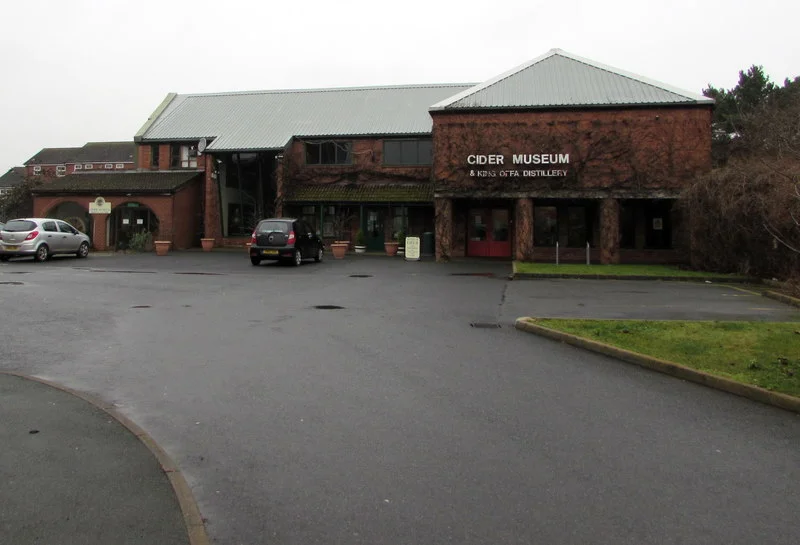

Museum of Cider
Henry Percival Bulmer was twenty years old in 1887 when he made his first batch of cider. His father was the rector of Credenhill, just outside Hereford, and the family had no obvious reason to go into the apple business. But Herefordshire was thick with orchards and Henry had ideas. A year later he and his brother Fred bought a plot of land on the edge of Hereford and built a shack. They dug cellars beneath it in 1889. By the 1920s the shack had a grand frontage and the Bulmer name was on bottles across England. The Museum of Cider now lives in the original factory at Pomona Place, surrounded by the cellars Henry dug.
From Shack to Empire
The Bulmer story is one of those Victorian arcs that sounds invented. Henry started making cider in 1887. By the early 20th century he had transformed cider from a rural cottage beverage into an industrial product sold nationally. The company introduced champagne-style cider, fermented in bottles in deep cellars, and built a reputation for consistency that small farm producers could not match. Strongbow, launched in 1960, became the largest-selling cider brand in the world. Woodpecker followed. By the time Bulmer's was taken over by Scottish and Newcastle in 2003 - and then passed to Heineken in 2008 - it was the biggest cider maker on the planet. The frontage on Pomona Place still says BULMERS in stone letters, even though the active production has moved to a larger plant elsewhere in the city.
The Trust That Saved the Story
By the 1970s, traditional cider-making was disappearing fast - small farm presses replaced by industrial vats, oral knowledge dying with the makers. Bertram Bulmer, Norman Weston, and the director of Long Ashton Research Station John Hudson saw what was happening and set up a trust to collect what could still be collected. They did oral histories with old cider makers. They surveyed every cider mill in Herefordshire. They opened a pop-up display in a shop next to the Butter Market in Hereford. In 1978 they took over the old Bulmer offices on Pomona Place. After extensive renovation, the Museum of Cider opened in 1981. Its founders had been right about timing - much of what they recorded would have been lost if they had waited another decade.
What the Cellars Hold
The original cellars from 1889 run beneath the museum, lined with the equipment that turned Herefordshire apples into bottled cider for the first half of the 20th century. A cooper's workshop, a vat house, a bottling line. A 300-year-old French beam press, massive and beam-balanced like something from a Brueghel painting, demonstrates how cider was made before steam power. There is a rare collection of English lead crystal cider glasses dating from 1730, donated when Scottish and Newcastle bought Bulmer's in 2003 - the kind of glassware that suggests cider was once an upmarket drink, not just farm refreshment. The Beam Press Gallery, added to the museum in the 1980s, was built from bricks and timber salvaged from the Godwins Cider Factory, another lost Hereford works.
The Brandy Licence
In one curious chapter, the Museum of Cider became the first place in Britain in 200 years to be granted a licence by HMRC to distil cider into brandy. The distinctive spirit - similar to French Calvados, which is made the same way in Normandy - had not been produced commercially in England since the 18th century. The museum operated its still as a working exhibit, demonstrating how strong apple-based spirits had once been part of the cider tradition. Production ceased in 2012, but the licence inspired Julian Temperley in Somerset to apply for his own commercial permit, and English cider brandy is now made again at his Burrow Hill Cider Farm. The legacy, as the museum likes to say, lives on - in southwestern barrels, slowly mellowing toward Calvados-like complexity.
The Competition and the Pensioners
The museum runs an annual programme of events that includes art exhibitions, talks, and the International Cider and Perry Competition - one of the most respected blind judgings in the cider world. The competition has run since the early 1980s. In 2018 there were 210 entries. The museum also welcomes the Bulmer's Pensioners once a month for a coffee morning in their old place of work - the workers who spent decades on the bottling line returning to drink tea where they once filled bottles. It is the kind of detail that explains why the Museum of Cider feels different from most industrial museums. It is not commemorating something dead. The orchards still produce. The cider still flows. The pensioners still come for coffee.
From the Air
The Museum of Cider sits at 52.056 N, 2.726 W on Pomona Place in Hereford, about half a mile west of the cathedral. From the air it is part of the city's western edge, near the railway corridor that runs into Hereford station. Not a distinctive landmark from altitude - the building is a low industrial Victorian structure - but the cathedral tower a short distance east makes orientation simple. Best viewed from 1,500-2,500 ft AGL. Nearest airports: Gloucestershire (EGBJ) about 30 nm east-south-east, Shawbury (EGOS) about 35 nm north, Wolverhampton (EGBO) about 30 nm north-east. The surrounding Herefordshire countryside is one of the densest orchard areas in England - apple blossom is spectacular from the air in late April and May.
Nearby Stories
- Pershore Abbey 2.4 km away
- Halifax V9977 Crash, Welsh Bicknor 3.4 km away
- Halesowen Abbey 6.5 km away
- Ebbw Vale Steelworks 9.8 km away
- Chedworth Roman Villa 13 km away
- Stokesay Castle 14 km away
- Builth Castle 16 km away
- Dolforwyn Castle 19 km away