
Halifax V9977 Crash, Welsh Bicknor
At 4:20 in the afternoon on 7 June 1942, a farmer in the Forest of Dean looked up and saw a Halifax bomber passing overhead with its outboard starboard engine on fire. Moments later the left wing tore away. The aircraft rolled, then dropped into a field on the Courtfield estate above the River Wye, near the village of Welsh Bicknor. All eleven men aboard were killed. One of them, Alan Dower Blumlein, had invented stereophonic sound and the 405-line television system that would carry pictures into British living rooms for more than forty years. The plane he died in was carrying the most secret radar in the world. It remains the deadliest crash in the history of British military flight testing, and for nearly half a century almost nobody outside a few corridors of Whitehall knew it had happened.
The Aircraft and the Secret
V9977 was an early Halifax II, a four-engine heavy bomber, modified into the strangest of flying laboratories. Bolted to its belly was an eight-foot perspex blister housing the rotating scanner of H2S, the first airborne ground-mapping radar. With H2S a bomber could see, in fog and on the blackest night, the outlines of cities below: rivers, coastlines, the dense mass of a target town. Churchill had given the project the highest national priority. The chief designer at Handley Page had been outraged when the team turned up wanting to bolt a huge bulge to his streamlined bomber, but his protests were overruled. By early June, after weeks of work at RAF Defford, the system was performing well. Towns 25 miles away were resolving on the cathode-ray tube. Production was now the question, and that was why three civilian scientists from EMI had come down to see it for themselves.
The Eleven
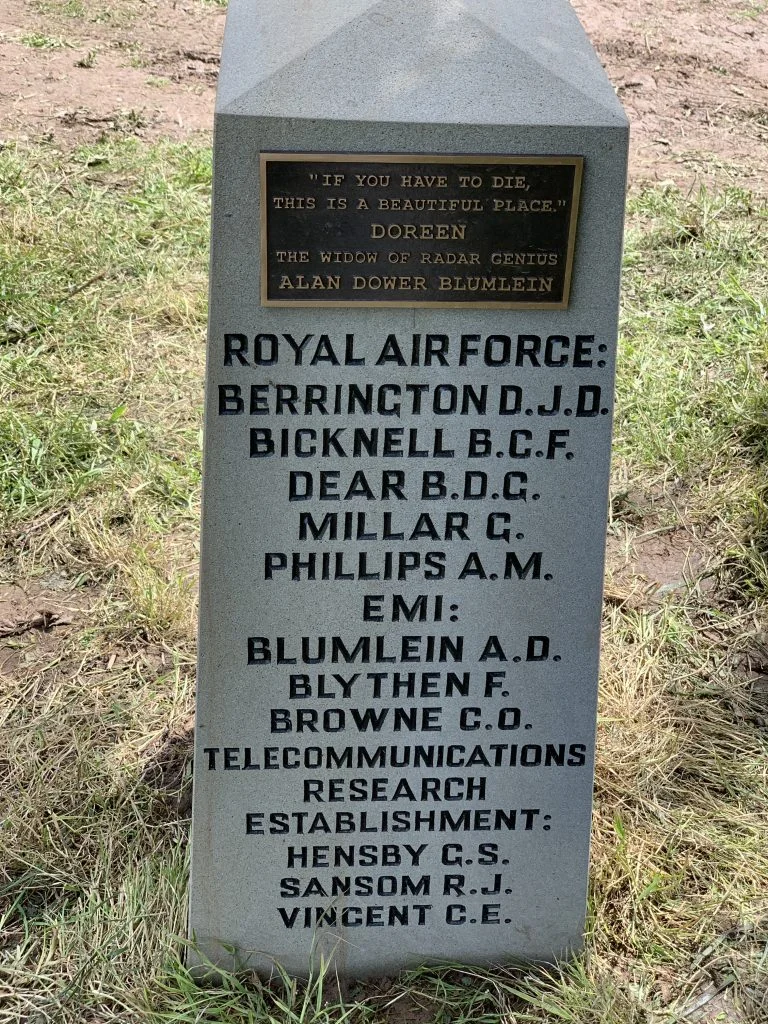
They took off about 2:50 pm, eleven men in all. From the RAF: Pilot Officer Douglas Berrington at the controls; Flying Officer Algernon Phillips beside him; Warrant Officer Gavin Millar as observer; Leading Aircraftman Brian Dear, flight engineer, just twenty years old; Aircraftman Bernard Bicknell on the wireless; and three more RAF officers attached to TRE, Squadron Leader Ronald Sansom, Pilot Officer Clifford Vincent, and Flying Officer Geoffrey Hensby. Three civilians from EMI: Alan Blumlein, the prodigy whose stereo patent in 1931 had been so far ahead of its time that the world only caught up after his death; Cecil Browne; and Frank Blythen. Berrington was experienced as a pilot but had only thirteen hours on the Halifax, a notoriously demanding aircraft. The other crew were mostly new. The eleven men were strangers welded together by a war, climbing through clear summer light toward the Bristol Channel.
Forty-Eight Lock Nuts
What killed them, investigators would eventually conclude, was a maintenance error counted in eighths of an inch. Rolls-Royce had noticed that the Merlin engine's tappet valves tended to work loose in service. Their fix was to tighten the clearances slightly at the factory. For engines already in the field, every one of forty-eight lock nuts had to be removed, the valve adjusted, the nut re-tightened. The procedure had been carried out on V9977 only days before its fatal flight. One nut, on one engine, had not been properly tightened. In flight it backed off. The valve worked loose and snapped. Fuel and air rushed into the space under the rocker cover and ignited. The fire extinguisher bottles, kept on the wrong side of the firewall by an early Halifax design flaw, may not even have been filled; bottles had been delivered empty before, and nobody had checked. The propeller kept windmilling, the fuel pumps kept pumping, and the fire travelled back along the lines toward the wing tanks. The flight engineer could not reach the cut-off, which lay too far back in the fuselage to be operated in time.
The Long Silence
They were at 15,000 feet when the fire began, high enough to bail out if everyone had a parachute. Crew had them. The civilian observers did not. So the men chose to stay together and try to bring her down. They almost made it. The aircraft held together until about 350 feet before breaking apart. Bernard Lovell, the radar physicist who had narrowly escaped being aboard, was driven that night to the crash site to retrieve the cavity magnetron, the single most secret component of the H2S set. For decades after, the only public record of what had happened was a single index card at the Ministry of Defence. Blumlein's wife and Isaac Shoenberg, head of EMI research, suspected sabotage; the silence around the loss was that complete. Only in the 1980s did a retired Royal Radar Establishment engineer named W. H. Sleigh assemble the full picture. A memorial stone now stands on the Wye Valley Walk near the crash site, just north of the B4234. It carries the names of all eleven men. The H2S radar they had been testing went into action on bombers later that summer and shortened the war.
From the Air
Located at 51.85 degrees N, 2.59 degrees W, a few metres north of the Herefordshire-Gloucestershire boundary in a field on the Courtfield estate, on the north side of the River Wye near Welsh Bicknor and Lydbrook. The site is hard to identify from cruise altitude; the meander of the Wye and the wooded Forest of Dean to the south are the obvious geographical markers. Nearest major airports are Gloucestershire (EGBJ) about 15 nm east-south-east and Cardiff (EGFF) 35 nm south-west. The Wye Valley Walk passes the memorial.
Nearby Stories
- National Museum Cardiff 2.2 km away
- Kings Weston Roman Villa 2.2 km away
- Ebbw Vale Steelworks 2.6 km away
- Hereford Cathedral Library 6 km away
- Pershore Abbey 9.1 km away
- Chedworth Roman Villa 14 km away
- Windmill Hill, Avebury 18 km away
- Builth Castle 21 km away