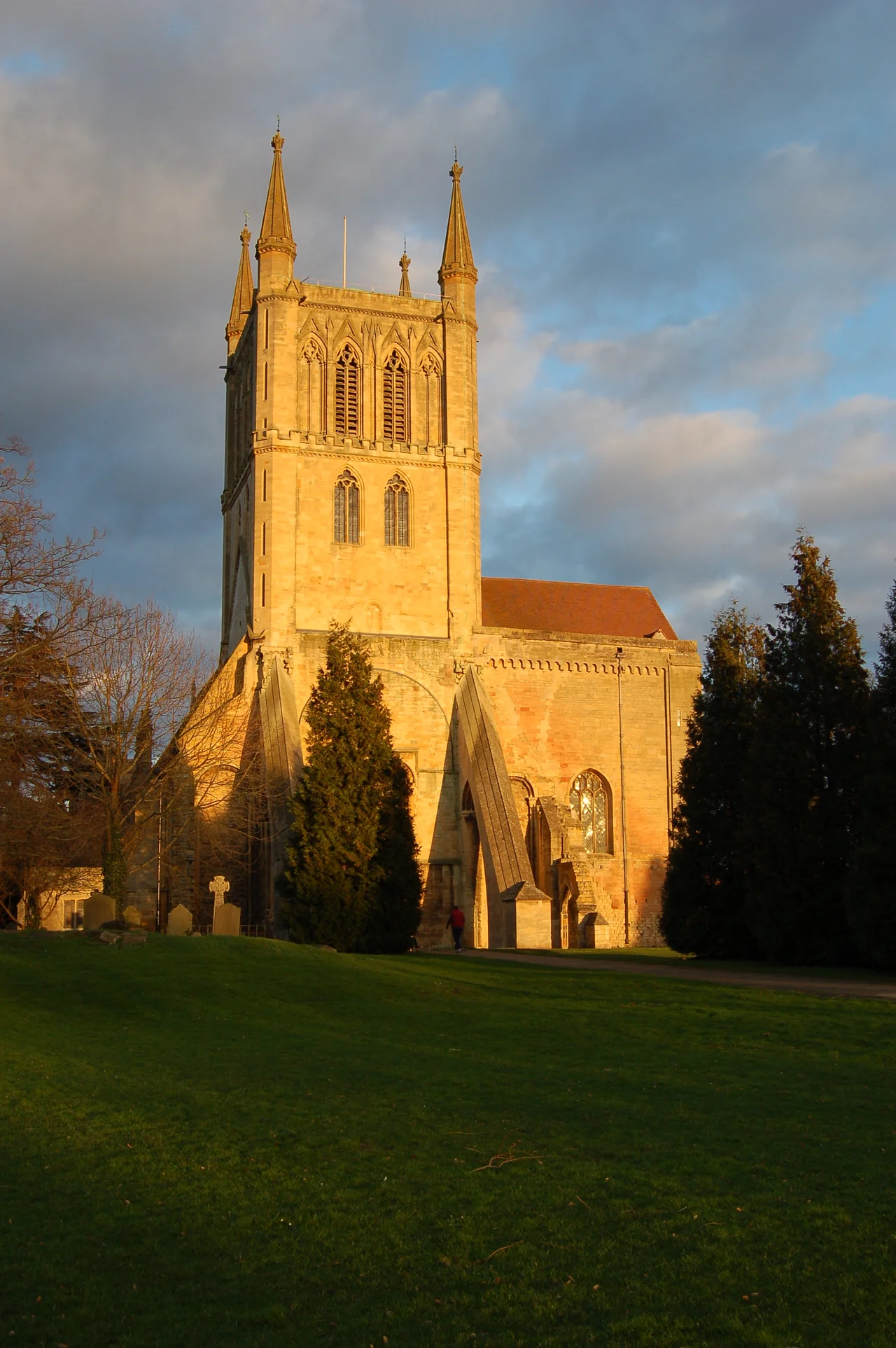

Pershore Abbey
In 1540 the townspeople of Pershore did something unusual. The Crown's commissioners had arrived to dismantle their Benedictine abbey, as they were dismantling abbeys all over England, but the people of Pershore offered Henry VIII £400 - a substantial sum then - to leave them the choir and the tower so they could keep them as their parish church. The king accepted. The nave came down, along with the cloisters and the dormitories. The choir, the south transept, and the magnificent central tower remained standing. They are still standing. The Church of the Holy Cross, as it has been called since, is a Norman abbey cut in half and inhabited like a museum of itself.
An Anglo-Saxon Beginning
The abbey at Pershore claims an Anglo-Saxon origin that is half-lost in fire and forged charters. A chronicle written around 1150 puts the foundation in the year 683, when Oswald, brother of King Osric of the Hwicce, established a minster on this gravel terrace above the River Avon. The antiquary John Leland, drawing on a now-lost Annals of Pershore, gave the year as 689. The trouble with confirming either date is that the abbey burned twice - in 1002 and again in 1223 - and most of its archives went with the flames. What survived in copied form was Edgar's charter of 972, which restored the abbey under the Benedictine reform that swept English monasticism in the late tenth century. The first abbot of the refoundation was Foldbriht, a monk previously of Glastonbury and Abingdon.
The Tower at the Centre
What you see today is the eastern arm and crossing of a much larger building. The central tower, completed in the mid-13th century, is the abbey's signature: a square Norman drum with later pinnacles added in 1871, lifting almost 30 metres above the surrounding fields. The lantern inside the tower was hidden for centuries by a belfry floor. In the 1862-64 restoration, the Victorian architect George Gilbert Scott had the floor removed and opened the lantern back up to view, exposing what he described as the best internal tracery in England after Lincoln Cathedral. He also designed the ringing chamber as a metal cage suspended high above the chancel crossing; to reach it the bell-ringers still climb two stone spiral staircases, walk through the roof, squeeze through a narrow passage, and finish by an iron see-through staircase that is not for the cautious.
Six Bells from 1729
Pershore has a ring of eight bells, six of them cast in 1729 by the younger Abraham Rudhall in Gloucester. The treble was added in 1814 by Thomas Mears at the Whitechapel Bell Foundry. The fourth bell cracked, was recast in 1897 by J. Barwell of Birmingham with what one report described as 'moderate success', and was rehung that same year. The tenor weighs about 25 and a half hundredweight - 2,856 pounds - and sounds the note D. On a still morning the sound of the full ring carries the length of the Avon valley and is, by long local consent, one of the better sounds in southern Worcestershire.
The North Transept That Fell
The townspeople had bought half a building, and half a building was harder to keep standing than they realised. In 1686 the north transept simply collapsed; a blank wall was built across the open scar where it had been. Two centuries later, with the building visibly sagging towards its missing nave, two great flying buttresses were added on the western side in 1913 to compensate for the support that was no longer there. The 1994 repairs stabilised the south transept and re-pointed the tower and pinnacles. In 2023 a new pipe organ from the Fratelli Ruffatti workshop in Italy - about £850,000 of bespoke pipework - replaced the previous instrument and gave the choir a new voice.
Buried Foundations and a Quiet Park
Walk out the south door and the grass is unusually flat - too flat for an old churchyard. Beneath it lie the foundations of everything Henry VIII's commissioners pulled down: the cloister walks, the chapter house, the refectory, the dormitories of the Benedictine monks. They were identified by archaeological survey in 1929 but never excavated. At the Dissolution the monastic buildings passed to John Richardson, who demolished what remained and sold the stone. A house called Abbey House was built on the site in the 1830s, briefly hosted Anglican Benedictine monks from Caldey in the 1920s, and was demolished in 1947. The grounds became parkland - a green silence at the centre of Pershore where most of an abbey once stood.
From the Air
Pershore Abbey lies at 52.111 degrees N, 2.078 degrees W, in the centre of Pershore on the south bank of a wide bend of the River Avon. Best viewed from 2,500 feet. The square Norman tower is the tallest object in town and the orienting landmark; the surrounding park reads as a perfect green rectangle south of the church. Gloucestershire Airport (EGBJ) lies 15 nautical miles south-west; Birmingham Airport (EGBB) is 22 nautical miles north-north-east; the M5 motorway is 4 nautical miles to the west, useful as a reference for inbound flights. The Vale of Evesham fruit orchards begin immediately east of the town.
Nearby Stories
- Woodstock Palace 3.4 km away
- Chedworth Roman Villa 4 km away
- Bournville 5.2 km away
- Battle of Cropredy Bridge 6.3 km away
- Halifax V9977 Crash, Welsh Bicknor 8.7 km away
- Much Wenlock 25 km away
- Market Bosworth 27 km away