
Bournville
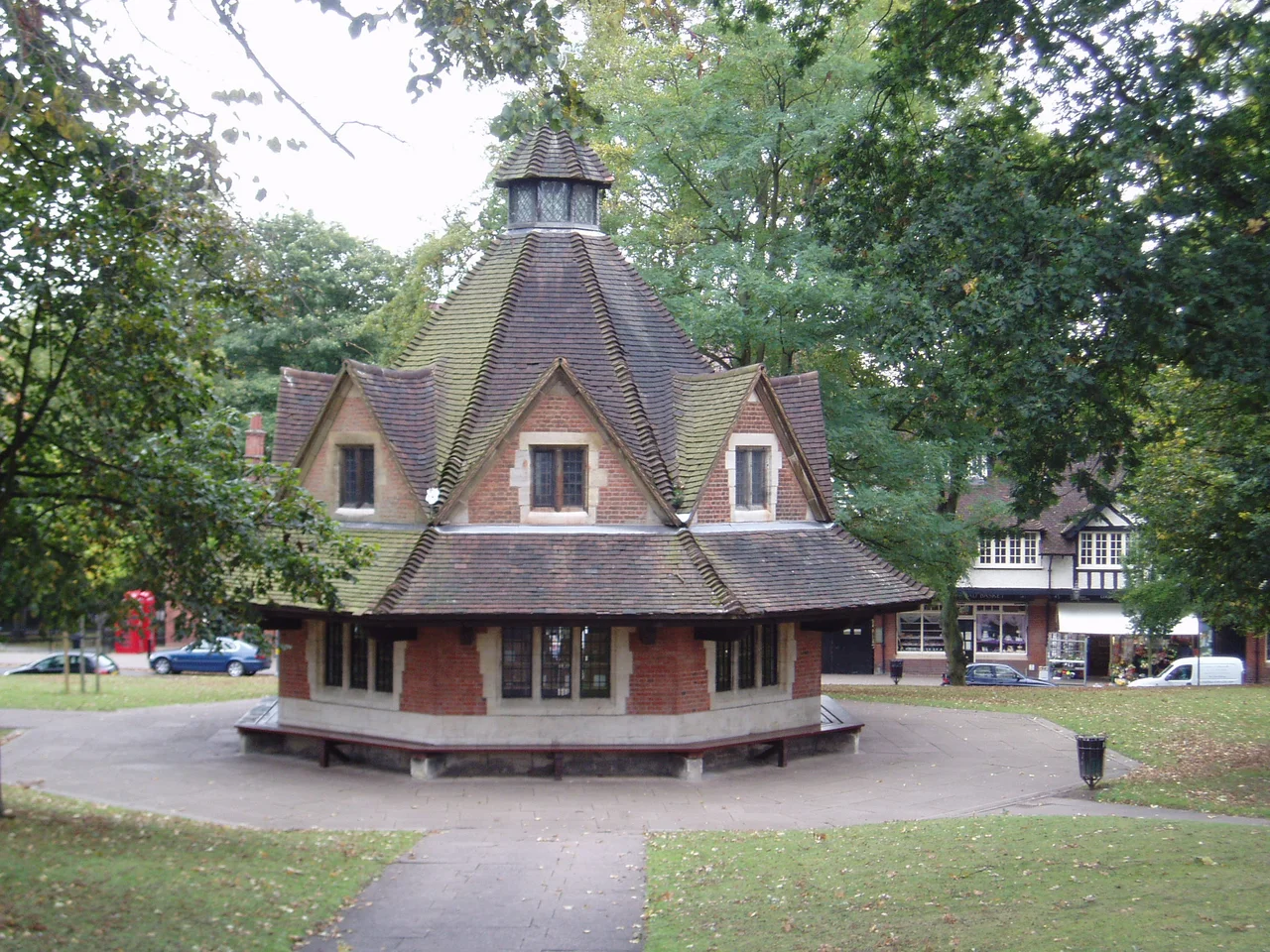
There are no pubs in Bournville. The Cadburys were Quakers, and George Cadbury -- who bought 120 acres of green land south-west of Birmingham in 1893 and laid out a village for his factory workers -- believed alcohol corroded the working family. The estate covenants ban the sale of drink within its historic boundaries to this day. Walk through Bournville's brick-and-tile cottages on a Sunday afternoon and you can hear the difference: bird song, a distant train, somebody mowing a lawn. The village green has a triangular shape that recalls a medieval common. The carillon rings out from the school tower. A Quaker meeting house sits next to the green. The Cadbury factory still makes chocolate a short walk away, smelling faintly of cocoa when the wind is right.
Why Cadbury Came Here
John Cadbury opened a small grocery on Bull Street in Birmingham in 1824, selling tea, coffee and cocoa. By 1861 the cocoa business had grown enough that his sons George and Richard took it over. By the 1870s their Bridge Street factory in central Birmingham was cramped and the city around it was filthy with industrial smoke. The brothers wanted a greenfield site with access to the new Birmingham West Suburban Railway -- which ran along the path of the Worcester and Birmingham Canal -- because they needed both rail for cocoa coming from London and Southampton, and canal for milk coming from the Worcestershire dairy farms. In 1879 they bought Bournbrook Hall, four miles south of central Birmingham, and built a new factory next to it. The location was clean, healthy, and undeveloped. They named it Bournville, after the local Bourn brook, with the French "ville" attached to give the place a slightly continental dignity.
The Workers' Town
George Cadbury was not interested in housing his workers in the same Victorian back-to-backs they had escaped. In 1893 he bought 120 acres next to the factory and -- at his own personal expense, not the company's -- planned a model village to "alleviate the evils of modern, more cramped living conditions." By 1900 the estate held 313 cottages on 330 acres. The resident architect William Alexander Harvey designed houses in a soft Arts and Crafts idiom: traditional in roof line and chimney, but with large gardens, indoor bathrooms, modern interiors, and through-ventilation. Each plot had room for fruit trees and vegetables. The Cadburys believed -- correctly, as it turned out -- that workers given decent housing produced better work, took fewer sick days, and stayed with the firm. Pension schemes, joint works committees, and a full medical service followed. Bournville was a paternalist experiment with carefully calculated economic and moral foundations.
The Bournville Village Trust
In 1900 George Cadbury set up the Bournville Village Trust to formally control the estate's development -- independently of himself or of the Cadbury company. He did not want the model village to depend on either his own continued goodwill or the commercial fortunes of his business. The Trust acquired schools, hospitals, public baths and reading rooms; it built the carillon tower and the Quaker meeting house beside the village green; it operated swimming baths, a boating lake, sports pitches and a cricket ground that became famous as the picture on Milk Tray chocolate boxes through the 1950s. After George's death in 1922, his widow Elizabeth Cadbury succeeded him as chair and shaped the Trust's focus on education and youth work. The estate has grown to 7,800 homes across 1,000 acres, with 100 acres of parks and open space, and the Trust still vets every planning application within the conservation area. Bournville is one of the longest continuously-managed model communities in the world.
Influence Beyond the Estate
Harvey's Bournville designs became a template. Garden city planners studied them. Ebenezer Howard cited Bournville and Port Sunlight -- William Lever's slightly earlier model village on the Wirral -- as proof that decent worker housing could pay for itself. Letchworth (1903) and Welwyn Garden City (1920) drew directly from the Bournville pattern. So did much of the inter-war British council housing programme: cottage estates with gardens, low densities, communal greens, schools and shops within walking distance. Bournville's quiet revolution travelled the world. Lever Brothers' planners visited; later, civil servants from Australia, India and South Africa came too. The model village was particularly influential in the planning of New Earswick near York, built by the rival Quaker chocolate-making Rowntree family from 1902. The Quaker industrial paternalists shaped, between them, an idea of how working-class housing could look -- not in the unreal future of utopia, but built and inhabited and humming with bees on a particular set of streets in southern Birmingham.
The Estate Today
The 2011 census found 21,866 people living in Bournville with a population density of 4,217 per square kilometre, above the city average. Terraced houses (38.9 percent) are still the most common form, followed by semi-detached (32.9 percent). The largest employer in the area is Mondelez International, which owns Cadbury and which still employs roughly 6,500 people at the factory site. Cadbury World, the visitor attraction, has been open since 1990 and pulls in over half a million tourists a year. Bournville railway station sits on the Cross-City Line and is painted Cadbury purple, the only station on the line not in West Midlands Railway's standard orange livery. Notable residents have included Bertha Bracey, the Quaker aid worker who organised the Kindertransport rescue of Jewish children from Nazi-occupied Europe and was named a Hero of the Holocaust; the actress Felicity Jones; the architect William Alexander Harvey himself, who designed his own house here. The Bournville Friends Meeting House on Linden Road, completed in 1905, still hosts Quaker meetings every Sunday. The village remains, as the Joseph Rowntree Foundation concluded in a 2003 study, one of the nicest places to live in Britain.
From the Air
Located at 52.43N, 1.94W roughly 4nm south-southwest of Birmingham city centre, just east of the A38 Bristol Road and immediately west of the Cross-City rail line. The Cadbury factory complex with its tall chimneys is the most prominent landmark. The triangular village green, the carillon tower, and the Cadbury-purple Bournville railway station are visible features. Nearest airports: EGBB (Birmingham, 8nm ESE), EGBE (Coventry, 26nm ESE), EGOC (RAF Cosford, 17nm WNW). Best viewed at 2,000-3,000 ft AGL with the Worcester and Birmingham Canal visible to the east.
Nearby Stories
- Shepshed 8.5 km away
- Battle of Evesham 11 km away
- Hixon rail crash 12 km away
- Battle of Cropredy Bridge 12 km away
- Wenlock Priory 15 km away
- RAF Shawbury 16 km away
- Market Bosworth 17 km away