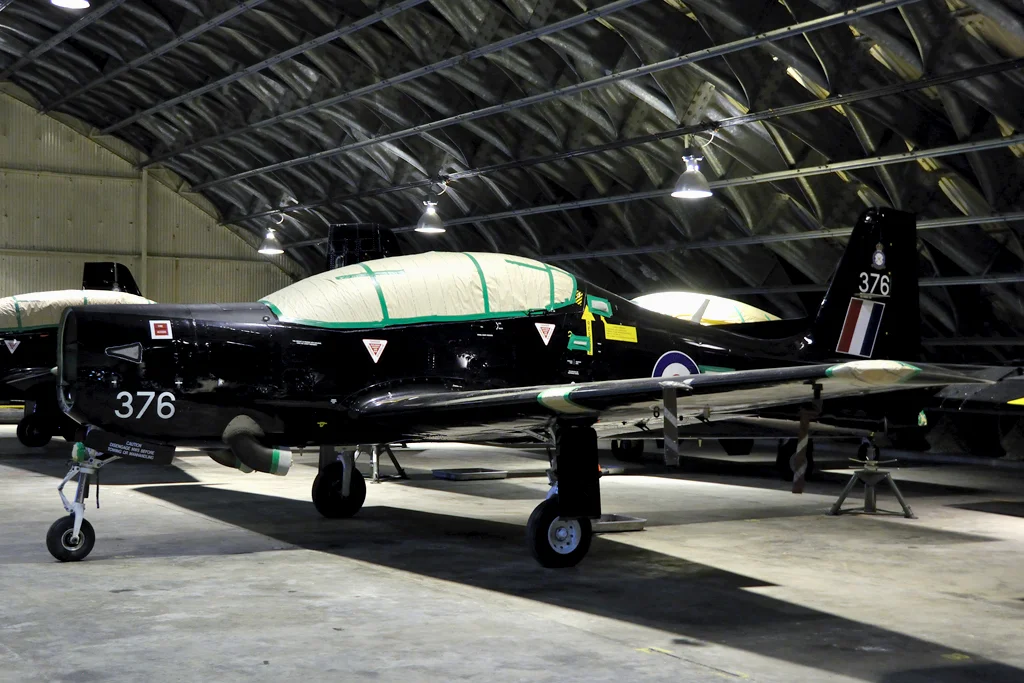

RAF Shawbury
If you are a British military helicopter pilot - Royal Navy, Army Air Corps, or Royal Air Force - you learned how to hover, transition, and autorotate over the green fields of north Shropshire, because that is the only place the British military teaches anyone how to fly a helicopter. RAF Shawbury, six miles north-east of Shrewsbury, runs the entire rotary-wing pipeline for all three services and trains for a handful of foreign air forces besides. Twenty-nine Airbus Juno light helicopters and three larger Jupiter aircraft sit on the apron, working through 286 students a year under 161 instructors. The station's history runs back more than a century: it opened in 1917 as a Royal Flying Corps training field, closed in 1920 when the postwar RAF was slashed to the bone, and reopened in 1938 in time to train pilots for the war that everyone could see coming.
Two Decades Underfarmland
The first hangars went up in 1917. Number 29 Training Wing formed on 1 September that year with three training squadrons attached - Number 10 Squadron, an Australian Number 29 Training Squadron, and Number 67 - all of them struggling with the chaos of running mixed aircraft fleets through new pilots in the last year of the First World War. Two of those squadrons combined to form 9 Training Depot Station in March 1918. Training carried on until the armistice. Then, in May 1920, the airfield closed. The Royal Air Force of the early 1920s was a small, underfunded service competing with the Army and Navy for what little money the Treasury could spare, and Shawbury was one of the casualties. The hangars came down. The land returned to agriculture, and for nearly two decades nothing moved in the sky above Shawbury except wood pigeons and the occasional kestrel.
Back in Time for the War
In February 1938, with Hitler having occupied the Rhineland and the Sudeten crisis approaching, the Air Ministry reactivated Shawbury as a training establishment. Number 11 Service Flying Training School moved in. Number 27 Maintenance Unit set up an Aircraft Storage Unit alongside the runway, ready to receive and prepare new airframes coming off the production lines. Relief landing grounds opened at RAF Bridleway Gate and RAF Bratton, with additional satellite fields at Hinstock, Hodnet, and Weston Park - a constellation of smaller airfields radiating out from the main station, used when traffic at Shawbury itself became congested. The main aircraft was the Airspeed Oxford, a wooden twin-engine trainer that taught a generation of bomber pilots how to fly on instruments and in formation. In 1944, the Central Navigation School arrived from RAF Cranage in Cheshire, and Shawbury's emphasis began to shift toward the precise mathematics of long-distance bomber navigation.
The Helicopter Era
After the war, the runways stayed busy. The School of Air Traffic Control arrived in 1950, combining with the existing navigation school to create the Central Navigation and Control School. Number 27 Maintenance Unit continued storing and scrapping aircraft until July 1972. Then, in 1976, the station took a turn that defines it today: Number 2 Flying Training School moved in to teach basic and advanced helicopter flying, operating the Aerospatiale Gazelle and the Westland Wessex. The Cold War had created a vast demand for military helicopter pilots - for anti-submarine work, for troop transport, for casualty evacuation, for special forces insertion - and Shawbury became the place to train them. By 1997, the three services agreed to consolidate all their basic helicopter training in one place, and the Defence Helicopter Flying School was born here. From then on, every Royal Navy, Army, and RAF helicopter pilot has earned their wings on the same Shropshire airfield.
The Juno Transition
In 2016, the Ministry of Defence signed a twenty-five-year contract with Ascent Flight Training to deliver the entire UK Military Flying Training System - elementary, basic, multi-engine, fast-jet, and rotary. For helicopters, Airbus was selected to supply thirty-two new aircraft: twenty-nine H135 airframes designated Juno HT1, plus three larger H145 airframes designated Jupiter HT1. The new fleet replaced the single-engine Squirrel and the larger Griffin, and brought the school in line with the rest of British military aviation - which now operates almost exclusively twin-engine helicopters. The first two Juno and a Jupiter arrived on 3 April 2017. Deliveries continued through the rest of that year and into 2018, with the final Juno arriving on 24 May 2018. Squirrel and Griffin operations ceased on 1 April 2018, and the older aircraft returned to civilian use. Kier Construction rebuilt the training school facilities, including new flight simulator bays, between 2016 and 2017.
Other Things That Happen at Shawbury
Helicopter training is the main job, but it is not the only one. The School of Air Operations Control - successor to the original air traffic school - trains controllers for the RAF and other services. The School of Aerospace Battle Management moved in from RAF Boulmer in Northumberland in August 2019. The Central Flying School (Helicopter) Squadron trains the instructors who will go on to train the students. Between 2001 and 2014, Shawbury was home to the Assault Glider Trust, a charity quietly building a non-flying replica of a Horsa glider - one of the troop-carrying gliders used at Pegasus Bridge and Arnhem - for permanent museum display. Prince Michael of Kent opened the station's Jubilee Hall Sports and Fitness Centre on 24 April 2012. In January 2020 the RAF announced an expansion - four additional Jupiter aircraft and a new simulator, a £183 million contract amendment - to grow rear crew training capacity. The runways have not been quiet at Shawbury since 1938, and they are unlikely to be quiet again.
From the Air
Located at 52.7981 N, 2.6681 W in north Shropshire, six miles northeast of Shrewsbury. RAF Shawbury (ICAO: EGOS) is an active military airfield with constant helicopter circuit traffic - approach with caution and pre-arrange transit if necessary. From altitude, the airfield is distinctive: three intersecting runways arranged in a triangle, with hangars and dispersals around the perimeter, set in the otherwise rural Shropshire countryside. Best viewed at 3,000-5,000 feet AGL but expect rotary traffic at all levels below 2,000 feet. Civilian alternates: Sleap Airfield (EGCV) 4 nm south, Welshpool (EGCW) 22 nm southwest, Hawarden (EGNR) 28 nm north. The Mid-Wales Marches landscape provides good visual references; the River Severn loops to the south.
Nearby Stories
- Priory of St. Thomas near Stafford 3.1 km away
- Battle of Tipton Green 3.8 km away
- Peckforton Hills 4.5 km away
- Brindley Water Mill 5.6 km away
- Dolforwyn Castle 6.1 km away
- Caratacus' last battle 9.2 km away
- Moel Famau 9.8 km away
- Llangollen 16 km away