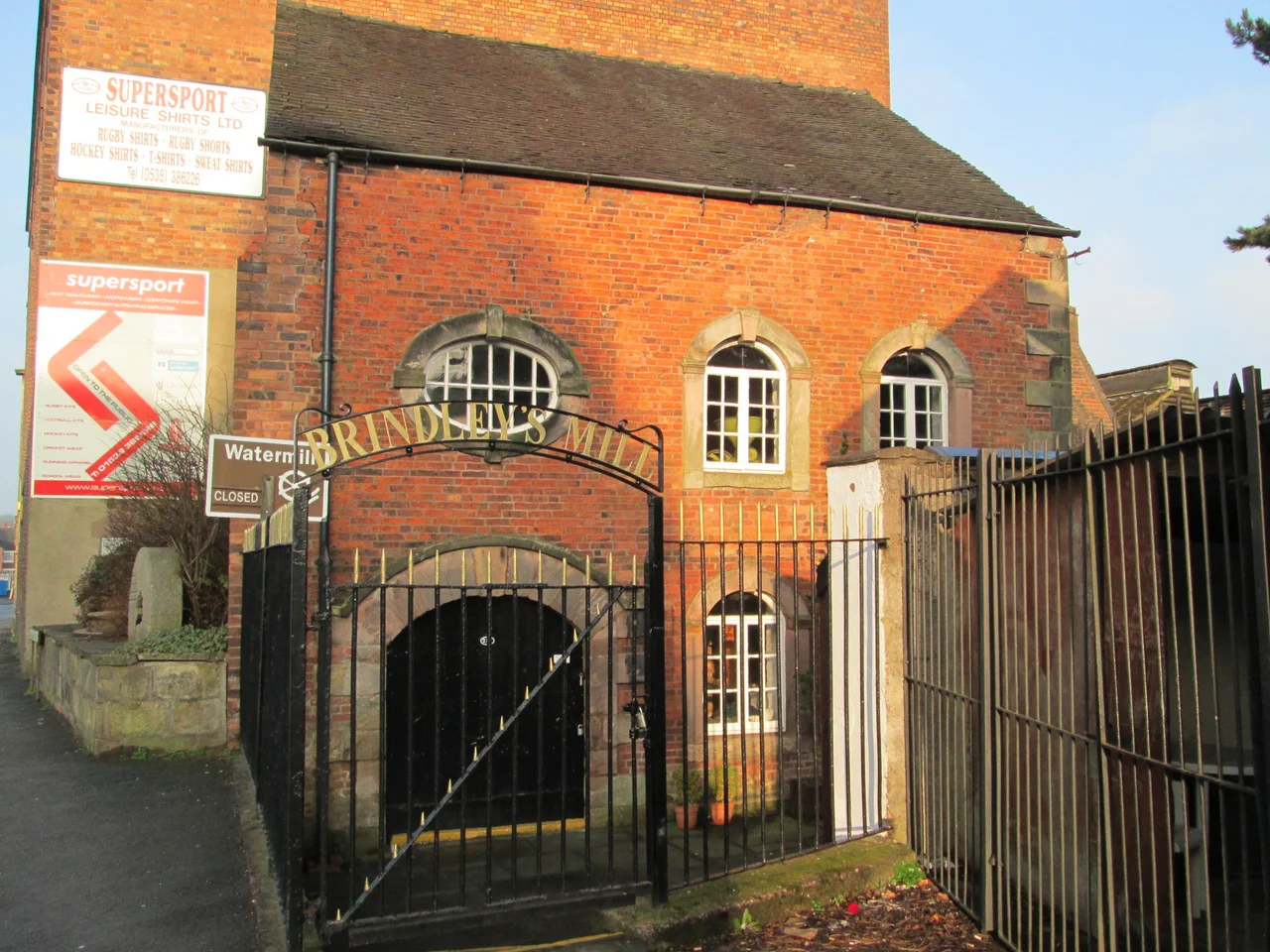

Brindley Water Mill
Before James Brindley was the engineer who taught Britain how to dig canals, he was a thirty-six-year-old millwright in the Staffordshire moorland town of Leek who had just been asked to rebuild a corn mill on the River Churnet. The year was 1752. The stone he set into the west wall of the finished building still carries that date. Inside, an undershot waterwheel sixteen feet across drives two pairs of grinding stones through a pit wheel and a forest of oak beams. Brindley would go on to engineer the Bridgewater Canal and the Trent and Mersey, the first great works of the British canal age. This small mill in Leek is one of the few buildings of his own design that survive, and you can still walk inside it and watch the wheels turn.
A Mill With Long Memory
The site is older than Brindley by six hundred years. There was a water mill in Leek by the mid-twelfth century, owned then by Ranulf de Gernon, fourth Earl of Chester, the great Anglo-Norman magnate who fought King Stephen during the civil war known as the Anarchy. His grandson Ranulf de Blondeville, sixth Earl of Chester, gave the mill to the Cistercian foundation at Dieulacres Abbey in the early 1220s. The abbey owned two water mills in Leek by the time Henry VIII dissolved it between 1536 and 1541, one of them on the Churnet in Mill Street. That mill ground corn for the abbey's tenants and the surrounding farms for nearly four hundred years. When Brindley arrived in 1742 to set up his own millwright workshop on Mill Street, after completing an apprenticeship in Macclesfield, the abbey was long gone but the mill site was still in use, and a decade later it was tired enough to need rebuilding.
Brindley's Method
Brindley had no formal education and could barely read or write. He worked from physical experiment and from a remarkable mental capacity for spatial geometry; one famous account describes him solving difficult engineering problems by going to bed for three days, refusing food, and emerging with a complete answer. The Leek mill is the work of a craftsman thinking carefully on a small scale. He chose an undershot wheel rather than the more powerful overshot, almost certainly because the head of water available from the Churnet at this point did not justify the higher capital cost of a large pond and a tall race. He built a new mill race and a weir to control flow, set the wheel into a wheel pit on the north side of the stone building, and ran the power inward through a pit wheel to a vertical shaft that turned two pairs of millstones. The roof rafters rest on a king post structure supported by a curved tie beam, a slightly unusual joint that gives the upper space its open headroom. The whole footprint is small, just 28 feet by 27, but every dimension is sized to its job.
From Canals to Corn Sacks
Six years after finishing the Leek mill, Brindley was engaged by the third Duke of Bridgewater to design what became the Bridgewater Canal between Worsley and Manchester, completed in 1761. It was the first great industrial canal in Britain, and it cut the price of coal in Manchester roughly in half overnight. Brindley followed it with the Trent and Mersey, the Staffordshire and Worcestershire, and the Oxford Canals, eventually mapping out and partially building most of the original Grand Cross system that connected the four great rivers of England. He died in 1772 at age 56, exhausted from twenty years of constant travel and surveying. The Leek mill carried on grinding corn through all of this. The mill became part of the Earl of Macclesfield's estate in the nineteenth century, then passed into the hands of the neighbouring textile manufacturers, and continued in use as a corn mill until 1940.
Demolition and Rescue
The mill's near-disaster came in 1948, when about a third of the building was demolished to make room for the widening of the adjacent A523 road. A new brick gable was built on the south side where a partition wall had once stood. The building survived, but as an industrial fragment behind a busy main road, gradually forgotten. In the 1960s an engineering historian named Dr Cyril Boucher, who was researching a biography of Brindley, studied the mill in detail. His 1968 biography put the building back into public conversation, and that same year the mill was officially listed as a Scheduled Monument. The Brindley Mill Preservation Trust was set up and registered as a charity in 1970 specifically to buy and restore the building. The freehold changed hands in 1972. Two years of patient restoration followed, on the structure, the waterwheel, the leats, the sluice gates, and the internal machinery, and on 4 May 1974 the mill reopened to the public. In 1980 the James Brindley Museum was added inside the building.
Visiting the Wheel
The mill is one of the rare working corn mills in the country that visitors can see in operation. The undershot wheel turns when the sluice is raised. Water hits the lower paddles, the great oak hub creaks, the pit wheel meshes with the wallower, the line shaft tightens, and two pairs of grinding stones begin to revolve overhead. Flour dust drifts in the air. It is louder than most people expect and slower than anyone expects, a reminder that pre-steam industry ran on the patient grinding of stone against stone for hours at a stretch. The mill is, in its way, the prologue to the canals: the same engineer who calculated the gradients of the Trent and Mersey Canal began his career here, working out, very carefully, how to make a stream do useful work.
From the Air
Brindley Water Mill sits at 53.11°N, 2.04°W on the western edge of Leek, a market town in the Staffordshire moorlands. From above the mill is a small stone building in a green strip beside the A523, with the River Churnet running just south of the building. The Peak District uplands rise to the north and east; Manchester airspace begins not far to the northwest. Manchester Airport (EGCC) lies 23 nautical miles to the northwest, the closest major field. East Midlands Airport (EGNX) is roughly 30 nm to the southeast. Recommended viewing altitude is 2,500 to 4,000 feet to take in the town of Leek, the river, and the rising moorland behind.
Nearby Stories
- Brianna Ghey 4.9 km away
- RAF Tern Hill 6.5 km away
- Vale Royal Abbey 7.8 km away
- Lundhill Colliery Explosion 8.7 km away
- Donington Park 9.1 km away
- Markham Colliery disaster 9.3 km away
- Hixon rail crash 10 km away
- Astley Deep Pit Disaster 11 km away