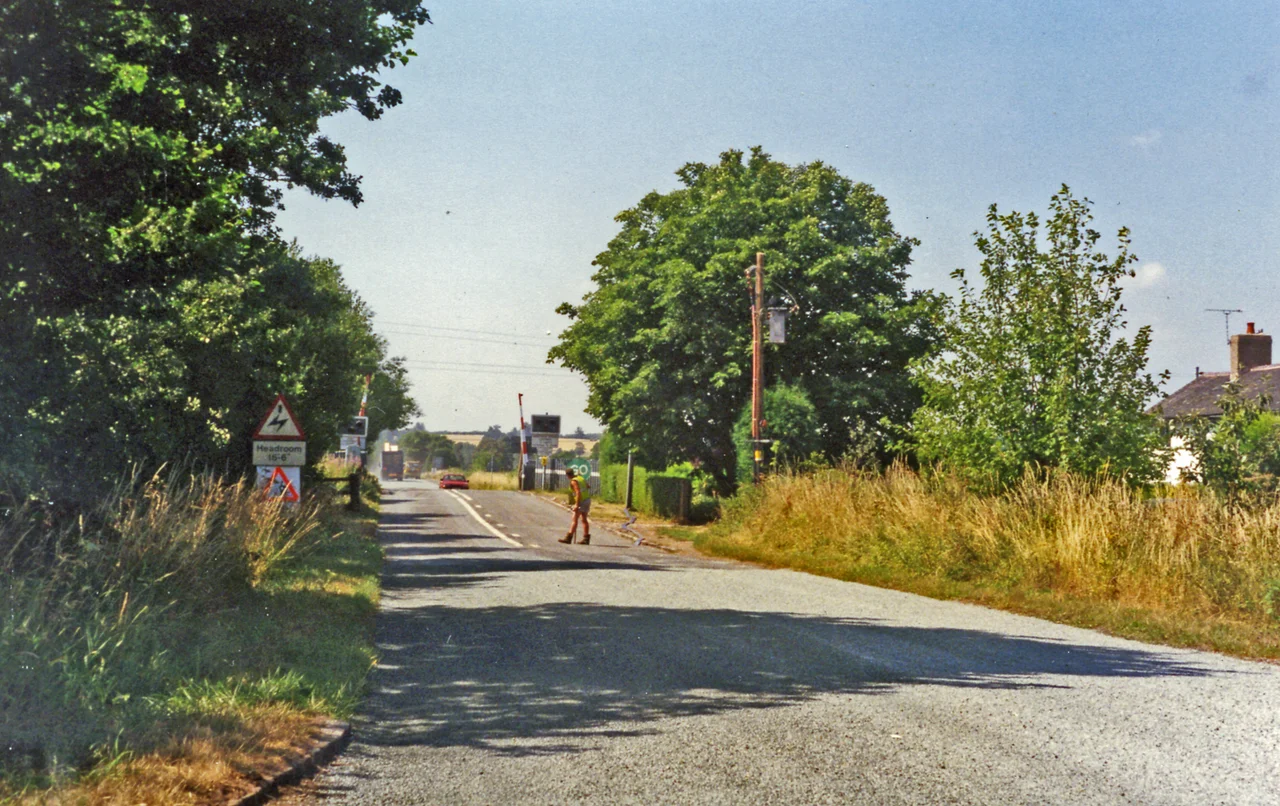

Hixon rail crash
On the morning of Saturday 6 January 1968, an enormous low-loader was moving slowly across a level crossing on the West Coast Main Line at Hixon in Staffordshire. The transporter was 148 feet long, weighed 162 tons, and carried a 120-ton electrical transformer destined for a depot at the disused RAF Hixon airfield. The crossing was a new automatic half-barrier installation, only the second generation of its kind in Britain. The transporter was too long and too slow to clear the rails in the warning time the system allowed. An express train approached at speed. Eleven people died. The inquiry that followed changed level crossings across Britain.
A Cheaper Crossing
British Railways in the 1950s was looking for a way to cut the cost of crossing keepers. The bill for manning the country's 2,400 level crossings had climbed past £1 million a year, and at some locations had risen tenfold. The job itself was responsible but dull and hard to recruit for in the postwar labour market. Manual gates also slowed road traffic, since they had to close, latch, and let the distant signal clear before a train could pass, taking three or four minutes. In October 1956 senior members of Her Majesty's Railway Inspectorate visited the Netherlands, Belgium, and France to study automated crossings. Their report recommended automatic half-barrier installations, known as AHBs. Closed for under a minute, no keeper required, the projected savings were significant. The first pioneering British installation went in at Spath in 1961. Hixon, eight miles away, followed soon after.
The Earlier Warning
On 8 November 1966, a transporter belonging to the haulage firm Robert Wynn and Sons Ltd had nearly come to grief on an automatic crossing at Leominster, in Herefordshire. The vehicle had become grounded on the rails. Disaster was avoided only because the driver violently revved the engine and let in the clutch, dragging the transporter clear before a train arrived. Wynn's wrote to British Railways to flag concerns about the short warning time the crossings gave to slow heavy vehicles. The reply, from the Western Region's assistant general manager, was, in a later assessment, remarkable for its arrogance and lack of insight: "I must emphasise that the hazard was of your firm's making and it is fortunate that it was not more than a hazard." The letter closed the conversation. In parallel, a BR signal technician at Leominster, Jack Westwood, had quietly phoned the signalman to set the signals to danger before an earlier slow Wynn's transporter could be hit. The luck would not hold.
The Morning of 6 January 1968
The transporter that left Stafford at around 9:30 that Saturday was hauling a 120-ton electrical transformer from the English Electric works to a storage depot at the old RAF Hixon airfield, three miles north of Colwich Junction. The vehicle was propelled by a tractor unit at each end and crewed by five men, with B. H. Groves in the leading cab. The journey was only six miles as the crow flies, but the load forced a long roundabout route south out of Stafford, up the M6 motorway, along the A34 to Stone, and finally the A51 to Hixon. The Ministry of Transport had approved the route. The order said nothing about the level crossing. Six earlier abnormal loads belonging to English Electric had already crossed at Hixon without incident in the preceding months. The crew at the crossing that morning had no special instructions for it.
The Collision
An express on the West Coast Main Line met the transporter on the crossing. Eleven people were killed. Forty-five were injured. The damage to the train and rolling stock was significant, the inquiry put it at £2 million. The transformer was wrecked. Two of the Mark 1 Tourist Second Open carriages involved, numbers 4963 and 4973, derailed and came to rest beside the ruined transformer; both have since been preserved, along with the undamaged Mark 2 TSO 5191. Behind the bare facts lay 11 individual lives ended in a few seconds on a Staffordshire crossing whose risk had been raised, in writing, more than a year before.
Aftermath
The public inquiry found the haulage company's directors chiefly at fault. It also exposed the institutional pattern that had allowed the disaster: the Railway Inspectorate, not BR, had pushed automatic half-barriers into service, and Colonel Reed of the HMRI, who took charge of AHB introduction in 1961, had opposed providing telephones or signal protection at the crossings. Some BR managers had insisted on telephones anyway, and Hixon did have a telephone, but the available 24 seconds of warning was simply not enough for a 148-foot, 162-ton vehicle. Signage and procedure around automatic crossings were tightened across the network. On 6 January 2018, on the fiftieth anniversary, a memorial stone was dedicated in Hixon village churchyard. Another stands by the railway bridge near the site. The crossing itself is gone, replaced by a bridge with cul-de-sacs of road on either side. In 2021, a CrossCountry train, 220009, was named Hixon at Stafford station, in memory of those who died and of the slow institutional learning that followed them.
From the Air
Hixon lies at 52.8301 N, 2.0129 W in Staffordshire, on the West Coast Main Line roughly 5 miles east of Stafford. The former RAF Hixon airfield is now an industrial estate beside the village. Birmingham Airport (EGBB) is about 35 miles to the south-east, and East Midlands Airport (EGNX) is roughly 25 miles to the east. Manchester Airport (EGCC) is roughly 35 miles to the north. The railway line is visible curving through the flat Trent valley farmland. Recommended viewing altitude is 2,500 to 4,500 feet AGL for clear views of the rail corridor and the airfield site.
Nearby Stories
- Donington Park 2.3 km away
- Hamstead Colliery 3 km away
- Brindley Water Mill 7.3 km away
- RAF Tern Hill 7.3 km away
- Sherwood Observatory 13 km away
- Peckforton Hills 16 km away
- Caratacus' last battle 21 km away
- Battle of Naseby 32 km away