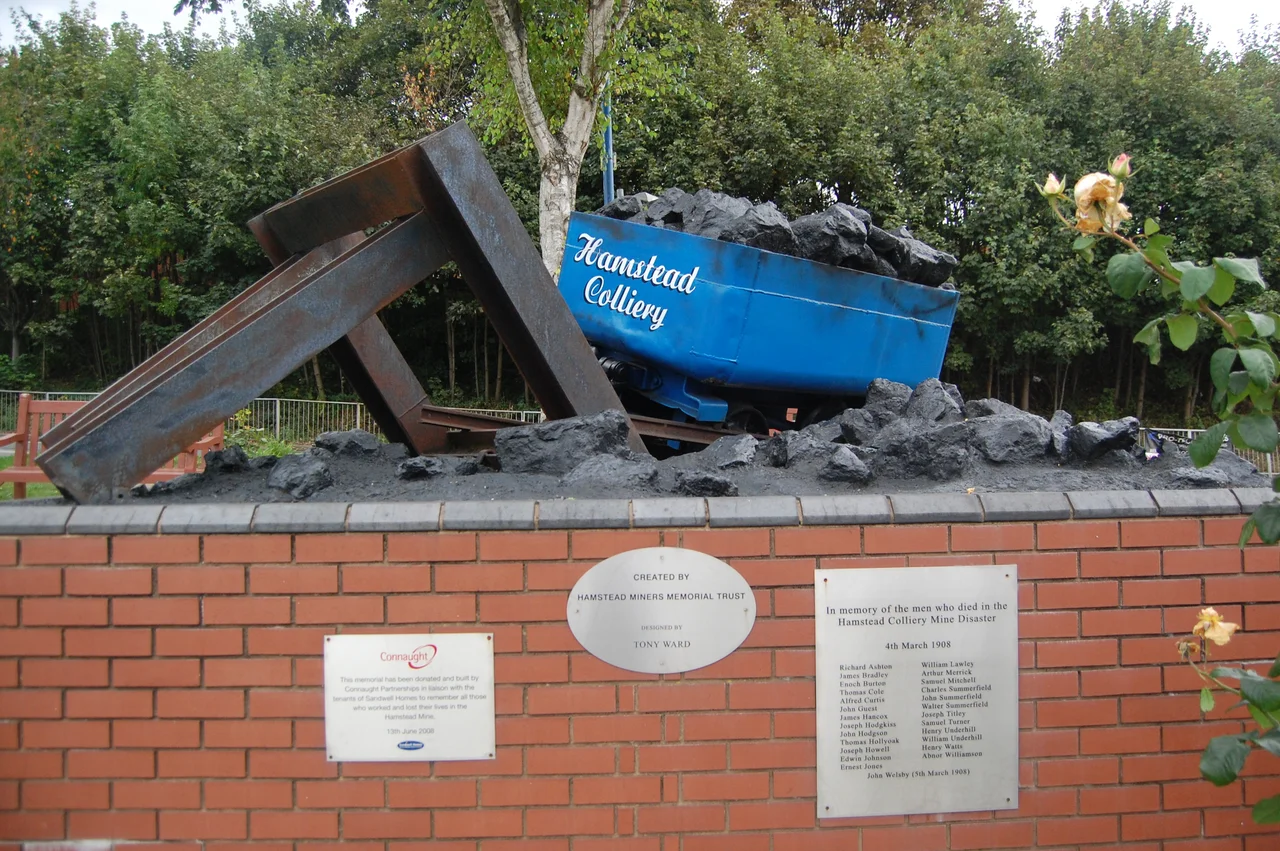

Hamstead Colliery
Just before midnight on 4 March 1908, fire broke out in the workings of Hamstead Colliery, deep below the north-western edge of Birmingham. Thirty-one men were below ground when the smoke began to rise. Six made it out before the poisonous fumes filled the roadways. Twenty-five never did. Rescue parties from Yorkshire pits at Tankersley and Altofts arrived by train and went down again and again with breathing apparatus that was still new technology, but the heat and gas drove them back. It took a week for the mine to clear enough to recover the bodies. The names on the memorial today read like a roll-call of the Black Country: a father and son among them, and an Altofts rescuer, John Welsby, who collapsed and died from the heat the day after.
Sinking the shafts
The Hamstead Colliery Company was formed in April 1875 to work the South Staffordshire Thick Coal, an extraordinary seam thirty feet deep in places that had made the Black Country famous as the workshop of the world. The company bought land in Perry Barr, then in Staffordshire, from G. C. Calthorpe of nearby Perry Hall, and sank shafts in 1876. Coal began coming up in 1878. By 1933 the pit was producing 260,000 tons a year. A tramway ran from the pithead to a basin on the Tame Valley Canal, since filled in, and to Hamstead Hill Wharf above the colliery. Boundary changes in 1928 swept the mine head into West Bromwich, and shortly afterwards the operation was reorganised as the Hamstead Colliery (1930) Limited. The brickworks across Old Walsall Road, opened in 1929 just inside Birmingham, made bricks from clay dug out during tunnelling. Bricks stamped NCB Hamstead can still be found in local walls.
Fires, collapses, and the disaster of 1908
Hamstead's history was punctuated by trouble before the catastrophe. A fire in 1898 had closed the mine for nearly two years, putting eight hundred men out of work, but the Midlands faced an acute coal shortage and the pit reopened on 8 January 1900. In October 1905 a coal fall trapped two miners; rescuers freed them unharmed the next day. Then came 4 March 1908. The fire that night caught miners deep in the workings with no safe route to the shaft. The fumes spread quickly through the roadways. Of the twenty-six who died, the rescue teams could reach fourteen bodies on 11 March, with six more recovered the following day. John Welsby of the Altofts rescue team was posthumously awarded the Edward Medal second class for his role in the recovery. Five of his fellow rescuers received the Edward Medal first class. Welsby is buried at St Mary Magdalene in Altofts, under a monument paid for by his fellow miners at Pope and Pearson's Colliery. The known coal was largely worked out by the disaster, and 664 miners lost their jobs.
Modernisation and closure
Boreholes sunk after the disaster found more of the seam to the north, bringing reserves back up. Hamstead kept producing through the First World War, the Depression, and the Second. After nationalisation in 1947 it was modernised by the new National Coal Board, with bigger pumps and improved ventilation, and modernised again in the early 1960s. None of it could change the geology. The Thick Coal was running out. The pit closed in 1965 after eighty-seven years of production. The pithead was demolished and houses were built on the site. The miners' welfare hall, opened in 1937, was redeveloped as a nightclub called Kings, then demolished. As of 2025 the site is occupied by a petrol station. Each layer of redevelopment buried more of the colliery beneath the suburb, until almost nothing on the surface betrayed what had been there.
The memorial at the junction
The Hamstead Miners Memorial Trust, registered as charity number 1098711, was established to record the colliery and the men who worked it. On the centenary of the disaster, in 2008, the trust erected a memorial at the junction of Hamstead Road and Old Walsall Road, a few hundred yards from where the pithead used to stand. The memorial is a derailed tramway wagon full of coal, set against a buffer stop, with plaques carrying the names of the dead. It is a small, deliberately industrial monument, the kind of thing that requires you to know what you are looking at, and it sits a few minutes' walk from the petrol station that now covers the shaft. For the families of the 26 miners who died on 4 March 1908, and for those who pass on the bus and remember the stories their grandfathers told, the wagon at the junction is the marker that says: people worked here, people died here, and we have not forgotten.
From the Air
Hamstead Colliery's former site sits at 52.532 degrees north, 1.933 degrees west, on the north-western edge of Birmingham just inside the border with Sandwell. From 1,500 to 2,500 feet AGL, look for the junction of Hamstead Road and Old Walsall Road, with the Tame Valley Canal threading west toward Spaghetti Junction. Hamstead railway station and the River Tame are nearby landmarks. Birmingham International (EGBB) is sixteen kilometres south-east, Wolverhampton Halfpenny Green (EGBO) is eighteen kilometres west, and Coventry (EGBE) is thirty kilometres south-east. The Black Country to the west is a dense urban grid; expect helicopter and light aircraft traffic between Birmingham and Wolverhampton.
Nearby Stories
- Shepshed 8.5 km away
- Battle of Evesham 11 km away
- Hixon rail crash 12 km away
- Battle of Cropredy Bridge 12 km away
- Wenlock Priory 15 km away
- RAF Shawbury 16 km away
- Market Bosworth 17 km away