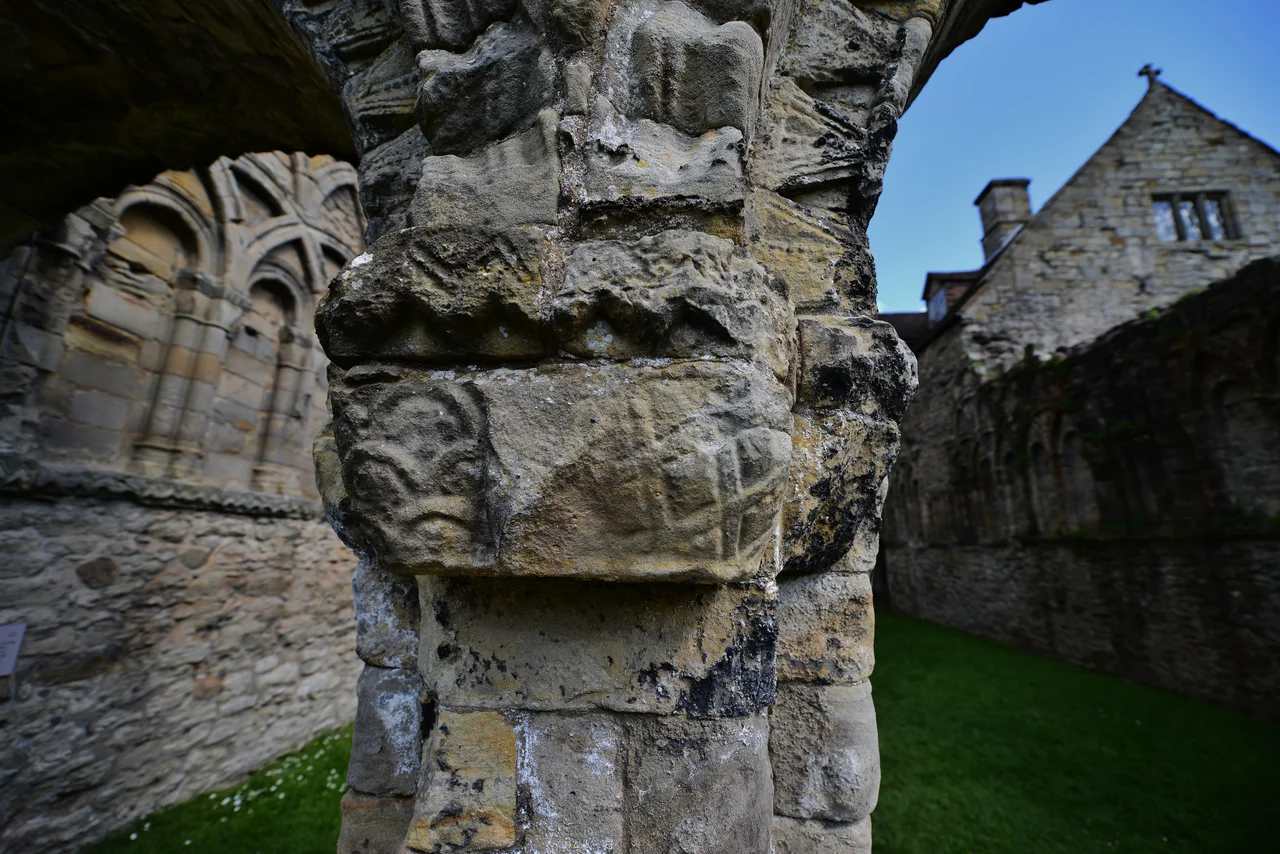

Wenlock Priory
In 1101, workmen repairing the floor of an old church in Shropshire found human bones beneath the flagstones. The priors believed they had uncovered Saint Milburga, a Mercian princess turned abbess who had died nearly four centuries earlier. The discovery transformed Wenlock from a modest house of Cluniac monks into a pilgrimage site, and Odo, the cardinal bishop of Ostia, was moved enough to compose an account of the miracles that followed. Today the church above her bones is roofless, but the walls still rise dramatically out of the lawns of Much Wenlock, an English Heritage site where the layers of a thousand years sit one atop another.
Milburga's Mercian Foundation
Around 680, Merewalh, king of the Magonsaete and a sub-king under Mercia, founded a double monastery here for both monks and nuns. He called it Wimnicas, and put his daughter Milburga in as its second abbess. She would die in 715 and eventually be canonised; the foundation she led continued under sporadic patronage from later Anglo-Saxon rulers. In 901, Aethelflaed, the famous Lady of the Mercians and daughter of Alfred the Great, gave Wenlock land along with a golden chalice weighing thirty mancuses for the shrine of Saint Milburga. After her death the historical trail goes mostly cold. Endowments resumed in the mid-11th century under Leofric, Earl of Mercia, but Wenlock's second life would not begin until after the Normans arrived.
A Cluniac Refounding
Roger de Montgomery, Earl of Shrewsbury and one of William the Conqueror's most powerful lieutenants, refounded the priory between 1079 and 1082. He brought Cluniac monks from La Charite-sur-Loire in central France, attaching Wenlock to the great reforming network that had spread out of Burgundy. By the time of the Domesday Book in 1086 the monastery was already a recognised landowner. Then came the rediscovery of the bones in 1101, and with it a wave of donations. By 1170 Wenlock was prosperous enough to send a prior and twelve monks north to found Paisley Abbey in Scotland, along with other daughter houses at Dudley, St Helen's, and Church Preen. Pevsner dates the visible church rebuild to roughly 1200 to 1240, an ambitious project that signals just how rich the cult of Milburga had become.
The Lavabo and the Chapter House
What survives at Wenlock is unusually rich for a dissolved priory. The Norman chapter house, built around 1150 to 1180, has three levels of intersecting round arches running along its inner walls, a decorative motif that monks would have stared at every morning during their daily meetings. In the cloister garth, the base of the lavabo still stands. This was the fountain where monks washed before meals, and Wenlock's pavilion preserves two carved late-12th-century panels showing scenes from the lives of the Apostles. Three bays of the south-west nave also survive, and they contain a quiet puzzle: a vaulted room built above the aisle that forced the vault below it to be unusually low. Graham's 1965 study suggests it was a chapel to St Michael, by analogy with Cluny itself, though no altar has ever been found.
Dissolution and Afterlife
Henry VIII dissolved Wenlock on 26 January 1540. There was a brief proposal to elevate the priory church to a new diocesan cathedral, as actually happened at Gloucester, but nothing came of it and most of the buildings were pulled down for their stone. The late-15th-century Prior's Lodging and adjoining infirmary survived because they were turned into a private residence later called Wenlock Abbey. Pevsner ranked it among the finest examples of domestic architecture in England around the year 1500. Since 1983 it has been owned by the actress Gabrielle Drake, who bought it with her late husband Louis de Wet. The rest of the priory grounds, run by English Heritage, are now best known for their elaborate topiary garden, listed Grade II in Historic England's Register of Parks and Gardens. The town of Much Wenlock itself folds tightly around the ruin, a network of narrow streets lined with timber-framed black and white buildings, and somewhere in those streets is the well of Saint Milburga, said in Victorian times to cure failing eyesight and, more optimistically, to help local women find a husband.
From the Air
Located at 52.60 N, 2.56 W in south-east Shropshire. View from 2,500 to 4,000 feet shows the ruins inside Much Wenlock, with Wenlock Edge running south-west and the Severn Valley visible to the east. Nearest airfields: RAF Cosford (EGWC) about 12 nm east, RAF Shawbury (EGOS) about 14 nm north.
Nearby Stories
- Ludlow 5.7 km away
- Llangollen 6.7 km away
- Murder of Shawn Seesahai 8 km away
- Avoncroft Museum of Historic Buildings 8.1 km away
- Caverswall Castle 8.4 km away
- Combermere Abbey 9.4 km away
- Battle of Maes Moydog 11 km away
- Cwmhir Abbey 16 km away