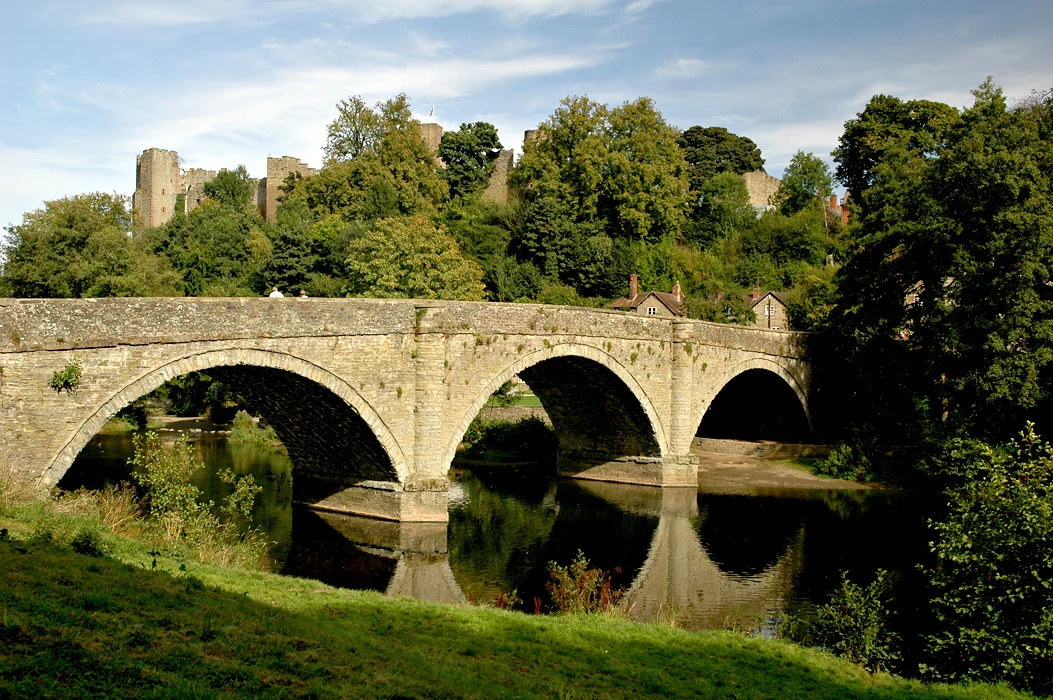

Ludlow
Sir John Betjeman called Ludlow the loveliest town in England. He was not the only one. The medieval walled town sits on a small hill above the confluence of the rivers Teme and Corve, crowned by a castle and the parish church of St Laurence's, with streets sloping outward in every direction. There are nearly 500 listed buildings inside the old walls. The 18th-century traveller Daniel Defoe thought it a most pleasant town. The 21st-century Country Life ranks it among the best places to live in Britain. The Mortimer Trail starts here. So, for a time, did the British food revolution.
The Norman Castle on the Hill
Ludlow began in the late 11th century, after the Norman Conquest, as a planned town huddled around a brand-new castle. Walter de Lacy held the surrounding lands at Domesday in 1086, though the castle and town were still too new to be mentioned by name in the survey. The castle was built around 1085 to defend the Welsh border, and within a generation it had become one of the most important strongholds in the Marches. Over the next four centuries it played a part in nearly every English dynastic struggle: the Owain Glyndwr rebellion, the Wars of the Roses, the English Civil War. The Mortimer family - eventually merging into the royal house of York - made Ludlow Castle their principal seat. From here they fought for the crown of England, and from here they sometimes briefly held it.
Where a King Found Out He Was King
In 1472, Edward IV established the Council of Wales and the Marches and made Ludlow Castle its headquarters. He sent his young son Edward, Prince of Wales, to live here as the nominal head of the council - a boy in his castle, learning to govern a country he would one day rule. In April 1483, while at Ludlow, the young prince received word that his father had died. He was now Edward V of England. He set out from Ludlow toward London with his uncle Richard, Duke of Gloucester. He and his younger brother Richard, Duke of York, were lodged in the Tower of London. Within months neither was seen alive again. They became known to history as the Princes in the Tower, and the question of what happened to them - and whether their uncle, who became Richard III, ordered their deaths - remains one of the great mysteries of English history. Ludlow Castle was the last place Edward V was a free child.
Arthur, Catherine, and What Might Have Been
Under Henry VII, Ludlow Castle remained the headquarters of the Council of Wales. In 1501, Arthur Tudor, the eldest son of Henry VII and Prince of Wales, came to live here with his new wife Catherine of Aragon. They had married that November at St Paul's Cathedral in London. They were both fifteen. Within five months of arriving at Ludlow, in April 1502, Arthur died of a mysterious illness - possibly the sweating sickness, possibly tuberculosis, possibly something else. He was buried at Worcester Cathedral. Catherine was widowed at sixteen, far from home, in a country whose language she barely spoke. She married Arthur's younger brother Henry seven years later, becoming Henry VIII's first queen. The question of whether her marriage to Arthur had been consummated would, three decades later, become the constitutional pretext for the English Reformation. The decision started at Ludlow.
Half-Timbered Streets
The medieval grid of Ludlow's streets has survived remarkably intact. From the castle, Castle Square opens onto Broad Street, which descends past the 17th-century Feathers Hotel - one of the most ornate Jacobean half-timbered buildings in England - to the Broad Gate, the only surviving medieval town gate. St Laurence's Church, the largest in Shropshire, dominates the centre with a tower that was completed in 1471. Inside, misericords carved with everything from drunkards to mermaids reveal the medieval craftsman's sense of humour. A. E. Housman, the poet who wrote A Shropshire Lad while never actually living in Shropshire, asked for his ashes to be buried at St Laurence's. They were. The Reader's Memorial in the churchyard quotes his lines. Bodenhams, the clothing shop trading from a 600-year-old timbered building since 1860, is one of the oldest stores in Britain.
The Food Town
From the late 1990s, something extraordinary happened in Ludlow. The town became a cluster of seriously ambitious restaurants. At one point Ludlow had three Michelin-starred restaurants simultaneously - more per capita than any town in Britain outside the capitals. Shaun Hill's Merchant House and Hibiscus under Claude Bosi were among them. Most of those original stars have moved on - Bosi famously took Hibiscus to London - but the food culture stayed. The Ludlow Food Festival, held in the castle each September since 1995, helped invent the modern British food festival. It still attracts more than 20,000 visitors over a weekend, with stalls full of local cheeses, ciders, breads, and beers. The town has more independent food shops than most cities ten times its size. Ludlow became, briefly and then permanently, the place where modern British food cooking and old market-town agriculture met each other and decided they liked the combination.
From the Air
Ludlow sits at 52.367 N, 2.717 W in south Shropshire, at the confluence of the rivers Teme and Corve. From the air the medieval town shows clearly as a compact cluster on a low hill, with the castle's curtain walls and round chapel at its north-western tip and St Laurence's church tower (135 ft) marking the centre. The A49 trunk road bypasses the town to the east. Best viewed from 2,000-4,000 ft AGL. Nearest airports: Shawbury (EGOS) about 18 nm north, Wolverhampton/Halfpenny Green (EGBO) about 22 nm east, Gloucestershire (EGBJ) about 45 nm south-east. Titterstone Clee Hill (1,749 ft, distinctive flat top with radar domes) is 6 nm east and one of the best navigation features in the Welsh Marches.
Nearby Stories
- Murder of Shawn Seesahai 2.3 km away
- Avoncroft Museum of Historic Buildings 3.3 km away
- Much Wenlock 6.8 km away
- Sudeley Castle 14 km away
- Battle of Maes Moydog 15 km away
- Fforest Fawr Geopark 15 km away
- Treago Castle 15 km away
- Cwmhir Abbey 16 km away