
Avoncroft Museum of Historic Buildings
In 1962 a 15th-century timber-framed merchant's house in Bromsgrove was about to be demolished. A group of local people - architects, historians, schoolteachers - thought this was a poor idea, and they did the only thing left to do: they took the building apart, oak peg by oak peg, marked every joint and timber, and waited. By 1967 they had found a field, raised some money, and re-erected the merchant's house at Stoke Heath on the edge of Bromsgrove. They called the new site Avoncroft, and it became the first open-air museum in England - second in the United Kingdom only to St Fagans in Wales. The merchant's house is still here. So are around thirty other buildings, all rescued from somewhere else, all reassembled where they would not otherwise have stood.
The Greiners and the Town House
The merchant's house - now known simply as the Town House - was dismantled, restored and reconstructed by Gunolt Greiner, a German-born craftsman, and his son Francis. They worked to a rule of strict honesty: where the original details were known they reproduced them; where they were unknown they used plain, unembellished oak so that no visitor would ever mistake a guess for evidence. The result is a building that wears its own scholarship lightly. The same father-and-son team went on to reassemble the windmill and the granary at Avoncroft, then moved on to other open-air museums in England, including the Bayleaf Farmhouse and Market Guildhall at the Weald and Downland near Chichester. Their habit of marking new oak with restraint became a quiet standard across the British conservation movement.
Thirty Buildings, Seven Centuries
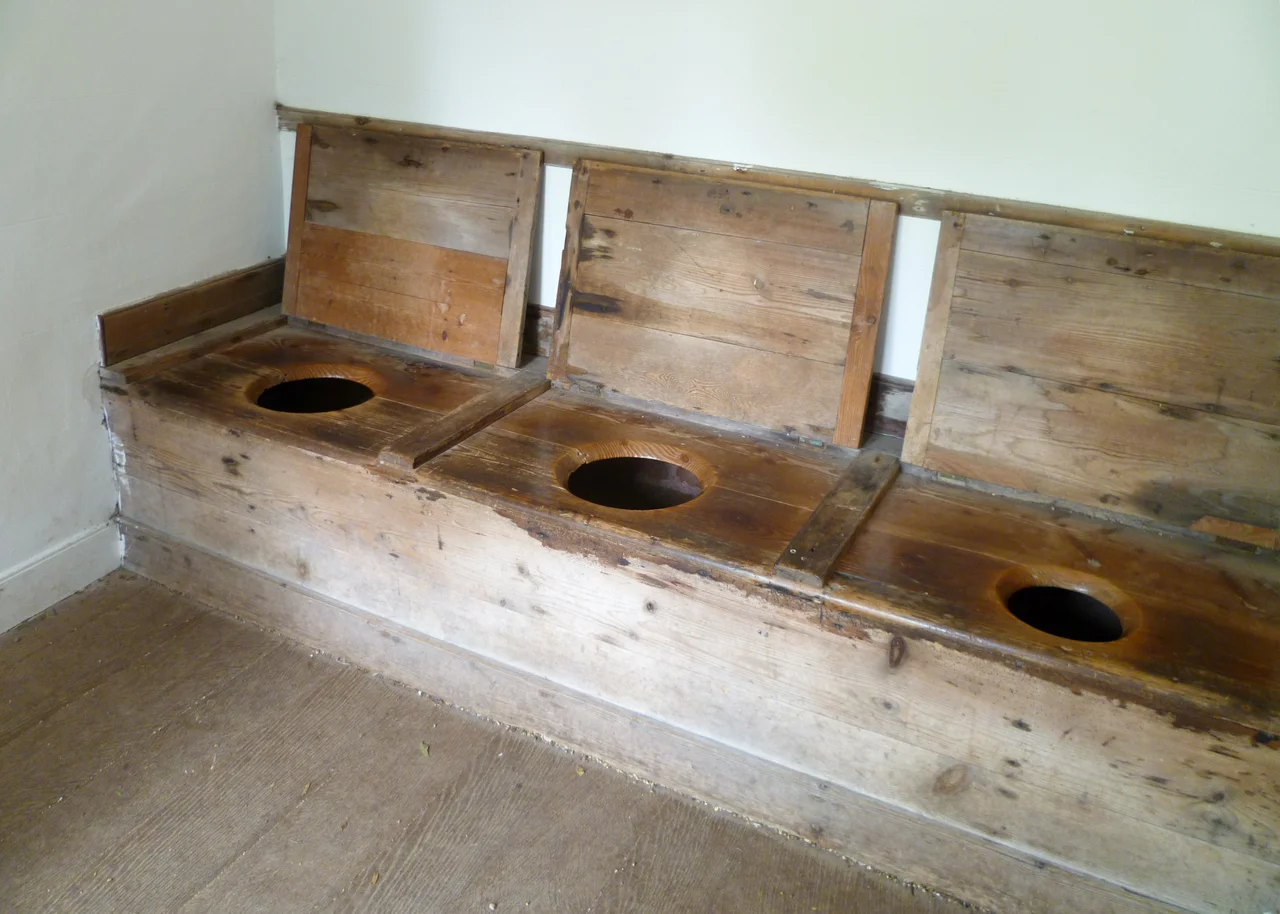
The collection at Avoncroft now runs to more than thirty structures spanning over 700 years. There is a chain-makers' workshop and a cell block, a counting house and an earth closet, an ice house and a 16th-century threshing barn. The granary stands on staddle stones to keep the rats out. The windmill turns - actually turns, in a stiff westerly - and grinds flour by appointment. A perry mill from Redditch presses pears. A tollhouse from Little Malvern still has the painted board listing the prices for cattle, sheep and laden carts. A fibreglass church spire from Smethwick, rescued because no other museum would touch it, leans peculiarly in a corner of the field. A cockpit for cockfighting, illegal since 1835, sits on the grass as a small, dark reminder of what country sport once was.
The Arcon V and the New Guesten Hall
Two buildings on the site are easy to overlook and hold the most surprising stories. The first is a prefab - an Arcon V, one of the emergency post-war houses that were thrown up in their thousands after the Second World War to replace bombed-out homes. This particular one came from Moat Lane in Yardley, Birmingham, and was moved to Avoncroft in 1981. It still has its little bathroom built around a galvanised-steel cabinet, its compact kitchen, its window onto a notional 1947 garden. The second is the New Guesten Hall, built specifically to house an extraordinary thing: the original timber roof of the Guesten Hall that once stood beside Worcester Cathedral, the chamber where the Prior received his important guests. The roof is medieval; the walls around it are modern; the licence covers wedding receptions and conferences. The medieval craftsmen who shaped those oak trusses would not have predicted that ending.
Britain's Phone Boxes, All in One Place
Avoncroft also holds the UK's National Telephone Kiosk Collection - the largest single gathering of British phone boxes in the country. The familiar red K2 from 1924, designed by Giles Gilbert Scott. The K6, the smaller red box that proliferated in 1936. The K8, the K3 in concrete, the experimental designs that never quite caught on. A Glasgow Police Box stands among them, a tall blue rectangle that looks unmistakably like the TARDIS from Doctor Who - because of course the TARDIS was modelled on exactly this object. Behind the kiosks sit three working manual telephone exchanges, including BT's last Strowger electromechanical exchange, all wired up and demonstrable. A guided tour will route a call through them by hand, as it would have been routed in 1950.
Rescue as a Philosophy
Every building at Avoncroft was moved to save it. Some had been threatened by road schemes. Some had been condemned as unfit. Some had simply fallen so far out of use that demolition was cheaper than repair. Taken individually each rescue is a small story; taken together they make a different point. The architecture of ordinary life - barns, prefabs, toll houses, chain shops - is exactly the architecture that gets thrown away first when no one is paying attention. Avoncroft pays attention. The events programme keeps the place lively with Wars of the Roses re-enactors and 1940s weekends. The buildings, meanwhile, stand patient on their new ground, waiting to be walked through by the next school party that has never seen an outside toilet or a working windmill.
From the Air
Avoncroft Museum lies at 52.314 degrees N, 2.072 degrees W, at Stoke Heath on the south-eastern edge of Bromsgrove, Worcestershire. Best viewed from 2,000-3,000 feet. The museum reads from the air as a clustered group of small buildings of varied roof shapes scattered across a green parkland field, with the windmill conspicuous on the high ground - the only working post-mill structure for many miles. Birmingham Airport (EGBB) lies 18 nautical miles east-north-east; Gloucestershire Airport (EGBJ) is 25 nautical miles south. The M5 and M42 motorways converge 3 nautical miles north of the museum.
Nearby Stories
- Walsall 3.9 km away
- Market Bosworth 7.3 km away
- Ironbridge Gorge 7.6 km away
- Sudeley Castle 9.5 km away
- Death of Harry Dunn 15 km away
- Ludlow 19 km away
- Battle of Cropredy Bridge 21 km away
- Halifax V9977 Crash, Welsh Bicknor 22 km away