
Combermere Abbey
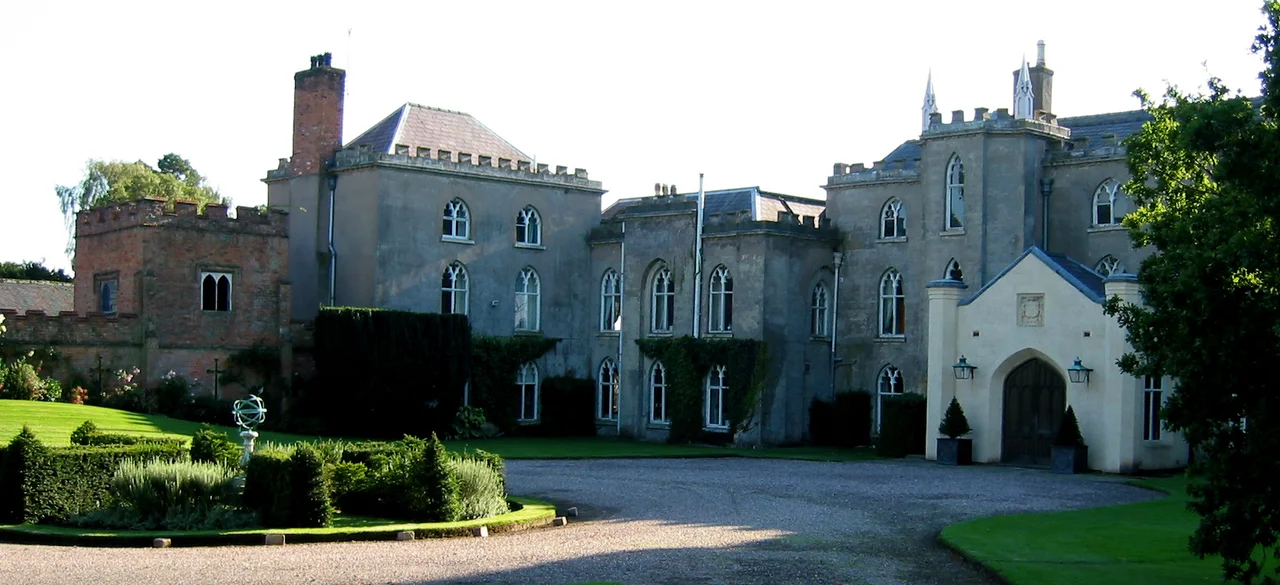
The photograph was meant to be ordinary. On a December afternoon in 1891, while the family of the second Viscount Combermere gathered miles away to bury him, his sister-in-law Sybell Corbet set up her camera in the abbey library and made a long exposure of an empty room. When she developed the plate, a figure had appeared in one of the chairs: a man in pale clothing, his head and an arm visible against the dark upholstery. Lord Combermere's ghost photograph, as it became known, has been argued over for more than a century. Sir William Barrett, investigating in 1895, was satisfied it was a servant who had wandered through during the long exposure. Lady Combermere's family insisted otherwise. The chair is still in the library. The abbey is still here, mostly.
From Cistercian Cells to Tudor Hall
Cistercian monks founded Combermere in the 1130s, choosing a wooded valley in southern Cheshire where the natural mere could feed their fishponds and water their fields. The order arrived from France carrying a reformist hunger for austerity, and for four centuries they built and rebuilt the abbey at the lake's edge. Henry VIII dissolved the house in 1538, handing the land and stones to one of his servants, and the family that eventually bought the estate (the Cottons) turned the cloister and chapter house into a Tudor mansion. The Great Hall still holds the dais where abbots once sat, a smoke bay above where the central hearth once burned, and timber framing that has stood through nearly five hundred years of patching and pretending.
The Clock Tower for Waterloo
Sir Stapleton Cotton, who became the first Viscount Combermere, fought beside Wellington across Spain and at Waterloo and came home to an estate his family had outgrown. In 1815 he raised a square clock tower on the south range, fitted with arrow slits he could never have used and a JB Joyce mechanism keeping time over the courtyard. Twelve years later he commissioned a new stable block in Elizabethan revival style from the architect Edward Blore, with lancet windows, lead-roofed turrets, and an octagonal-flued chimney. Architectural historians have not been kind to the alterations. Peter de Figueiredo and Julian Treuherz called them an exhibition of "empty-headed show." The first viscount seems not to have minded. An obelisk on the north-west edge of the park, raised in 1890, marks his memory.
The Mere
Comber Mere covers about 132 acres, which makes it the largest lake within a private English park. Reed beds and fen surround the open water, and the whole sweep of mere and marsh has been protected as a Site of Special Scientific Interest for its swamp environments and its birds. Tufted ducks and goldeneye drift here in winter; one of the largest heronries in Cheshire stands above the trees on the eastern shore. The estate around it still runs as an organic dairy, 1,110 acres of pasture stretching from Cheshire into Shropshire, with a walled garden that holds a maze of fruit trees planted in the 1990s. The view that Samuel Johnson saw when he visited in the eighteenth century has not changed much. The water still mirrors the sky.
A House in Slow Trouble
In 1998 the abbey entered English Heritage's Buildings at Risk register the year it was first compiled, and in 2013 the empty north wing was classed in the worst grade the inspectors use: "very bad," in considerable danger of falling. A roof of scaffolding has stood over it since around 2001, slowing the rot without stopping it. The estimated repair bill runs to two million pounds. Two schemes to fund the work by building houses on greenfield estate land were rejected by Cheshire East Council in 2005 and 2012, then partly overturned on appeal. The game larder and clock tower have been pulled back from the brink. The north wing waits. The chair in the library waits too.
From the Air
52.99 N, 2.61 W, in southern Cheshire near the Shropshire border. Best seen from about 2,500 feet AGL, where the mere reads as a clear blue oval against the dairy fields and the abbey's red-brick ranges sit on its western shore. Nearby airports: EGCC Manchester to the north, EGNX East Midlands to the east, EGGP Liverpool to the north-west. Look for the obelisk on a rise at the park's north-west edge.
Nearby Stories
- Valle Crucis Abbey 1.8 km away
- Caverswall Castle 2.9 km away
- Haughmond Abbey 2.9 km away
- Basingwerk Abbey 4.1 km away
- Battle of Winnington Bridge 6.6 km away
- RAF Hednesford 8.3 km away
- Anson Engine Museum 9.7 km away
- Battle of Maes Moydog 14 km away