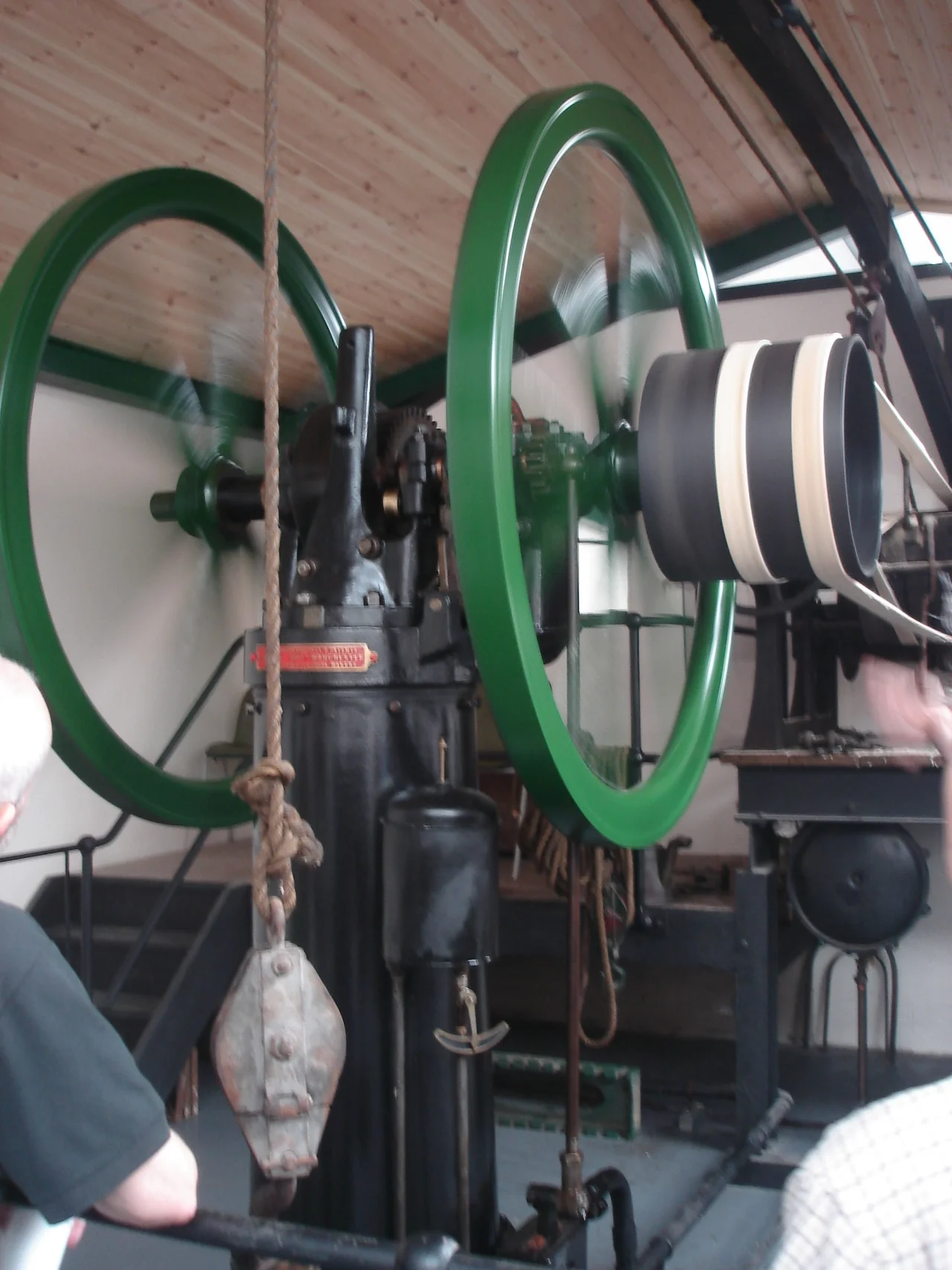

Anson Engine Museum
Les Cawley and Geoff Challinor liked engines the way some people like vintage cars or model trains, only the things they collected weighed several tons each. They began in the 1980s on the site of the old Anson colliery in Poynton, a pit that closed in 1935 after producing coal for more than three centuries. By the time Cawley died in 2002, the two friends had built one of the largest stationary engine collections in Europe, and Challinor decided to push on alone. Today the Anson Engine Museum runs Crossley atmospheric gas engines, Mirrlees diesels, Gardner marine engines, and a steam plant once used to power Ealing Studios. The machines are loud, hot, and oily, and almost every one of them was built within a twenty-mile circle of Poynton.
A Pit Older Than the Industrial Revolution
The earliest written record of coal at Poynton comes from a lease dated 28 February 1589, mentioning a pit at Wourthe lately worked by one George Finche. People in the area had been pulling coal out of shallow shafts long before that. The seams outcrop east of Towers Road along the line of the Red Rock Fault, which made early extraction easy. By the late eighteenth century the Warren family of Poynton was working the Cannel and Sheepwash seams with the Leghs of nearby Lyme Park, and output climbed from around 26,000 tons in 1789 to a peak of 243,000 tons in 1859. The colliery employed a Newcomen atmospheric engine for winding as early as 1826. It was, in a small way, a working museum of steam power before anyone thought of museums.
The Anson Pit Itself
By 1847 the pit on this site was called the Anson, or Lower Anson, and it employed thirty-six men and six boys working the Gees Seam 132 yards underground. In 1853 they pushed down to the Accommodation Seam at 191 yards. The winding engine fitted in 1869 had two horizontal cylinders, each 25 inches in bore and 60 inches in stroke, driving a 14-foot rope drum, and it was still pulling tubs of coal when the pit closed in 1926. Lord Vernon, who took control of the mines in 1832, kept investing in steam plant; three Lancashire boilers supplied a tangle of engines, fans and pumps. The colliery shut for good on 30 August 1935. Two hundred and fifty men lost their jobs. The shafts were capped, Park Pit was levelled, and the surface buildings sat empty for half a century.
Manchester's Engine Country
By 1900 there were more than twenty stationary engine builders within twenty miles of where the museum now stands. Crossley Brothers in Openshaw took up the patents of Nicolaus Otto and Eugen Langen, becoming Britain's first serious internal combustion engine builder. Mirrlees, Bickerton and Day in Hazel Grove pioneered heavy oil and diesel engines, with their Mirrlees No. 1 still the oldest diesel in the United Kingdom. L. Gardner and Sons of Patricroft built the small high-speed diesels that powered everything from canal boats to delivery lorries; the museum's original Gardner L-series carries a Heritage Hallmark plaque from the Institution of Mechanical Engineers. Cawley and Challinor's instinct was to collect local. Almost every running engine in their sheds was made by someone whose factory the visiting families could once have walked past.
What Actually Runs
Visitors arrive expecting static displays and find machines breathing. The Crossley atmospheric gas engine, the largest running example in existence, fires with a flat thump and pulls a winch as it did when it left a Bristol tar distillery. The 63-ton Ruston and Hornsby once supplied power at Ealing Studios. There are oddities too: a rare Griffin six-stroke engine, an Atkinson cycle engine that swapped power for efficiency in a way that anticipates the Toyota Prius by more than a century, and a Hugon gas engine of a design almost no other museum holds. A Stott cross-compound mill engine and a Fowler beam engine anchor the steam side. The smithy is real, the carpentry shop is real, and the café has the look of a works canteen because, in a sense, that is what it is.
Why One Hobby Mattered
Stationary engines are easy to overlook. They did not move, did not fight wars, did not carry passengers. They sat in mills and pumping stations and factory cellars, driving line shafts and grinders and lathes through long leather belts, and almost all of them were scrapped when electric motors replaced them. The Anson collection exists because two men in the 1980s saw what was about to vanish and started saving it, piece by enormous piece. Lord Vernon's old pit yard now holds the engineering DNA of a region that built much of the modern industrial world, lovingly oiled and still capable of running under load. The site reopens each spring, and on event weekends the air smells the way Manchester smelled for a hundred years: warm metal, hot oil, and steam.
From the Air
The Anson Engine Museum sits at 53.348°N, 2.090°W on the southern edge of Poynton, Cheshire, just below the Pennine foothills. The site is recognisable from the air by its complex of red-brick sheds, slag heaps softened by grass, and the surviving capped headgear of the old colliery. Recommended viewing altitude is 2,000 to 3,000 feet AGL, keeping clear of Manchester Airport's busy approach corridors. Manchester (EGCC) lies only about 5 nautical miles north-northwest, so this airspace is dense; East Midlands (EGNX) is about 45 nautical miles southeast, Liverpool (EGGP) about 25 nautical miles west. Expect haze and low cloud in the Cheshire plain. On clear days the Peak District ridge to the east makes a striking eastern boundary.
Nearby Stories
- Orgreave rail accident 3.7 km away
- Winter Hill Air Disaster 3.9 km away
- Nostell Priory 4.5 km away
- Nantwich 4.6 km away
- Lion Salt Works 8.6 km away
- Eastwood, Nottinghamshire 10 km away
- Huddersfield Town Hall 11 km away
- Croxden Abbey 15 km away