
Nostell Priory
The clock in the billiard room keeps time with wooden gears. John Harrison built it in 1717, before he was famous, before anyone called him "Longitude" Harrison, before the Royal Society and the Board of Longitude and the chronometer that finally let ships know where they were on the empty ocean. He was a young man from Foulby then, son of an estate carpenter, and he had only the materials a carpenter's son could shape. So he carved his wheels and pinions from English oak, and they have turned, more or less faithfully, for over three hundred years. Half a mile from where this clock ticks stands the cottage where Harrison was born. Nostell Priory holds both.
What Lies Beneath
The house that visitors see today is Palladian, severe, geometric, completed for the Winn family beginning in 1733. James Paine designed the main block; Robert Adam later added a wing and the elegant double staircase that climbs the east front. But the name remembers what was here first. From around 1114, this rise above the lakes held an Augustinian priory dedicated to St Oswald, supported by Robert de Lacy of Pontefract and Thurstan of York. Monks lived here for more than four centuries. Aldulf, confessor to Henry I, was prior of the canons by 1114, and tradition holds that the monks of Nostell helped found Scone Abbey in Scotland. Then in 1540 Henry VIII's commissioners arrived, the priory was dissolved, and the buildings were given to Dr Thomas Leigh. The Winns built their house over the foundations of the priory and kept its name.
Sabine's Chippendales
Inside, the rooms are full of furniture made for them and never moved. Sir Rowland Winn, 5th Baronet, and his Swiss wife Sabine commissioned an extraordinary collection from Thomas Chippendale, who had been born in Otley in 1718, just down the road. Chippendale ran his workshop in St Martin's Lane in London, but Nostell was perhaps his most complete commission. Cabinets, beds, mirrors, tables made to the dimensions of specific rooms, all still here. Among the paintings hang Pieter Brueghel the Younger's Procession to Calvary, Hogarth's Scene from The Tempest (said to be the first painting of any Shakespeare scene), and Rowland Lockey's 1592 copy of Holbein's Sir Thomas More and his Family, made for the More family themselves. The Holbein original burned long ago; the Nostell copy is considered closest to what Holbein actually painted.
Coal, Iron, and the Air Ambulance
The Winns prospered first from London drapery, then in the nineteenth century from coal mined beneath their own estate. Rowland Winn, 1st Baron St Oswald, discovered iron ore on family land at Scunthorpe in 1858 and helped build the Trent, Ancholme and Grimsby Railway to carry it. By 1953 the estate could no longer maintain itself, and the trustees and the 3rd Baron St Oswald gave the house and contents to the National Trust. The 300 acres of parkland came later, with help from the Heritage Lottery Fund. The Adam stable block has been restored as a visitor centre, and in 2013 the Yorkshire Air Ambulance opened a base on the estate, replacing its previous Leeds Bradford operation. From the front lawn you can sometimes hear the helicopter lifting off behind the trees.
Walking the Park
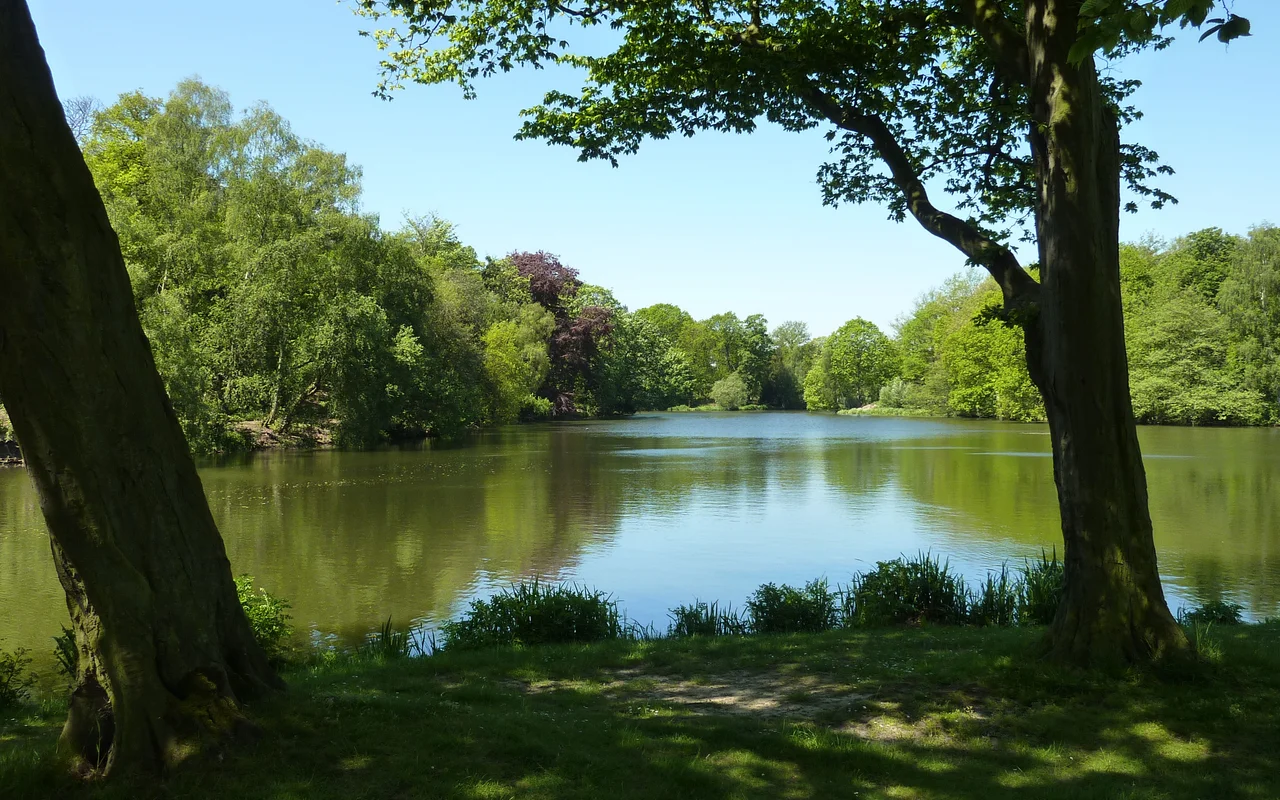
The grounds extend west from the house through a sequence of artificial lakes and across the Druid's Bridge to wildflower meadows and the restored Obelisk Lodge. To the west of Middle Lake lie the Menagerie Gardens, laid out around 1760 on the site of a medieval quarry, where the Winns once kept a lioness, monkeys, and bats. The Gothic arch and keeper's lodge survive. The east lawn has hosted everything from Scout jamborees (the 2000 Millennium Camp drew 2,500 Yorkshire scouts) to a 1982 Theakston's Brewery music festival that, two years later, drew the Convoy and a riot squad. Behind it all the grass vista runs straight from the east front of the house toward the rising sun. From above, the geometry of the park is unmistakable: a Palladian house in a Palladian landscape.
From the Air
Nostell Priory sits at 53.65 degrees north, 1.39 degrees west, on rolling West Yorkshire farmland between Wakefield and Pontefract, just south of the A638. From altitude the long east-facing facade of the house and the chain of artificial lakes to the west are easily picked out. Recommended viewing altitude: 2,500 to 4,500 feet AGL. The nearest controlled airfield is Leeds Bradford (EGNM), about 16 nautical miles north-northwest. Doncaster Sheffield (EGCN, former RAF Finningley) lies 17 nm to the southeast but ceased passenger operations in 2022. The Yorkshire Air Ambulance hangar is on the estate itself, so expect rotary traffic in the immediate vicinity.
Nearby Stories
- Maltby Main Colliery 4.1 km away
- Shibden Hall 6.2 km away
- Beningbrough Hall 6.3 km away
- Pennine Way 8.4 km away
- Bolton Abbey 8.7 km away
- Flixborough Disaster 9 km away
- Sledmere House 14 km away
- RAF Scampton 18 km away