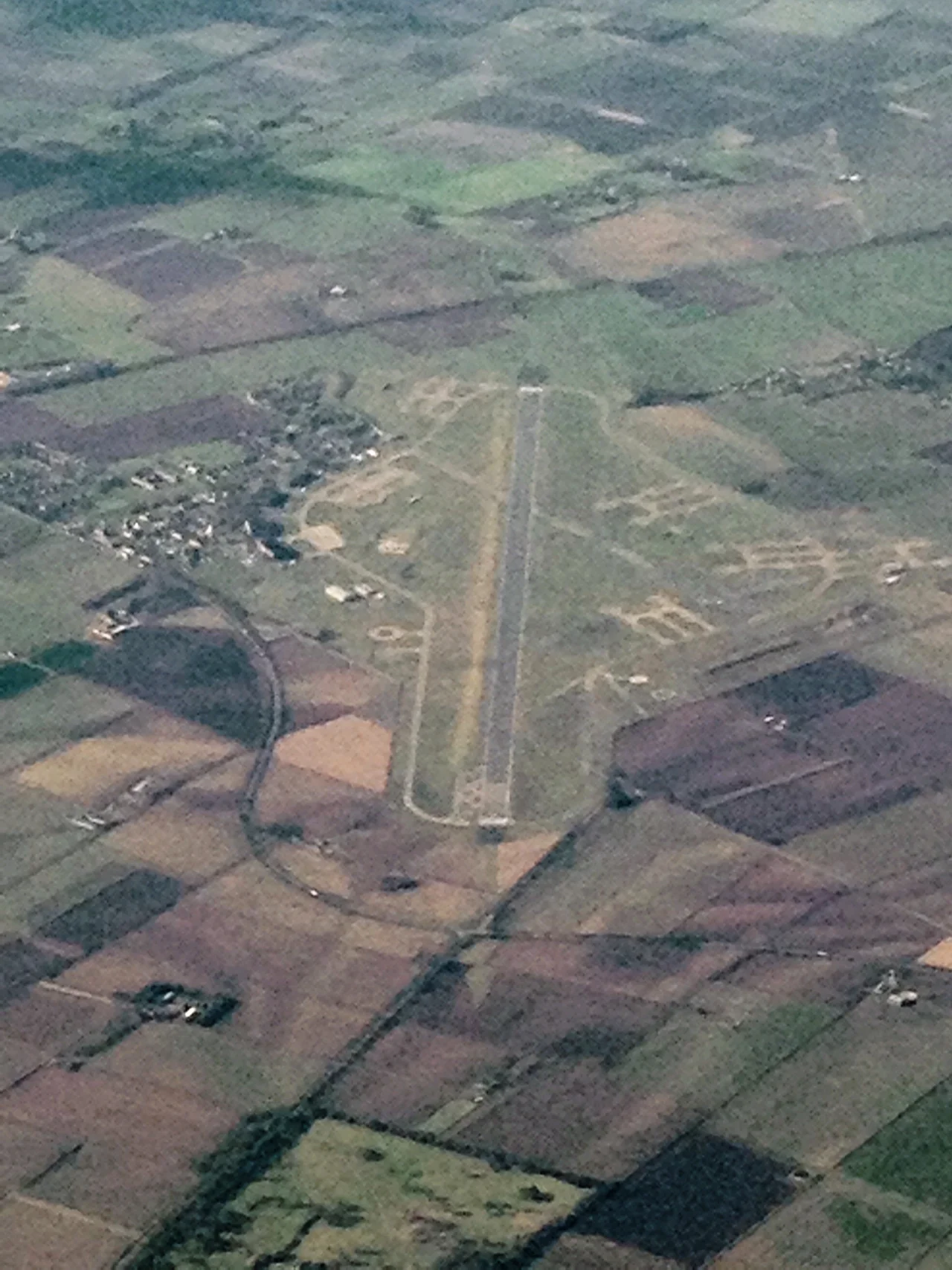

RAF Scampton
On the night of 16 May 1943, nineteen modified Avro Lancasters of No. 617 Squadron took off from this airfield carrying a bomb that bounced. Twelve hours later, eight of them had not come back. Fifty-three men were dead. Two German dams — the Möhne and the Eder — were breached, releasing 330 million tonnes of water into the Ruhr valley and killing somewhere between 1,300 and 1,650 people, most of them civilians and forced labourers in camps downstream. The Wing Commander who led the raid was Guy Gibson, twenty-four years old, who won the Victoria Cross for it and died in another aircraft seventeen months later. His dog Nigger had been killed by a car outside the station gate on the day of the raid and was buried that same night outside Gibson's office at No. 3 Hangar. RAF Scampton closed as a working RAF station on 31 December 2022. The grave is still there.
The men of 617 Squadron
617 Squadron was formed at Scampton in March 1943 for a single mission — the attack on the Ruhr dams that Barnes Wallis had spent two years convincing the Air Ministry to authorise. The crews were young, experienced, drawn from across the Commonwealth. Many had completed full tours of bomber operations already. The bouncing bomb — code-named Upkeep — required them to fly at sixty feet over water, at exactly 232 miles per hour, in moonlight, and release at the precise calculated distance. The training was secret and intense. Flight Lieutenant Roderick 'Babe' Learoyd of No. 49 Squadron, also based at Scampton, had already won a Victoria Cross there in 1940 for a low-level attack on the Dortmund-Ems Canal — pressing on through intense flak at 150 feet despite severe damage to his aircraft, then circling Scampton for three hours until dawn because his hydraulics were too badly damaged to risk a night landing. The station has produced three VC recipients in total. The Dambusters mission of 16-17 May 1943 — Operation Chastise — has overshadowed every other story Scampton has to tell, and that is partly because of what the survivors and the families have done since to keep it alive. Both the 50th and the 70th anniversaries were marked by BBC broadcasts from the base. Surviving aircrew — Les Munro, Johnny Johnson — returned to walk the dispersals and stand beside the Battle of Britain Memorial Flight's Lancaster, one of only two airworthy left in the world.
The dog at the gate
The grave outside Hangar 3 has long been a place that visitors find awkward to talk about. Gibson's black Labrador was named with a racial slur — the word was in common, casual use in 1940s Britain, and his crew adopted it as the code-word that confirmed the Möhne Dam had been breached during the raid. The dog was killed by a car on the A15 outside the station entrance on the day of the operation. He was buried that night, while the bombers were flying. The headstone became, over decades, a fixture of station heritage tours. In recent years the RAF has replaced the plaque with one that records the dog's history without the name that 1943 used, preserving the grave and the connection to Gibson and his crew while no longer carrying the slur in public lettering. It is a small act of revision that some find overdue and others find awkward — and an honest acknowledgement that historical respect and historical language do not always survive each other intact.
The Red Arrows years
After the bombers and the Vulcans (No. 83 Squadron returned to Scampton with V-bombers in 1960), the station became the home of the Royal Air Force Aerobatic Team. The Red Arrows moved to Scampton in 1983, left briefly, and returned permanently in 2000. For two decades the red Hawk T1s — nine aircraft in diamond formation, white smoke streaming behind — were the public face of Scampton. The team's 146 personnel trained over the Lincolnshire fenland, low and loud, in a routine the locals planned their afternoons around. A revived Scampton Airshow ran in September 2017, drawing about 50,000 visitors — Avro Anson to Eurofighter Typhoon — with Battle of Britain veteran Terry Clark and Dambuster Johnny Johnson as guests of honour. Plans were laid for a heritage centre on the site, focused on the Dambusters, the Red Arrows, and Lincolnshire aviation engineering, with an £80 million budget. The plans changed.
What happens to a closed station
RAF Scampton closed as a working station on 31 December 2022. The Red Arrows and their personnel relocated nine miles south down the A15 to RAF Waddington in October 2022, ahead of the formal closure. After closure, the government proposed using Scampton's buildings to house asylum seekers — a plan that drew legal challenges from Lincolnshire authorities and local residents who wanted the site preserved for its heritage value, and that was eventually withdrawn in September 2024. The future of the airfield itself, the hangars where 617 Squadron's crews briefed for the Dambusters Raid, and the heritage that Lincolnshire County Council had hoped to celebrate with a £40 million first-phase museum, remains contested as of 2026. The last gate guardian — a former Red Arrows Hawk T.1, XX306, unveiled in October 2015 — still stands. The dog's grave is still outside Hangar 3. The runway is empty.
From the Air
RAF Scampton (ICAO: EGXP, now decommissioned) lies at 53.308°N, 0.551°W, on the A15 about 5 nm north of Lincoln Cathedral. The site is no longer an active military airfield as of December 2022; the runway and infrastructure remain but Quick Reaction Alert and aerobatic operations have moved to RAF Waddington. Check current charts — the airspace status has changed. Lincoln Cathedral on its limestone ridge is the dominant visual landmark for navigating to the site. Closest active military airfields: RAF Waddington (EGXW) 9 nm south, RAF Coningsby (EGXC) 22 nm southeast.
Nearby Stories
- Worksop 6.3 km away
- St Mary's Church, Welwick 6.5 km away
- RAF Cranwell 6.9 km away
- Newstead Abbey 9.3 km away
- Flixborough Disaster 11 km away
- Louth Navigation 12 km away
- Battle of Ferrybridge 18 km away
- Old Hunstanton Lighthouse 36 km away